
A 3 octave vocal range means a singer can produce notes spanning three full octaves (36 semitones) from their lowest to highest comfortable, repeatable notes. While often described as “wide,” a three-octave range is best understood as a functional benchmark, not a measure of vocal talent on its own.
A 3 octave vocal range means a singer can sing across three full octaves, which is wider than average and considered strong for most vocalists. It allows greater flexibility across low, mid, and high notes, useful for versatile singing styles.
You can test your voice using this tool. This guide explains what a 3-octave vocal range actually represents, how it compares to average singers, how it should be measured correctly, and why control and consistency matter more than raw range numbers.
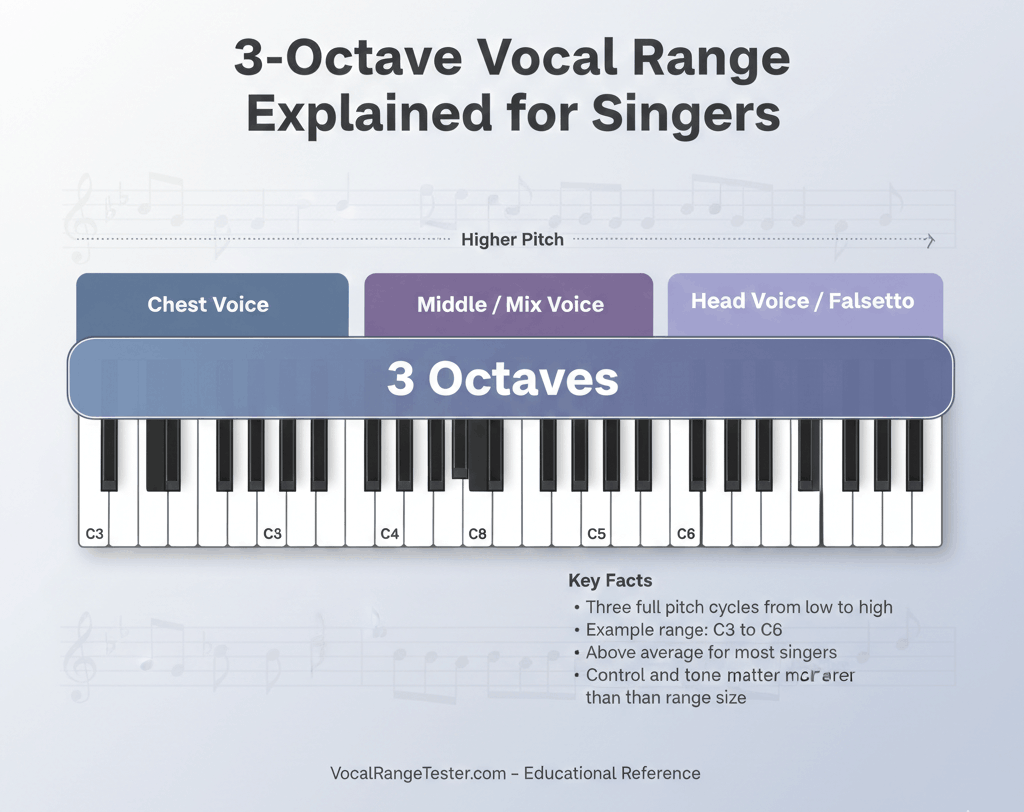
What Is a 3 Octave Vocal Range?
In music, an octave is the interval between one pitch and another with double the frequency. For example, C3 to C4 is one octave.
A 3 octave vocal range spans three such intervals, such as A2–A5 or C3–C6.
A 3 octave vocal range is the ability to sing across three full octaves (36 semitones) with stability, control, and without vocal strain.
Importantly, vocal range should not be confused with forced extremes. Notes that can only be produced once, sound unstable, or cause discomfort are not considered part of a usable range.
For foundational context, see what vocal range actually means in singing.
Is a 3 Octave Vocal Range Good?
Yes — a 3-octave vocal range is above average, especially when the notes are usable and consistent.
How it compares:
- Untrained singers: ~1.5–2 octaves
- Developing singers: ~2–2.5 octaves
- Well-trained singers: ~2.5–3+ octaves
A three-octave range is more than sufficient for most musical styles, including pop, classical, musical theatre, and contemporary genres. However, range alone does not determine vocal quality.
To place this in a broader context, see how many octaves the human voice can realistically sing.
How Common Is a 3 Octave Vocal Range?
A genuine 3-octave vocal range is:
- Uncommon in the general population
- Common among trained singers
- Not rare or extreme
Many online claims exaggerate vocal range by counting:
- Uncontrolled falsetto
- Vocal fry
- One-time strained notes
A realistic comparison by voice category can be found in the vocal range chart, which shows expected ranges across voice types.
Comfortable Range vs Extreme Notes (Why This Matters)
One of the most misunderstood aspects of singing is the difference between:
- Comfortable, repeatable range
- Absolute or extreme notes
A true 3-octave range means the singer can:
- Maintain pitch accuracy
- Produce consistent tone
- Sing without physical strain
This is why professional voice training emphasizes tessitura (the range where the voice functions best), not just maximum highs and lows. If pitch stability across the range is inconsistent, improving accuracy is often more important than expanding range (see how to improve pitch accuracy).
Does a 3 Octave Vocal Range Mean You Are a Skilled Singer?
No. Vocal skill is multidimensional.
More important than octave count:
- Pitch accuracy
- Breath management
- Register coordination
- Endurance
- Musical phrasing
Many professional singers perform at a high level with less than three octaves because their voices are efficient and well-controlled. Range becomes valuable only when it is usable in real music.
Can You Train to Reach a 3 Octave Vocal Range?
Sometimes — but not always.
Training can:
- Improve coordination between registers
- Expand usable extremes slightly
- Increase consistency across notes
Training cannot:
- Change vocal fold length
- Override anatomical limits
- Guarantee a specific octave count
Most singers can safely expand their usable range by a few semitones to about one octave over time. A responsible, technique-first approach is outlined in how to increase vocal range safely.
How to Test If You Have a 3 Octave Vocal Range
To measure accurately:
- Warm up gently
- Start from your lowest comfortable note
- Ascend gradually without pushing
- Stop at the highest repeatable note
Avoid whispering, yelling, or forcing, as these can distort results and strain the voice.
For objective measurement, use a pitch-based method such as the vocal range calculator, which helps prevent overestimation.
Voice Type and the 3 Octave Range
A three-octave range can occur in any voice type:
- Soprano, alto
- Tenor, baritone, bass
However, range does not define voice type. Classification depends on tessitura, tone quality, and where the voice resonates most naturally. If unsure, the voice type classifier can provide guidance.
Common Myths About 3 Octave Vocal Ranges
- More octaves automatically mean better singing
- Everyone can reach three octaves with enough practice
- Celebrity vocal ranges are exact and verified
In reality, many published ranges are estimates, and vocal health matters more than extreme range claims.
Key Takeaways
- A 3 octave vocal range spans 36 semitones
- It is above average, not rare among trained singers
- Comfort and consistency matter more than extremes
- Vocal range alone does not equal vocal skill
- Accurate measurement prevents misleading conclusions
For tools, education, and research-backed vocal resources, visit the Vocal Range Tester .
FAQs
1. Is a 3 octave vocal range considered good?
Yes. A 3 octave vocal range is considered above average, especially when the notes are sung with control and consistency. Most untrained singers have less than three octaves.
2. How common is a 3 octave vocal range?
A genuine 3 octave vocal range is uncommon in the general population but fairly common among trained singers. It is not considered rare or extreme in professional contexts.
3. Does having a 3 octave vocal range mean you are a great singer?
No. Vocal range alone does not determine singing ability. Pitch accuracy, tone, breath control, and musical expression are more important than the number of octaves.
4. Can beginners have a 3 octave vocal range?
Some beginners may naturally have close to three octaves, but most beginners start with 1.5–2 octaves. Training improves control more than it dramatically increases range.
5. Can you train your voice to reach a 3 octave range?
Training can sometimes expand a singer’s usable range, but it cannot override vocal anatomy. Many singers gain a few semitones to about one octave with proper technique.
6. How do I accurately test if I have a 3 octave vocal range?
You should test your range using comfortable, repeatable notes, not strained extremes. A pitch-based tool or piano reference provides more accurate results than guessing.
7. Is a 3 octave vocal range rare for men or women?
A 3 octave range is possible for both men and women. The difference lies in where the range sits, not how many octaves it spans.
8. What matters more than having a 3 octave vocal range?
Control, consistency, stamina, and musicality matter more than octave count. A smaller range used well is more valuable than a wider range used poorly.
9. Is a 3 octave vocal range enough for professional singing?
Yes. A 3 octave range is more than sufficient for most professional singing styles, including pop, classical, and musical theatre.
10. Why do many singers overestimate their vocal range?
Many singers count strained, unstable, or one-time notes as part of their range. A true vocal range includes only notes that can be sung reliably and without strain.
Related Articles:
- To put things in perspective, it helps to compare a three-octave span with the average vocal range most singers have.
- Some singers wonder how it stacks up historically, which is why understanding the human vocal range adds useful context.
- If you’re curious whether three octaves is common or exceptional, this breakdown of a 4 octave vocal range offers a clear comparison.
- Voice classification matters here, so reviewing how a tenor vocal range typically spans notes can be eye-opening.
- On the lower end, comparing results with a typical bass vocal range helps clarify where three octaves fit.
- If you’re measuring yourself, using a reliable vocal range calculator can confirm whether you truly cover three octaves.
- For singers aiming higher, it’s also helpful to see how rare a 5 octave vocal range actually is.