
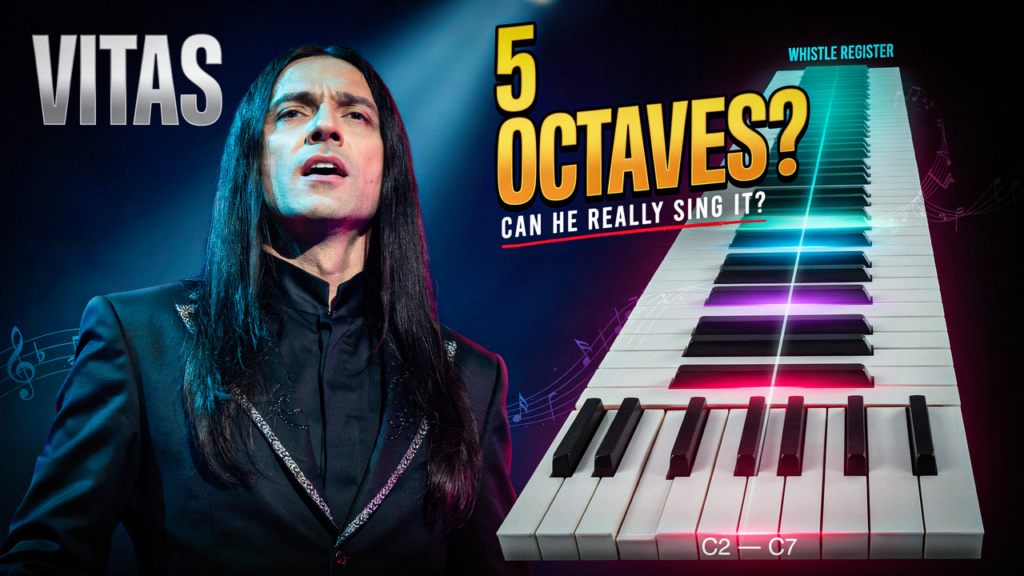
Vitas’ vocal range is often reported as spanning around five octaves in total, reaching from low baritone territory up into extremely high, flute-like upper notes. He is generally classified as a tenor, and many of his highest pitches are produced using reinforced falsetto or whistle-like coordination rather than full chest voice.
His voice became famous because of those piercing high notes. But range numbers alone don’t explain what’s really happening.
Let’s break it down clearly and realistically.
What Is Vitas’ Lowest and Highest Note?
Documented performances show that his lower notes sit in the second octave range. They are present but not the defining feature of his voice.
His highest notes reach into the sixth and possibly seventh octave in brief moments. These notes are extremely light and produced in an upper register coordination that sounds similar to whistle register.
If you’re unsure how these note spans are measured, review this explanation of what vocal range means so you understand the difference between extreme notes and usable singing range.
How Many Octaves Can He Sing?
Many sources claim five octaves. Some viral claims say six or even seven.
Here’s the important distinction:
- Usable range = notes he can sing with control and musicality.
- Extreme range = brief, very high pitches.
- Sustained tessitura = where he can sing comfortably in full songs.
For perspective, compare that to the average male vocal range, which is closer to two octaves. That makes his total span unusually wide, but not magically limitless.
Use the ear training tool to practice identifying random notes without a reference.
What Voice Type Is Vitas?
Vitas is generally considered a tenor.
His tessitura sits in upper male territory rather than baritone depth. If you compare with the tenor vocal range, his comfortable singing area aligns well.
However, classification becomes less important when discussing extreme upper register notes. Those high sounds are not typical full-voice tenor singing.
Falsetto vs Whistle: What’s Really Happening?
This is where most confusion happens.
Falsetto
Falsetto involves thinner vocal fold closure. The sound is lighter and more flute-like.
Whistle Register
Whistle register is even higher, with very minimal fold contact and a piercing tone.
Some of Vitas’ highest notes resemble whistle register, but in many performances, the sound is reinforced falsetto with strong resonance shaping.
Understanding how the vocal cords work during singing helps clarify why these tones sound so unusual.
Think of it like shifting gears in a car. You’re still moving forward, but the engine coordination changes.
Range vs Tessitura
Range tells you the outer boundaries.
Tessitura tells you where the voice feels stable and sustainable.
Imagine stretching a rubber band. You can pull it very far once, but you can’t keep it stretched at maximum tension all day.
Vitas’ tessitura sits in upper tenor territory, not in those extreme sixth-octave peaks.
If you want to calculate your own total span safely, try using a vocal range calculator rather than guessing.
How to Test Your Upper Range Safely
Extreme high notes attract attention, but chasing them recklessly can cause strain.
Follow this process:
- Warm up gently for at least 7 minutes using light scales.
- Slide upward slowly rather than jumping to high notes.
- Notice where your voice naturally shifts coordination.
- Stop immediately if you feel throat squeezing.
- Record the highest clean, tension-free note.
- Rest after testing.
If you need structured guidance, use this tutorial on how to test your vocal range safely.
Never force whistle attempts. High extension develops gradually.
Comparison: Vitas vs Typical Male Singer
| Category | Vitas | Typical Male Singer |
|---|---|---|
| Total Span | ~5 octaves (claimed) | ~2 octaves |
| Tessitura | Upper tenor | Middle |
| Extreme High Notes | Yes | Rare |
| Lower Depth | Moderate | Varies |
The key difference is upper extension, not lower power.
What Makes His High Notes Possible?
Several factors contribute:
- Efficient breath control
- Very thin cord coordination
- Strong resonance shaping
- Controlled airflow
Think of blowing across the top of a bottle to make a whistle sound. The pitch changes based on airflow precision, not brute force.
If you want to expand upward safely, focus first on stability in your middle register. This guide on how to increase vocal range explains the gradual process.
Self-Check: Is Your Range Similar?
Ask yourself:
- Can you sing comfortably above your speaking range?
- Do your high notes feel light rather than strained?
- Can you transition into falsetto smoothly?
- Does your mid-range remain stable and strong?
If your voice tightens or cracks easily, focus on coordination before extension.
You can also explore a structured voice type test to see where your natural tessitura sits.
Common Mistakes When Comparing Yourself to Vitas
1. Forcing High Notes
Trying to “push” into whistle territory can irritate the vocal folds.
2. Skipping Breath Work
High notes require steady airflow, not extra volume.
3. Ignoring Recovery
If you feel hoarse after practicing highs, rest.
4. Confusing Range With Skill
Range impresses people. Control impresses musicians.
5. Attempting Whistle Too Early
Whistle register coordination requires advanced control and should never feel painful.
Realistic Expectations
A five-octave total span is rare.
Most singers can safely develop 2.5 to 3 octaves with training. Extreme sixth-octave notes are not required for professional success.
If your throat feels tight, sore, or fatigued, pause immediately. Healthy training should feel progressive, not painful.
For perspective on what’s biologically typical, review the human vocal range limits before setting unrealistic goals.
Final Coaching Takeaway
Vitas’ vocal range is unusually wide, largely due to his extreme upper extension.
But his success isn’t about hitting the highest possible note.
It’s about breath control, coordination, and musical presentation.
Build strength gradually. Protect your voice. Let range expand naturally with technique.
FAQs
1. How many octaves can Vitas sing?
Many reports estimate around five octaves total. However, that includes extreme high notes rather than only sustained, usable singing range.
2. What is Vitas’ highest note?
His highest recorded pitches reach into the sixth or possibly seventh octave in brief moments. These are typically produced using falsetto or whistle-like coordination.
3. What is his lowest note?
His lowest notes sit in the second octave. They are supported but not the primary focus of his vocal style.
4. Is Vitas using whistle register?
Some of his highest notes resemble whistle register, though many are reinforced falsetto. The exact coordination can vary by performance.
5. Is his 7-octave range claim true?
Seven octaves is likely exaggerated. Most credible estimates place his span closer to five octaves total.
6. Is Vitas a tenor?
Yes, he is generally classified as a tenor based on his tessitura and natural singing range.
7. Can beginners train to sing that high?
Extreme high notes require advanced coordination. Beginners should focus first on stable breath support and smooth register transitions before attempting upper extension.

John Mayer is a vocal analysis and music education writer specializing in vocal range testing, voice type analysis, pitch recognition, and singing improvement tools for singers, musicians, performers, and beginners. He creates practical content focused on vocal training, singing techniques, and voice analysis tools to help users better understand and improve their vocal abilities.