
Tim Storms’ vocal range is famous for including the lowest recorded sung note ever measured, reaching frequencies below typical human hearing. When including subharmonics and upper extensions, his total span covers multiple octaves. He is classified as an extreme bass and is known for producing pitches far below standard modal singing.
If you’ve heard recordings of his lowest notes, they don’t just sound deep — they feel like vibration. To understand what makes his range unique, we need to separate measurable extremes from usable singing range.
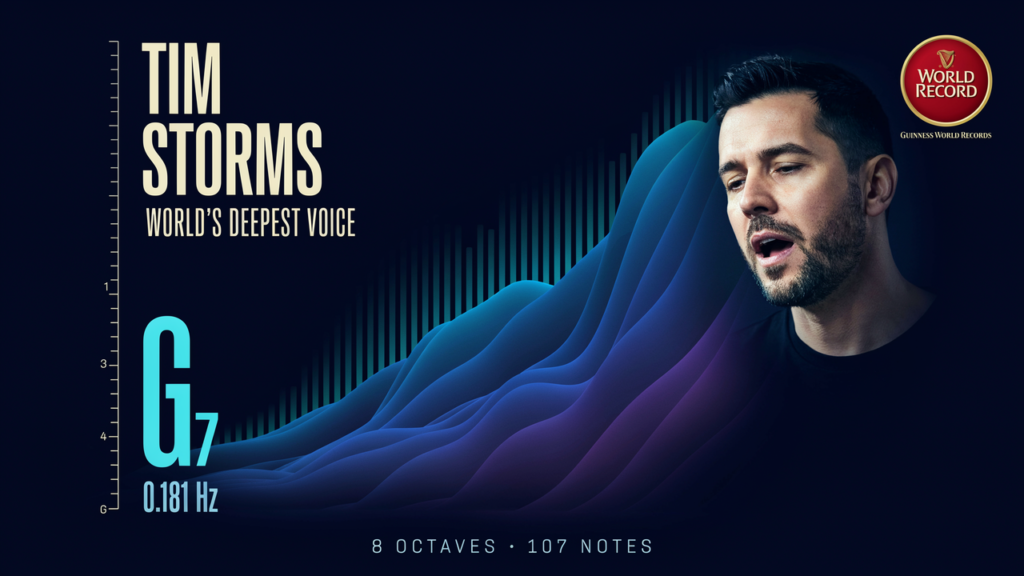
What Is Tim Storms’ Lowest Note?
Tim Storms holds a world record for producing a note below 10 Hz. That frequency is so low it falls beneath normal human hearing, which typically begins around 20 Hz.
This is important:
You may not “hear” the pitch clearly. You feel it as vibration.
In musical note terms, his lowest measurable pitches sit far below standard bass territory. For perspective, reviewing the typical human vocal range shows just how extreme this is compared to average singers.
How Many Octaves Does He Cover?
Depending on how the extremes are calculated, his total span is often described as around ten octaves. However, that includes subharmonic production and very high extensions.
This does not mean he sings ten octaves in everyday music.
There’s a big difference between:
- Measurable frequency extremes
- Usable singing range
- Comfortable tessitura
If you want to understand how ranges are counted accurately, a clear breakdown is available in this guide on how to measure vocal range.
If you want a quick ear workout, try the note recognition test and track your score.
Modal Voice vs Subharmonics
This distinction matters more than any octave number.
What Is Modal Voice?
Modal voice is your regular singing register — stable, resonant, and sustainable.
For most bass singers, modal range may start around E2. If you’re curious where that sits, reviewing the bass vocal range gives helpful context.
What Are Subharmonics?
Subharmonics are produced when the vocal folds vibrate in a special coordination pattern that allows pitches lower than typical chest voice.
Think of it like shifting your voice into “low gear.” The vibration pattern changes, allowing deeper frequencies.
These notes can be measured acoustically — but they are not the same as standard modal singing.
Why This Matters
When people claim huge octave spans, they often count:
- Subharmonic lows
- Modal middle
- Falsetto highs
Without separating them.
A realistic evaluation keeps these categories distinct.
Are Those Notes Actually Audible?
Some of his record-setting notes are below normal hearing range.
To understand why that’s impressive, here’s a simplified comparison:
| Frequency (Hz) | What It Means |
|---|---|
| 20 Hz | Lowest typical human hearing |
| 40–80 Hz | Very deep bass range |
| Below 20 Hz | Felt more than heard |
When a singer produces frequencies below 20 Hz, you may perceive vibration instead of pitch clarity.
This doesn’t reduce the achievement — it highlights how unusual the coordination is.
Is Tim Storms a Basso Profundo?
He is often associated with the deepest bass classifications.
However, classical classification depends on:
- Tessitura
- Tone quality
- Projection
- Passaggio location
If you want deeper insight into how voice types are classified, review the vocal fach system explained.
Extreme low notes alone do not define voice type.
What Singers Can Learn From His Technique
Most singers will never reach those depths — and that’s completely normal.
But you can improve your lower register safely.
Step-by-Step: Exploring Your Lower Range Safely
- Start in mid-range with a comfortable hum.
- Descend slowly in half steps.
- Keep the jaw loose and throat relaxed.
- Maintain steady airflow.
- Stop when tone becomes unstable.
Low notes should feel grounded, not forced.
If you’re unsure where your natural limits are, try a vocal range calculator to establish a baseline.
Why You Shouldn’t Chase Extreme Low Notes
It’s tempting to try to “beat” a record.
But vocal anatomy plays a huge role. Vocal fold length and thickness influence depth.
Training improves coordination — it does not redesign anatomy.
If you’re working to expand range generally, structured exercises from how to increase vocal range are far more productive than pushing downward aggressively.
Common Mistakes When Assessing His Range
1. Counting Subharmonics as Chest Voice
Subharmonics are a specialized coordination, not typical modal singing.
2. Ignoring Tessitura
The lowest possible pitch does not equal everyday singing range.
3. Confusing Vocal Fry With True Pitch
Fry is loose and irregular. Subharmonics are controlled and measurable.
4. Forcing Low Notes
Trying to push the larynx down or add weight often creates tension.
If you want a visual reference for how ranges typically align, the vocal range chart makes comparisons clearer.
Quick Self-Check: Is That Low Note Actually Yours?
Ask yourself:
- Can I sustain the note clearly for 3 seconds?
- Does it sound stable rather than crackly?
- Can I repeat it consistently?
- Does my throat feel relaxed afterward?
If the answer is no, it may not be a functional part of your range yet.
Extreme lows should feel like controlled depth — not strain.
How Rare Is His Range?
Extremely rare.
Even among bass singers, very few can produce measurable subharmonics below E1 with stability.
For comparison, reviewing broader voice categories in voice types shows that most male voices fall much higher.
The combination of anatomical structure and refined coordination makes this level unusual.
Musical Range vs Record Range
There’s a difference between:
- The lowest measurable frequency
- The lowest musical note used in performance
Record-breaking notes often exist as demonstrations of capability, not everyday musical tools.
In practical singing, clarity, projection, and blend matter more than raw depth.
Imagine owning a car that can reach 200 mph. That doesn’t mean you drive that fast daily. It means the engine is capable of extreme output.
The same principle applies here.
What Should You Focus On Instead?
Rather than chasing world-record lows, build:
- Breath stability
- Relaxed phonation
- Consistent tone
- Comfortable low extension
A balanced voice is more valuable than an extreme one.
Your goal isn’t to break records.
It’s to sing consistently and healthily.
Final Takeaway
Tim Storms’ vocal range demonstrates the outer edge of human vocal capability, especially in subharmonic production. His record-setting lows are measurable, rare, and acoustically fascinating. But for most singers, the real lesson isn’t how low he can go — it’s how controlled and intentional his production is. Precision, not extremity, is what defines mastery.
FAQs
1. What is Tim Storms’ lowest recorded note?
He has produced a note measured below 10 Hz, which falls beneath typical human hearing. It is detectable as vibration rather than a clearly audible pitch.
2. How many octaves can Tim Storms sing?
When including subharmonics and high extensions, his measurable span is often described as around ten octaves. However, not all of that range is used in typical musical performance.
3. Can humans hear his lowest note?
Most people cannot clearly hear frequencies below 20 Hz. Instead, they perceive vibration or rumble.
4. Does he use vocal fry?
His lowest tones involve subharmonic coordination rather than casual fry. Subharmonics are more structured and controlled than typical fry phonation.
5. Is Tim Storms a basso profundo?
He is often associated with the deepest bass classifications. However, voice type depends on more than just lowest note — tessitura and tone quality also matter.
6. Can I train to sing as low as Tim Storms?
Most singers cannot drastically change their anatomical vocal limits. You can strengthen your low range safely, but extreme depths are rare.
7. Are extreme low notes dangerous to practice?
They can be if forced. Low notes should feel relaxed and supported. If you experience tightness or strain, stop and reset in a comfortable range.

John Mayer is a vocal analysis and music education writer specializing in vocal range testing, voice type analysis, pitch recognition, and singing improvement tools for singers, musicians, performers, and beginners. He creates practical content focused on vocal training, singing techniques, and voice analysis tools to help users better understand and improve their vocal abilities.