
Singing high notes should never hurt. If your throat tightens, your neck muscles engage, or your voice feels sore afterward, the issue is not your vocal range—it’s inefficient coordination.
To sing high notes without straining, relax your throat, use strong breath support, and let the sound resonate forward instead of pushing. Practice gentle warm-ups like lip trills and sirens, keep volume moderate, and never force notes beyond your comfortable range.
This guide explains why strain happens, what high notes are supposed to feel like, and how to sing higher safely, consistently, and sustainably, using principles grounded in vocal anatomy and professional singing practice.
You can test your frequency using this voice frequency range tool.
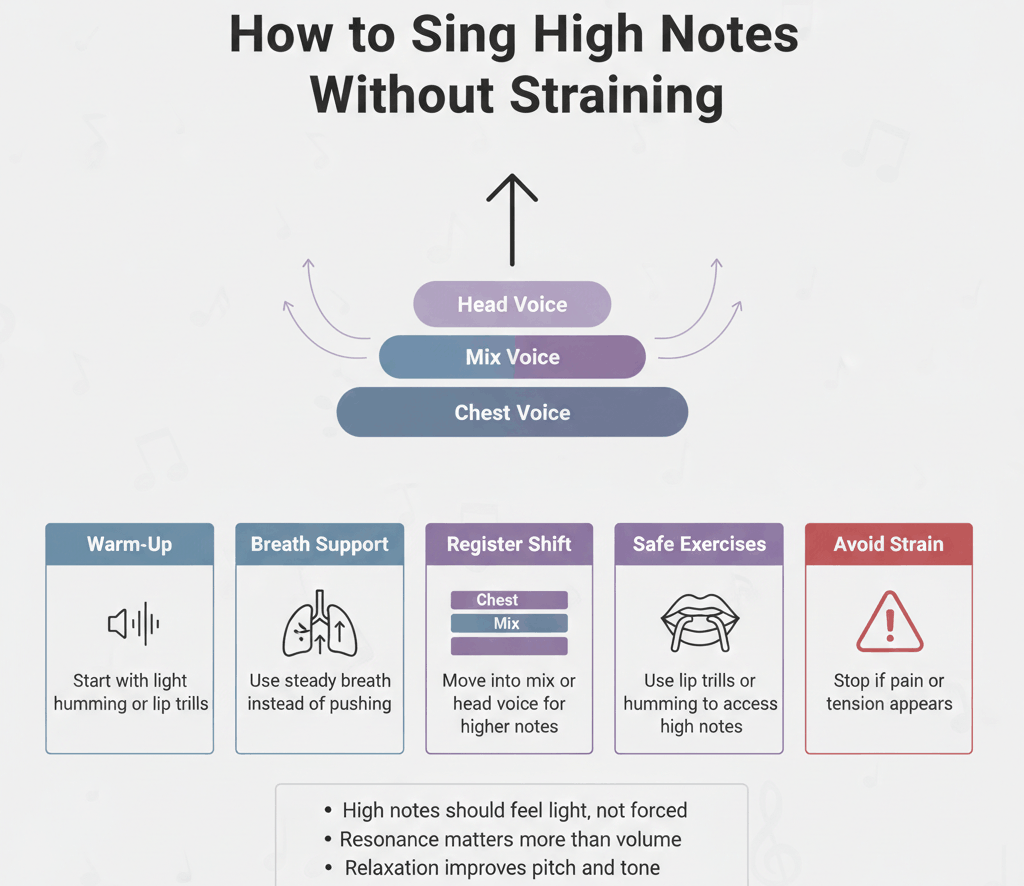
Why Singing High Notes Causes Strain
Most singers strain on high notes because they try to push pitch with effort instead of coordination.
The most common causes include:
- Pulling chest voice too high
- Excessive throat and neck tension
- Poor airflow control
- Forcing volume instead of adjusting resonance
- Skipping proper warm-ups
Your vocal cords are small, delicate muscles. They are not designed to be forced upward in pitch. High notes happen when airflow, vocal fold tension, and resonance balance correctly, not when you push harder.
For a clear, beginner-friendly explanation, see how vocal cords work.
How High Notes Should Feel (This Is Critical)
A correctly sung high note feels:
- Light, not heavy
- Stable, not squeezed
- Supported, not forced
- Easier than expected, not harder
If effort increases sharply as pitch rises, strain has already started.
How to Sing High Notes Without Straining (Step-by-Step)
1. Use Breath Support to Control Pressure — Not to Push
High notes require steady airflow, not more air.
- Inhale low into the ribs and abdomen
- Keep the chest relaxed
- Avoid breath holding before high notes
Proper airflow management is explained in breathing techniques for vocal range.
2. Stop Dragging Chest Voice Upward
One of the biggest causes of strain is trying to keep a “heavy” sound too high.
- Allow your voice to transition into head voice or mix
- Let resonance shift naturally
- Don’t wait until the note feels impossible
Knowing your natural tendencies helps—see voice types.
3. Modify Vowels as Pitch Increases
Wide vowels increase tension on high notes.
- “Ah” naturally narrows slightly
- “Eh” becomes more vertical
- This reduces vocal cord compression
This is normal acoustic tuning, not a loss of clarity.
4. Reduce Volume Before You Add Pitch
Pitch and loudness are separate skills.
- Practice high notes softly first
- Build coordination before power
- Loud high notes come from resonance, not force
5. Keep the Throat Neutral (Indirectly)
You can’t force relaxation—but you can remove causes of tension.
Avoid:
- Lifting the chin
- Tightening the jaw
- Raising the shoulders
Instead, maintain a neutral head position and loose facial muscles.
6. Warm Up Properly Before Singing High
High notes without preparation increase injury risk.
Effective warm-ups include:
- Lip trills
- Gentle sirens
- Light scales
Use structured routines from vocal warm-up exercises.
Warning Signs You Are Straining (Do Not Ignore These)
Stop singing if you notice:
- Burning or sharp discomfort
- Hoarseness after practice
- Tightness in the neck or jaw
- Loss of vocal control
Long-term strain can cause injury. For prevention, read vocal health tips.
Common Myths That Make High Notes Worse
| Myth | Reality |
|---|---|
| “Strain builds strength” | Strain damages coordination |
| “You need to push harder” | Efficiency beats force |
| “High notes should feel harder” | They should feel lighter |
| “Whispering rests the voice” | Whispering can increase stress |
Learn why in does whispering strain your voice.
Can Anyone Learn to Sing High Notes Without Straining?
Most singers can significantly improve comfort and range, within biological limits.
Range depends on:
- Vocal fold structure
- Training history
- Technique efficiency
You can explore your current range using the tool on the homepage or read how to increase vocal range safely.
How Long Does It Take to Fix High-Note Strain?
Typical timeline:
- 2–4 weeks: noticeable tension reduction
- 2–3 months: stable coordination
- Ongoing: endurance and consistency
Progress should feel easier over time, not exhausting.
If a high note works quietly but fails loudly, your coordination is correct.
If it only works loudly, strain is compensating.
Frequently Asked Questions
1. Should singing high notes ever hurt?
No. Pain is a warning sign, not a normal part of training.
2. Why do my high notes feel tight?
Usually due to chest voice dominance or excess air pressure.
3. Is breath support enough to stop strain?
Breath support is essential, but it must work with register balance.
4. Can beginners sing high notes safely?
Yes—when technique is prioritized over volume.
5. How often should I practice high notes?
Short sessions (10–15 minutes) are safer than long ones.
6. Can vocal strain become permanent?
Chronic strain can lead to nodules or inflammation if ignored.
7. Do professional singers ever strain?
Rarely—and they stop immediately when they do.
Related Articles:
- Strain often comes from poor airflow, which is why mastering proper breathing techniques is essential for high notes.
- Many singers push past their limits without realizing it, so understanding your vocal range correctly helps prevent tension.
- High notes feel easier when the voice is prepared, making these vocal warm-up exercises a non-negotiable step.
- Pushing beyond realistic limits causes strain, which is why reviewing how many octaves most people can sing sets healthier expectations.
- Control matters more than power, and improving it is easier with focused pitch accuracy training.
- Tracking usable high notes objectively becomes clearer when you measure your vocal range properly.
- Long-term freedom in the upper register depends on care, so following practical vocal health tips helps keep strain away.