
Yes — whispering can strain your voice, especially when it’s done frequently, for long periods, or when your voice is already tired or irritated.
Whispering feels gentle because it’s quiet, but volume alone does not determine vocal safety. In fact, whispering often requires more airflow and muscular tension than relaxed speech, which is why many people notice throat fatigue or soreness after whispering.
Does Whispering Strain Your Voice? Yes, whispering can strain your voice. Whispering forces the vocal cords into unnatural tension, increasing irritation and fatigue. Speaking softly with proper breath support is usually safer than whispering when your voice needs rest. To get instant feedback, try this online tool.
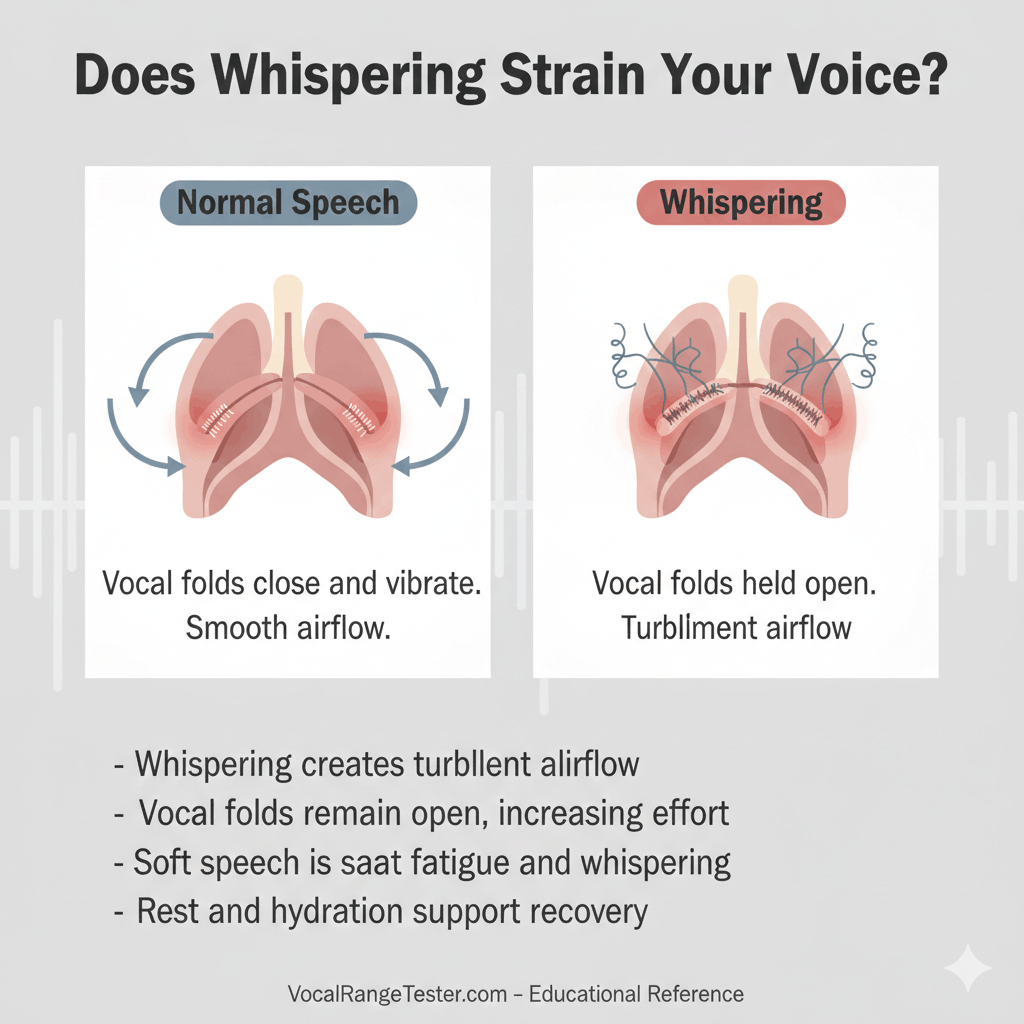
What Happens to Your Vocal Cords When You Whisper
During normal speech, the vocal cords come together and vibrate. This vibration is efficient and evenly distributes workload.
When you whisper:
- The vocal cords do not fully close
- Air moves continuously through the opening
- Nearby muscles tighten to regulate airflow
- The voice works harder to produce less sound
This creates higher muscular effort with lower efficiency, which explains why whispering often feels tiring even though it sounds soft.
This mechanism becomes clearer when you understand how the vocal cords work in normal phonation.
Why Whispering Often Feels Worse Than Talking
Many people report that whispering causes:
- Throat dryness
- Scratchiness
- Hoarseness
- Faster vocal fatigue
That happens because whispering:
- Uses more air, not less
- Encourages throat tension
- Reduces natural vocal efficiency
This is similar to what singers experience when airflow is uncontrolled. That’s why efficient breath management is emphasized in breathing techniques for vocal range — efficiency protects the voice more than volume control.
Whispering vs Soft Speaking: Which Is Safer?
In most everyday situations, soft speaking is safer than whispering.
A relaxed speaking voice:
- Keeps the vocal cords vibrating normally
- Uses less airflow
- Reduces unnecessary muscular tension
Whispering bypasses this natural system. That’s why voice professionals usually recommend gentle speech instead of whispering, especially during recovery.
Should You Whisper When You’re Sick or Hoarse?
This is a very common misconception.
When your voice is already irritated:
- Whispering often slows recovery
- Airflow dries the tissues further
- Muscle tension increases
Safer options include:
- Speaking briefly and softly
- Taking frequent vocal breaks
- Using silence when possible
These habits align with long-term vocal health tips rather than short-term fixes that feel gentle but aren’t.
Is Whispering Dangerous for Singers?
For singers, whispering is particularly problematic because:
- It reinforces tension patterns
- It disrupts efficient coordination
- It can affect pitch stability later
Many singers notice that whispering during the day makes singing harder at night — even though they thought they were “resting” their voice.
True vocal rest focuses on reducing strain, not just reducing volume.
Is Whispering the Same as Voice Rest?
No. Whispering is not voice rest.
Voice rest means:
- Minimal vocal use
- Low tension
- Efficient coordination
Whispering still uses the voice — just inefficiently. If your goal is recovery, whispering often works against it.
When Whispering Is Most Likely to Cause Strain
Whispering becomes especially straining when:
- Done for long conversations
- Used during illness
- Combined with dehydration
- Paired with stress or emotional tension
In these situations, even short periods of whispering can fatigue the voice faster than relaxed speech.
What to Do Instead of Whispering
Healthier alternatives include:
- Gentle, relaxed speaking
- Shorter phrases
- Texting or writing when possible
- Staying well-hydrated
If voice fatigue happens often, testing and tracking habits with a vocal range calculator can help identify patterns contributing to strain.
Can Whispering Affect Vocal Range?
Indirectly, yes.
Whispering doesn’t damage range directly, but:
- Increased fatigue
- Increased tension
- Reduced coordination
can make notes feel less accessible later. Over time, this affects consistency more than actual range size — an important distinction explained in what vocal range really means.
- Whispering can strain your voice
- It increases airflow and muscular effort
- It is often worse than soft speech
- Whispering is not voice rest
- Gentle speech or silence is safer
Frequently Asked Questions
1. Does whispering strain your voice?
Yes, especially when done frequently or for long periods.
2. Is whispering worse than talking quietly?
In most cases, yes. Soft speech is more efficient.
3. Can whispering damage your vocal cords?
Occasional whispering is unlikely to cause damage, but repeated whispering can contribute to chronic strain.
4. Why does whispering make my throat tired?
Because it increases airflow and muscle tension without efficient vibration.
5. Should I whisper when I lose my voice?
No. Gentle speech or silence is safer.
6. Is whispering safe for singers?
It’s best avoided, especially during heavy voice use days.
7. Does whispering dry out the throat?
Yes. Increased airflow can dry vocal tissues faster.
8. Is breathy talking the same as whispering?
No, but both can strain the voice if overused.
9. Can whispering affect pitch accuracy?
Yes, indirectly, by reinforcing tension patterns.
10. What’s the safest way to rest my voice?
Short, relaxed speech or silence with hydration.
- Vocal strain debates make more sense when viewed against the limits of the human vocal range.
- Since whispering often affects control, reviewing basic pitch accuracy fundamentals helps explain why tension builds.
- Strain risks increase when airflow is mismanaged, which is why proper breathing techniques are closely related.
- Repeated whispering can reduce usable notes, especially when compared with a typical four-octave range.
- Voices already under stress are more vulnerable, making general vocal health guidance particularly relevant.
- Long-term misuse can subtly alter comfort zones, something tracked well through regular vocal range measurement.
- For singers noticing fatigue, starting fresh with a full vocal range test can reveal early warning signs.