
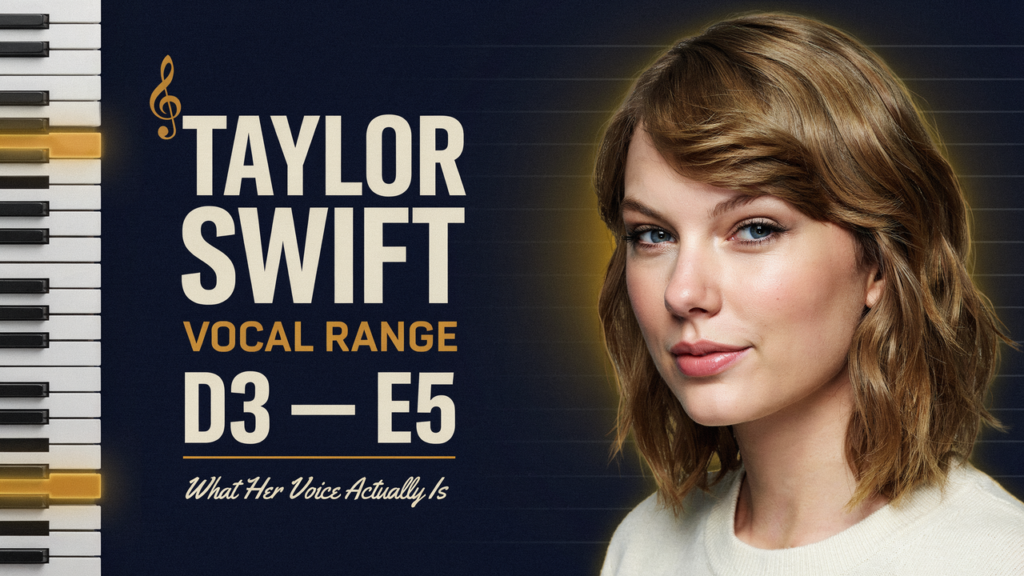
Taylor Swift’s documented vocal range spans D3 to E5 — approximately two octaves — which makes her one of the narrower-ranged major pop stars but does not diminish what she has achieved with it. Her voice type is a light mezzo-soprano, and her strength lies in storytelling, melodic instinct, and a vocal personality that is immediately identifiable. Two octaves is a perfectly functional professional range.
Taylor Swift Vocal Range at a Glance
| Detail | Value |
|---|---|
| Full Documented Range | D3–E5 |
| Span | ~2 octaves |
| Voice Type | Light mezzo-soprano |
| Lowest Note | D3 (146.8 Hz) |
| Highest Note | E5 (659 Hz) |
| Tessitura | G3–D5 |
| Known For | Storytelling, melodic phrasing, vocal personality |
What Voice Type Is Taylor Swift?
Taylor Swift is a light mezzo-soprano — a mezzo-soprano with lighter vocal weight and a higher natural tessitura than a dramatic mezzo. Her voice sits naturally in the G3–D5 range, where it carries a warm, slightly breathy quality that suits her conversational, narrative vocal style.
The “light” designation distinguishes her from heavier mezzos like Adele or Beyoncé. Her voice does not project with the same volume or weight but carries a different kind of presence — intimate, direct, and rhythmically expressive. In folk and country contexts, this is often the ideal voice type: a voice that feels close to the listener rather than performing for them.
Some vocal analysts classify her as a contralto based on her speaking pitch, but her singing range does not descend far enough into contralto territory to warrant that classification. See the mezzo-soprano vocal range guide for context on how light mezzo sits within the broader female voice type system.
What Makes Taylor Swift’s Voice Distinctive
Tonal personality. Her voice has a distinctive character in the speaking-adjacent range (D3–C4) that carries over into her lower singing register. The slightly nasal placement, the conversational rhythm, and the way she places vowels have made her voice one of the most recognisable in popular music.
Melodic memory. Her melodies are simple, often syllabic (one note per syllable), and built for memorability. This is a craft choice that suits her voice: elaborate melismatic runs would be technically demanding for her voice type and would also change the direct, storytelling quality of her delivery.
Genre adaptability. Across country, pop, folk-indie, and pop-rock, her voice has adapted to different production contexts without the range changing meaningfully. This adaptability within two octaves is a skill in itself.
Emotional specificity. Her phrasing is emotionally precise — a crack in the voice, a drawn-out word, a shift in breath pressure — in ways that serve narrative songwriting. These are controlled, intentional choices rather than technical limitations.
Songs That Showcase Her Voice
“All Too Well” (10-minute version, 2021) — The extended version builds to a climax in the E4–E5 range that represents the emotional and technical peak of her live vocal work. The bridge is her most demanding vocal section to date.
“Back to December” (2010) — Primarily in her natural tessitura (G3–B4), showing her voice at its most comfortable and characterful.
“Delicate” (2017) — A breathy, intimate lower-register performance in the D3–G4 range. Shows the darker, more introspective quality of her lower voice.
“Don’t Blame Me” (2017) — One of her more vocally ambitious tracks, with a gospel-influenced delivery and a build toward her upper range (D5) in the later choruses.
“The Archer” (2019) — Stripped-back production that isolates her voice without heavy production. What you hear is close to her natural, unprocessed sound.
How Her Range Compares
Two octaves (D3–E5) is below the typical trained professional range but comfortably above the average untrained singer (around 1.5 octaves). Among female pop artists: her range is narrower than Beyoncé (3 octaves), Adele (2.5 octaves), and Ariana Grande (4 octaves), but her commercial success demonstrates that range is not the primary determinant of vocal impact.
A typical mezzo-soprano spans G3–B5 — her upper limit of E5 is at the lower end of that range, reinforcing the “light” qualification of her mezzo designation. Compare your range to hers with the singer comparison tool.
Test Your Own Voice
If you sing comfortably in the G3–D5 range with a warm, conversational quality, you may share Taylor Swift’s voice type. The voice type test can confirm your classification. The free vocal range test maps your exact span.
Frequently Asked Questions
What is Taylor Swift’s vocal range? Her documented range is D3 to E5 — approximately two octaves. Her most comfortable performing zone (tessitura) is G3 to D5.
What voice type is Taylor Swift? She is a light mezzo-soprano — a mezzo-soprano with lighter vocal weight and a higher natural tessitura, suited to intimate, narrative-style singing.
Is Taylor Swift considered a good singer? Her vocal range is on the lower end for professional recording artists. Her strengths are melodic instinct, vocal personality, and storytelling rather than technical vocal range or classical technique. She has improved significantly from her early career — compare a 2010 live performance to a 2023 Eras Tour recording and the difference is clear.
Has Taylor Swift’s voice changed over the years? Yes. Her voice has developed noticeably — her pitch consistency, breath control, and ability to sing while performing have all improved from the Fearless era to the Midnights era. Vocal range can change with training and practice, though the fundamental voice type typically remains stable.
What is a 2-octave vocal range? Two octaves means your range spans 24 semitones — from your lowest comfortable note to a note two octaves higher. See the is a 2-octave range good page for a full breakdown of what this means for different types of singers.

John Mayer is a vocal analysis and music education writer specializing in vocal range testing, voice type analysis, pitch recognition, and singing improvement tools for singers, musicians, performers, and beginners. He creates practical content focused on vocal training, singing techniques, and voice analysis tools to help users better understand and improve their vocal abilities.