
The idea of a 6 octave vocal range has become one of the most repeated — and misunderstood — claims in singing culture. Social media videos, fan articles, and comment sections often assert that certain singers can sing six octaves or more, presenting it as the ultimate proof of vocal superiority.
But when examined through vocal science, music theory, and physiology, the reality is far more nuanced.
This article breaks down what a vocal range actually is, how octaves work, what the human voice is physically capable of, and why most 6-octave claims don’t hold up under professional scrutiny.
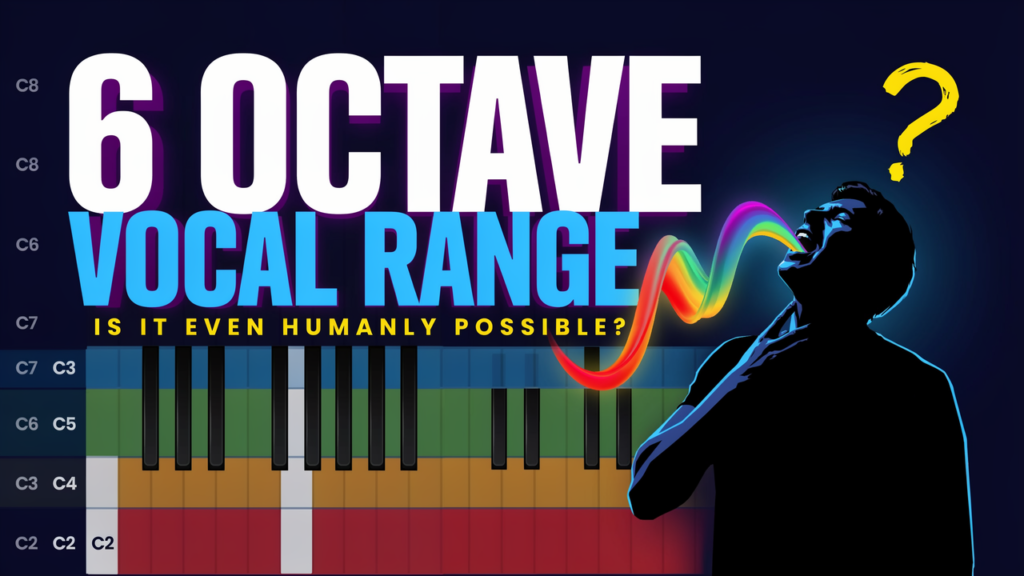
Is a 6 Octave Vocal Range Really Possible? Yes, a 6 octave vocal range is possible, but extremely rare. Only a few singers (like Dimash Kudaibergen) approach it, often using specialized registers such as whistle and subharmonics. Most trained singers average 2–4 octaves — range size is less important than control.
What Is a Vocal Range, Exactly?
A vocal range refers to the span of musical notes a person can produce musically and intentionally, typically measured from the lowest to highest usable pitch.
Key point:
Range is not just about hitting a note once
It’s about producing pitch with control, pitch accuracy, and repeatability
In professional contexts (voice pedagogy, choir placement, studio work), a note usually counts toward your range only if it can be:
- Sustained briefly
- Repeated on demand
- Used musically (not just as noise)
What Is an Octave?
An octave is the distance between one musical note and the same note at double (or half) the frequency.
For example:
- C2 → C3 = 1 octave
- C2 → C4 = 2 octaves
- C2 → C8 = 6 octaves
On a piano, each octave spans 12 semitones.
For reference:
- Average trained singers: ~2.5–3 octaves
- Exceptional singers: ~3.5–4 octaves
- Anything beyond that enters extreme territory
Average vs Exceptional Human Vocal Ranges
Let’s establish realistic baselines.
Typical Ranges
- Untrained adults: ~1.5–2 octaves
- Trained singers: ~2.5–3.5 octaves
- Elite vocalists: ~4 octaves (rare but documented)
Beyond 4 Octaves
Once claims exceed 4 octaves, they almost always involve:
- Multiple vocal registers
- Non-standard vocal techniques
- Sounds that are not traditionally considered “singing”
This distinction is crucial.
Vocal Registers Explained (Why This Matters)
The human voice doesn’t operate in one continuous mode. It uses different registers, each produced by different vocal fold behaviors.
Main Registers
- Chest voice – speaking and lower singing range
- Head voice / falsetto – higher pitched singing
- Whistle register – extremely high, flute-like tones
- Vocal fry – very low, creaky sound
- Subharmonics – advanced low-frequency technique
A key clarification:
Many extreme range claims stack all registers together — even when those sounds:
- Can’t be sustained
- Can’t be sung melodically
- Aren’t usable in music
Why the “6 Octave Vocal Range” Claim Is Misleading
To reach six octaves, a singer must combine:
- Vocal fry (lowest sounds)
- Subharmonics
- Chest voice
- Head/falsetto
- Whistle register
While this may produce six octaves on paper, it fails a critical test:
These sounds are not produced by the same vocal coordinationThey are not musically interchangeable
From a scientific and pedagogical standpoint, this is not considered a single functional vocal range.
Physiology: The Hard Limits of the Human Voice
The vocal folds are constrained by:
- Length
- Thickness
- Mass
- Elasticity
- Airflow capacity
These biological limits make a true, musically usable 6-octave range extremely unlikely, if not impossible, for humans.
Voice scientists generally agree:
- 3–4 octaves = exceptional
- 5+ octaves = technical edge cases
- 6 octaves = classification artifact, not singing reality
Famous Singers and 6-Octave Claims
Some artists are frequently cited online as having 6-octave ranges. In nearly all cases:
- Measurements include vocal fry or whistle tones
- Notes are isolated, not musical phrases
- Claims are based on fan analysis, not peer-reviewed studies
This does not diminish their artistry — but it does change how the claim should be interpreted.
Skill ≠ octave count.
What Actually Matters More Than Vocal Range
An obsession with octave count misses what defines great singers.
Professionals prioritize:
- Tone quality
- Control
- Consistency
- Musicality
- Emotional communication
- Healthy technique
A singer with 2.5 well-controlled octaves will outperform someone with 4 chaotic ones in nearly all real musical settings.
So… Is a 6 Octave Vocal Range Possible?
Not in the way most people imagine.
- Humans can sometimes produce sounds across six octaves
- Humans cannot realistically sing six octaves in a unified, musical sense
The claim persists because:
- It sounds impressive
- It’s easy to misunderstand
- Social media rewards extremes, not nuance
FAQ
Is a 6 octave vocal range rare?
Yes — but more accurately, it’s not a standard or accepted singing measurement.
Who has the widest vocal range ever?
This depends entirely on how “range” is defined. Under strict musical criteria, verified ranges cluster around 4 octaves.
Does whistle register count as singing?
It’s a valid vocal register, but it functions very differently from chest or head voice and is often excluded from traditional range classification.
Can training increase my vocal range?
Yes — safely trained singers often gain ½ to 1 full octave, sometimes more, depending on physiology and technique.
Should I try to expand my range at all costs?
No. Pushing extremes without guidance risks vocal damage. Control and health matter more than numbers.
- Many claims make more sense after reviewing what a six-octave vocal range actually means in measurable terms.
- Comparing extremes is easier when you first understand what a five-octave vocal range represents for trained singers.
- Context matters, which is why readers often check whether a four-octave range is considered exceptional in practice.
- Physiological limits become clearer by learning how the vocal cords work at different pitch levels.
- Some singers explore the upper edge of range by studying how whistle tones are produced safely.
- Evaluating realistic expectations often starts with asking if a three-octave range is strong for most voices.
- Range discussions benefit from technique-focused context such as ways to extend vocal range gradually over time.

John Mayer is a vocal analysis and music education writer specializing in vocal range testing, voice type analysis, pitch recognition, and singing improvement tools for singers, musicians, performers, and beginners. He creates practical content focused on vocal training, singing techniques, and voice analysis tools to help users better understand and improve their vocal abilities.