
Many people believe whispering gives the voice a rest. In fact, doctors, teachers, singers, and parents often recommend whispering when someone is hoarse or has laryngitis. But this advice is partly wrong.
Yes—whispering does use the vocal cords, and in many cases, it can strain them more than gentle speaking.
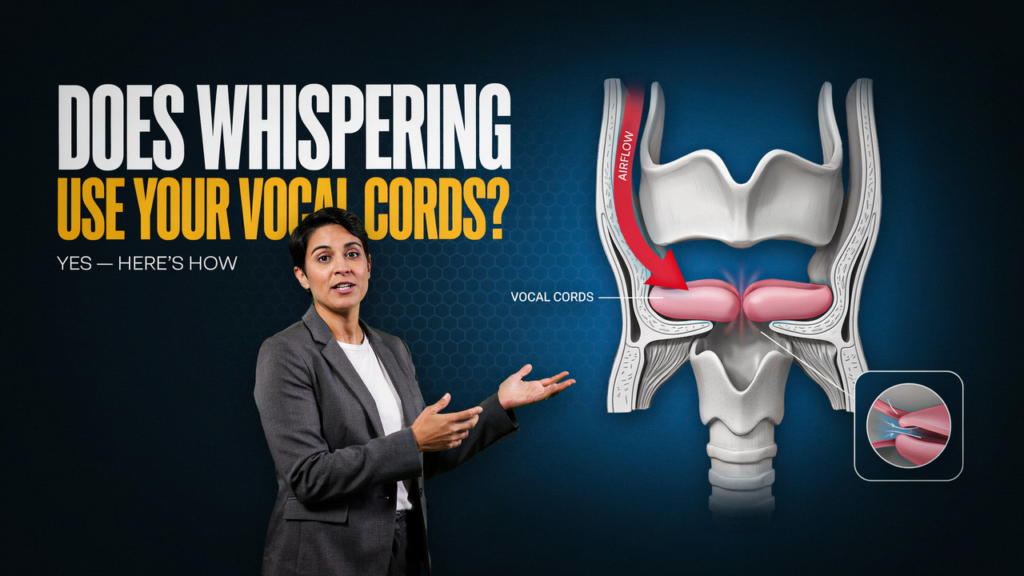
How the Vocal Cords Normally Work
To understand whispering, it helps to know how the voice works during normal speech.
- The vocal cords (vocal folds) sit inside the larynx (voice box).
- When you speak or sing, the vocal cords come together and vibrate.
- Air from the lungs passes through them, creating sound (this is called phonation).
- Pitch and volume change depending on tension, length, and airflow.
Normal speech involves balanced vibration with relatively low muscular tension when done properly.
If you want precision, try this tool to measure vocal pitch and range.
What Happens When You Whisper?
When you whisper, the vocal cords behave differently—but they are still actively involved.
During whispering:
- The vocal cords do not fully vibrate
- They remain partially closed
- Air is forced through a small opening at the back of the cords
- Surrounding muscles often become tense
This creates the soft, breathy sound of a whisper—but it also increases friction and muscular effort in the larynx.
Whispering is not vocal rest. It is a different, and often more stressful, way of using the vocal cords.
The airflow consistency test helps you avoid collapsing at the end of phrases.
Does Whispering Use Vocal Cords?
Yes. Whispering absolutely uses the vocal cords.
While they may not vibrate the same way as during normal speech, they are:
- Actively positioned
- Under muscular tension
- Exposed to turbulent airflow
In many people, whispering causes greater strain than relaxed, quiet talking.
Is Whispering Bad for Your Voice?
In most cases, yes—especially if your voice is already tired or injured.
Whispering can be harmful because:
- It increases tension in the throat muscles
- It dries out the vocal cords faster
- It encourages forceful airflow
- It delays healing during vocal fatigue or laryngitis
This is why many ENT doctors and speech-language pathologists advise not to whisper when your voice hurts.
Whispering vs Talking: Which Is Worse?
| Activity | Vocal Cord Vibration | Muscle Tension | Risk When Voice Is Injured |
|---|---|---|---|
| Gentle talking | Yes (balanced) | Low | Lower |
| Whispering | No vibration, high tension | High | Higher |
| Loud talking | Strong vibration | High | High |
Gentle, relaxed speech is usually safer than whispering.
Why Do People Think Whispering Helps?
Whispering feels easier because:
- It’s quiet
- There’s no clear vibration sensation
- It seems like “less effort”
But internally, the larynx is often working harder.
This misunderstanding is why the myth persists.
What Should You Do Instead of Whispering?
If your voice is hoarse, tired, or painful, better options include:
1. True Voice Rest
- Speak only when necessary
- Avoid long conversations
- No whispering, singing, or shouting
2. Gentle, Quiet Speech
- Speak softly but clearly
- Use a relaxed tone
- Avoid breathy forcing
3. Hydration
- Drink water regularly
- Use humid air if possible
- Avoid caffeine and smoke
4. Non-Verbal Communication
- Text or write instead of speaking
- Use gestures when possible
These strategies reduce strain and support healing.
What About Whispering With Laryngitis?
With laryngitis, whispering is especially discouraged.
Inflamed vocal cords:
- Are more sensitive to friction
- Heal slower under tension
- Are easily irritated by turbulent airflow
Most medical professionals recommend complete voice rest or minimal gentle speech, not whispering.
Is Whispering Ever Okay?
Occasional, brief whispering is unlikely to cause permanent damage in a healthy voice. The risk increases when whispering is:
- Prolonged
- Frequent
- Done during illness or fatigue
- Used by singers or professional voice users
For people who rely heavily on their voice, whispering should be avoided as a habit.
FAQ
Does whispering rest your voice?
No. Whispering still uses and often strains the vocal cords.
Is whispering worse than talking?
Often, yes—especially if the voice is tired or injured.
Why do doctors say not to whisper?
Because whispering increases tension and airflow stress on healing vocal cords.
Can whispering cause vocal damage?
Repeated or prolonged whispering can contribute to vocal fatigue and irritation
- Understanding voice mechanics is easier when reading how do the vocal cords work.
- Expanding vocal flexibility pairs well with vocal exercises to increase range.
- Posture can reduce strain, as explained in best posture for singing.
- Learning proper technique also relates to how to extend your vocal range.
- Beginners can benefit from understanding does vocal coaching work.
- Comparing vocal ranges provides context, like is a 2-octave range good.
- Long-term singers often combine this knowledge with how to start a singing career.

John Mayer is a vocal analysis and music education writer specializing in vocal range testing, voice type analysis, pitch recognition, and singing improvement tools for singers, musicians, performers, and beginners. He creates practical content focused on vocal training, singing techniques, and voice analysis tools to help users better understand and improve their vocal abilities.