
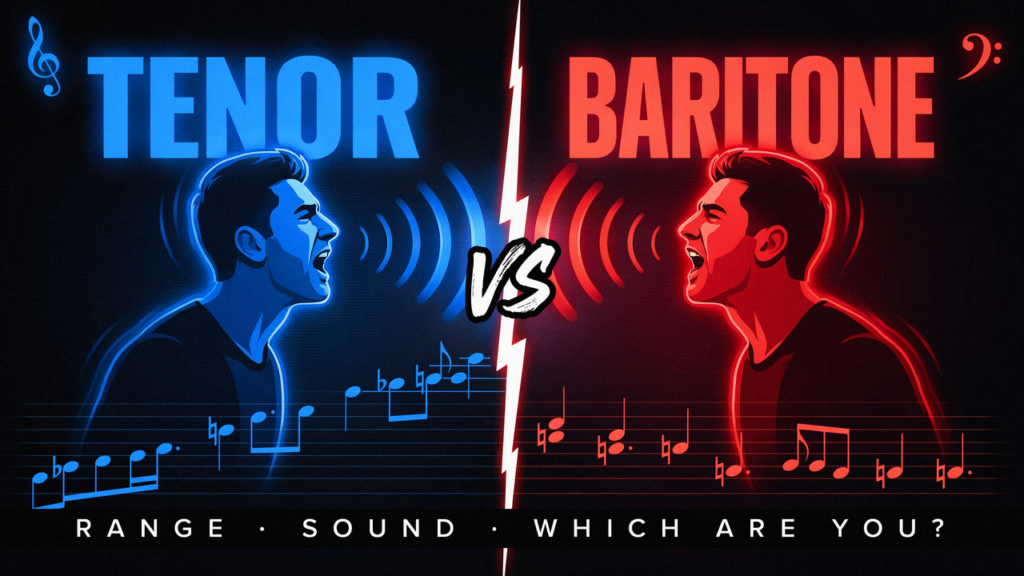
Tenor and baritone are distinct male voice types. Tenors sing higher on average, while baritones sing lower—but the real difference is tessitura (where the voice is most comfortable), timbre, and passaggio placement, not just the highest or lowest note you can hit once.
Why this comparison is so often misunderstood
Three common issues drive confusion:
- Range-only tests misclassify singers because ranges overlap.
- Choir labeling prioritizes balance over biology.
- Early training and age (especially teens) can temporarily mask a voice’s natural center.
As a result, many baritones are pushed to sing tenor—or told they “should be” tenors—long before their voices are ready.
Tenor vs Baritone: Differences
Tenor
- Category: Male voice type
- General tessitura: Higher male range
- Tone: Brighter, lighter, more ring
- Typical roles: Leads in opera and musical theatre, melody lines in choirs
Baritone
- Category: Male voice type
- General tessitura: Middle male range
- Tone: Warm, rich, weighty
- Typical roles: Authority figures, lyrical leads, character roles
A tenor is not a “high baritone,” and a baritone is not a “failed tenor.” They are different instruments.
Range vs tessitura (the factor)
Range is the total span of notes you can produce, including strained extremes.
Tessitura is where your voice sounds best most of the time—with ease, stamina, and consistent tone.
Common reference ranges (approximate):
- Tenor: ~C3–C5
- Baritone: ~A2–A4
These ranges overlap heavily, which is why range alone fails as a classifier. Training can extend range upward or downward; tessitura changes much less.
If your voice feels “at home” for long passages above middle C (C4), you likely lean tenor. If sustained singing above C4 is work—and your best sound sits lower—you likely lean baritone.
Passaggio: where voices reveal themselves
The passaggio is the transition between vocal registers. Its placement is a reliable indicator of voice type.
- Tenor passaggio: higher (the voice transitions later)
- Baritone passaggio: lower (the transition happens sooner)
Singers who constantly “fight” the upper middle of the voice are often baritones miscast as tenors. Healthy technique can help—but it cannot change where the passaggio naturally lives.
If you want fast voice analysis, try Vocal Range Tester.
Timbre and vocal weight: what listeners hear
Beyond pitch, voice types differ in color and density.
Tenor timbre
- Brighter overtones
- Lighter vocal weight
- Easier access to sustained high lines
Baritone timbre
- Darker, richer color
- Heavier core to the sound
- Power and resonance in the middle-lower range
Two singers may sing the same notes; trained ears can still tell them apart.
Choir reality: tenor sections and baritones
In choirs, directors balance sound, not taxonomy.
- Tenor sections often include both true tenors and higher baritones
- Baritone parts may be labeled “bass” or split lines
- Younger singers are frequently placed where the ensemble needs them
Singing tenor in choir does not make you a tenor voice type. It reflects current repertoire and ensemble needs.
Can a baritone sing tenor?
Sometimes—but with limits.
Many baritones can:
- Sing tenor lines occasionally
- Develop higher notes with training
- Cover tenor parts in choirs or pop styles
But living permanently in tenor tessitura can:
- Increase fatigue
- Reduce tonal quality
- Raise injury risk over time
Healthy singing respects the voice’s natural center.
Age, development, and misclassification
Male voices often settle later than expected. Teens and young adults may:
- Sound high before the voice drops fully
- Gain weight and depth through their 20s
- Shift from “tenor-ish” to baritone with maturity
This is why responsible teachers avoid locking in labels too early.
A safe checklist: tenor or baritone?
Not a diagnosis—just guidance.
You may lean tenor if:
- Sustained singing above C4 feels natural
- Your voice brightens as you go higher
- Upper notes don’t require pushing
You may lean baritone if:
- Your strongest sound sits below C4
- High passages tire quickly
- Your voice feels grounded and resonant lower
Note: Technique matters. Poor technique can make any voice feel uncomfortable.
Repertoire tendencies (descriptive, not prescriptive)
- Tenor: lead operatic roles, high choral melodies, pop leads
- Baritone: character and authority roles, rich harmony lines, lyrical leads
Repertoire should follow the voice—not force it.
Common myths (and corrections)
Myth: “If I can hit high notes, I’m a tenor.”
Hitting notes ≠ living there.
Myth: “Baritones are just untrained tenors.”
Baritone is a complete, valid voice type.
Myth: “You can train into any voice type.”
Training refines a voice; it doesn’t change its biology.
Final verdict
- Tenor and baritone are distinct male voice types
- Tessitura, timbre, and passaggio matter more than range extremes
- Choir roles don’t define voice type
- Healthy singing respects where the voice naturally lives
For certainty, the gold standard is long-term observation with a qualified vocal teacher, not a one-time range test.
- Comparing male voice types is easier when looking at a two-octave range benchmark.
- Understanding mid-range singing can be supported by a three-octave vocal range overview.
- Many singers explore technique improvements with how to do whistle voice.
- Female voice comparisons help contextualize ranges, such as mezzo-soprano vs contralto.
- Strengthening long-term performance relies on Alexander method exercises.
- Practicing safely is easier with how to do whistle tones.
- Career-minded singers often benefit from how to become a country singer.

John Mayer is a vocal analysis and music education writer specializing in vocal range testing, voice type analysis, pitch recognition, and singing improvement tools for singers, musicians, performers, and beginners. He creates practical content focused on vocal training, singing techniques, and voice analysis tools to help users better understand and improve their vocal abilities.