
You don’t make vibrato happen. Healthy vibrato emerges naturally when breath flow, pitch stability, and vocal freedom are balanced. Trying to shake your voice, pulse your breath, or wiggle your jaw usually creates artificial vibrato and tension—not the real thing.
High (strong consensus across vocal pedagogy and voice science)
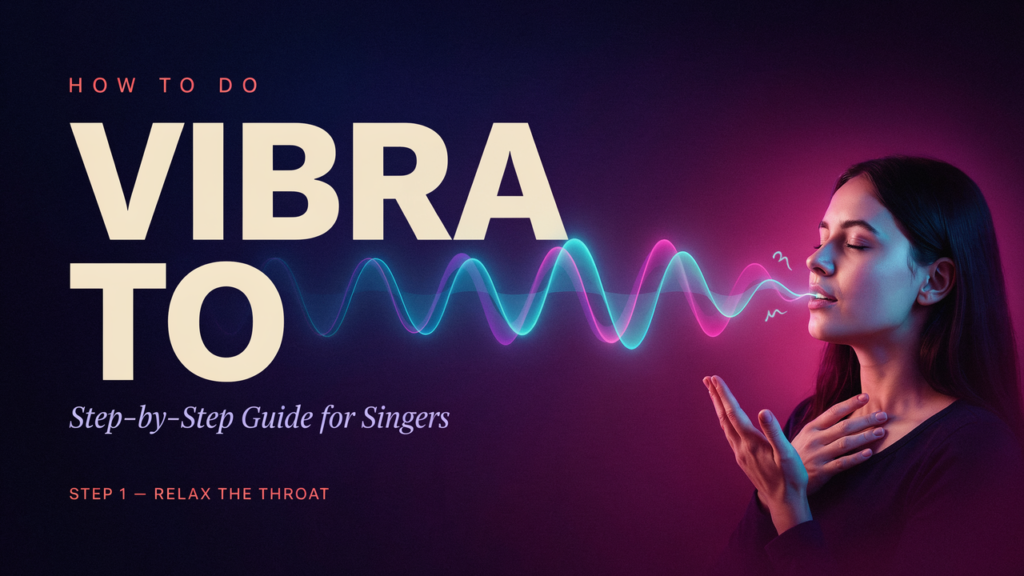
Why so many singers struggle with vibrato
Many singers are told to “add vibrato” without being taught what vibrato actually is. That leads to confusion and habits that work against the voice.
Common frustrations:
- “I don’t have vibrato—what am I doing wrong?”
- “Should I move my jaw or throat?”
- “Why does my vibrato sound wobbly or uneven?”
- “I can’t turn vibrato on when I want it”
Most of these problems come from trying to control a result instead of fixing the conditions that produce it.
What vibrato really is (and isn’t)
Vibrato is a natural, regular oscillation of pitch—typically around 5–7 cycles per second—that occurs when the vocal system is working efficiently.
Vibrato is:
- A sign of balanced coordination
- A result of free vocal fold vibration
- Consistent and even
Vibrato is not:
- Jaw shaking
- Throat wobbling
- Breath pulsing
- “Diaphragm bouncing”
If you are consciously moving something to create vibrato, it’s probably artificial.
Why forcing vibrato doesn’t work
When singers try to do vibrato, they often:
- Pulse the breath
- Shake the jaw or lips
- Push and release pitch
- Add tension to “manufacture” movement
This leads to:
- Uneven pitch
- Fatigue
- Loss of control
- Tremolo (too fast) or wobble (too slow)
Healthy vibrato requires less effort, not more.
The conditions vibrato needs to appear
Instead of asking how to do vibrato, ask what needs to be in place for vibrato to happen.
1. Stable pitch
Vibrato sits on top of a stable pitch.
If pitch is sliding, scooping, or strained, vibrato won’t settle.
Test:
Sing a comfortable sustained note with clean, steady tone. If you can’t hold pitch easily, vibrato will be unreliable.
2. Balanced breath flow
Vibrato doesn’t come from pushing air—it comes from consistent airflow.
Signs breath is balanced:
- You’re not running out of air quickly
- Sound doesn’t feel pressed or breathy
- The ribcage stays responsive, not collapsed
Over-blowing or under-supporting both interfere with vibrato.
3. Low tension (especially neck and jaw)
Excess tension blocks vibrato immediately.
Common tension areas:
- Jaw clenching
- Tongue pulling back
- Neck stiffening
- Raised shoulders
If the voice feels “held,” vibrato usually disappears.
4. Comfortable tessitura
Vibrato appears most easily where your voice is most comfortable.
If you’re singing:
- Too high
- Too low
- Outside your natural tessitura
the system prioritizes survival over finesse—vibrato shuts down.
Why some singers don’t have vibrato (yet)
Not having vibrato doesn’t mean something is wrong. Common reasons include:
- Being early in vocal development
- Singing with straight tone by habit
- Carrying hidden tension
- Singing outside comfortable range
- Focusing too hard on control
Many trained singers develop vibrato after technique stabilizes—not before.
How to encourage natural vibrato (safely)
These approaches invite vibrato without forcing it.
1. Start with easy, sustained notes
Choose a pitch that feels:
- Comfortable
- Resonant
- Unforced
Sustain it with a relaxed, steady tone. Don’t try to add vibrato—just observe.
Often, a gentle oscillation appears on its own after a second or two.
2. Release unnecessary control
If you’re micromanaging pitch, vibrato can’t emerge.
Helpful cues:
- “Allow the sound”
- “Let the note float”
- “Less doing, more listening”
If vibrato appears briefly and disappears, that’s progress—not failure.
3. Alternate straight tone and release
Sing a short phrase:
- Begin with clean straight tone
- Then slightly relax effort and see if vibrato emerges at the end
This builds awareness without forcing.
4. Improve posture and breath efficiency
Poor posture and shallow breathing directly suppress vibrato.
Balanced alignment + easy breath = more vocal freedom.
Vibrato vs tremolo vs wobble
These are often confused.
- Healthy vibrato: even, controlled, moderate speed
- Tremolo: too fast, nervous-sounding (often tension-based)
- Wobble: too slow and wide (often over-relaxation or fatigue)
If your vibrato feels extreme, the issue is usually coordination, not talent.
Style matters: pop vs classical vibrato
Vibrato is used differently across styles.
- Classical: vibrato is continuous and expected
- Pop/rock: vibrato is often lighter, delayed, or used selectively
- Musical theatre: varies by style and era
Being able to control when vibrato appears is a stylistic skill—not proof of vocal quality.
Can you “turn vibrato on”?
Advanced singers can allow vibrato quickly by relaxing into balanced coordination—but they’re still not forcing it.
Think of vibrato like:
- A relaxed reflex
- Not a switch you flip
- Something you permit, not command
Common vibrato myths (and the truth)
Myth: “You need to move your jaw.”
→ Truth: Jaw movement usually blocks healthy vibrato.
Myth: “Vibrato comes from the diaphragm.”
→ Truth: The diaphragm doesn’t pulse for vibrato.
Myth: “No vibrato means bad technique.”
→ Truth: Many singers develop vibrato later as tension decreases.
Myth: “More vibrato is better.”
→ Truth: Even, controlled vibrato is what matters.
When to get help
If vibrato:
- Never appears
- Feels forced
- Is wildly uneven
- Causes fatigue
A qualified voice teacher can help identify where coordination is breaking down—often quickly.
- Practicing airy control can feel easier after exploring whistle tone basics.
- Learning what strains your voice is clearer when you read about whispering and the cords.
- Tracking subtle pitch changes works better with a simple recording app.
- If your tone feels thin, using a mic for nasal voices can reveal what’s really happening.
- Understanding how different female voices behave helps when comparing mezzo and contralto types.
- Male singers often refine their vibrato after learning about tenor and baritone differences.
- Low-range stability can improve once you explore baritone versus bass traits.

John Mayer is a vocal analysis and music education writer specializing in vocal range testing, voice type analysis, pitch recognition, and singing improvement tools for singers, musicians, performers, and beginners. He creates practical content focused on vocal training, singing techniques, and voice analysis tools to help users better understand and improve their vocal abilities.