
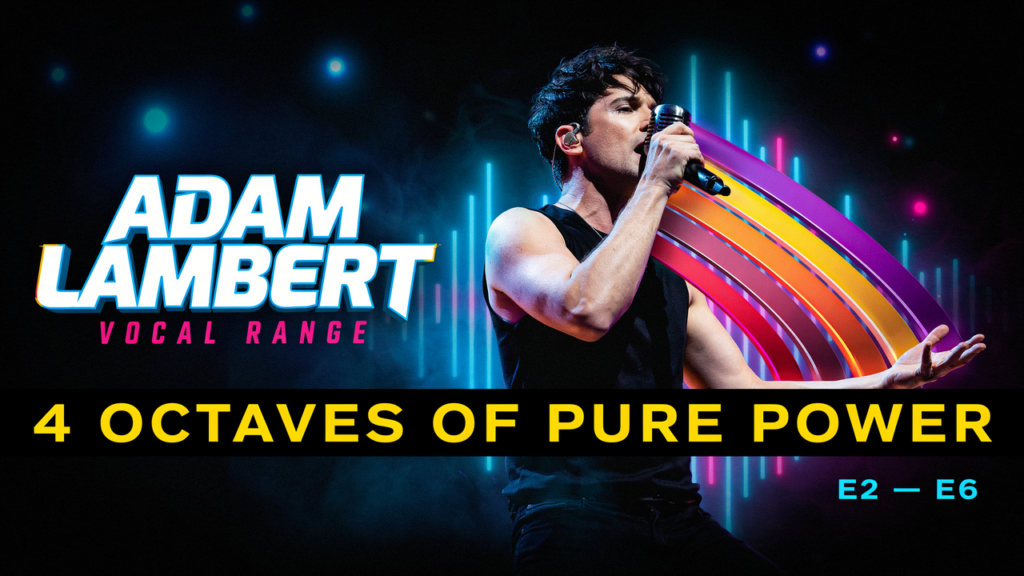
Adam Lambert’s vocal range is widely estimated at over three octaves, with exceptional command of chest voice, mixed voice, head voice, and falsetto. There is no officially verified measurement of his exact lowest and highest notes, but what is clearly documented—especially in live performance—is his high tenor tessitura, elite upper-register control, and unusual consistency at extreme pitches.
Unlike classical singers, contemporary artists almost never publish formal vocal range assessments. In Adam Lambert’s case:
- Songs are frequently transposed for live performance
- Studio recordings may include layering or reinforcement
- Falsetto and head voice are often confused or inconsistently labeled
- There is no clinical or conservatory-style documentation
As a result, any precise note claims should be treated as estimates, not facts.
Vocal range vs tessitura: the distinction people miss
To understand Adam Lambert’s voice, it’s essential to separate two concepts:
- Vocal range: the total span of notes a singer can produce
- Tessitura: the range where a singer performs comfortably and consistently
For elite singers, tessitura matters far more than extremes—and Adam Lambert’s tessitura is clearly high.
Try the sustain test for singers as part of your warm-up routine.
Adam Lambert’s tessitura and voice type
Across his solo career and with Queen + Adam Lambert, he consistently sings:
- In a high male tessitura
- Above the traditional tenor comfort zone
- With sustained power in the upper register
This strongly supports the classification of Adam Lambert as a high tenor, not a baritone and not a classical countertenor.
Important clarification
Online debates often label him a countertenor. This is inaccurate.
- Countertenor is a classical voice type relying primarily on falsetto
- Adam Lambert sings predominantly in chest-dominant mix and head voice
- His falsetto is an extension, not his main coordination
The most accurate modern description is:
How Adam Lambert uses vocal registers
What sets Adam Lambert apart is not just how high he sings—but how he navigates registers.
Chest voice
- Strong, resonant, and stable
- Used effectively up to the upper middle range
Mixed voice
- One of his greatest strengths
- Allows powerful high notes without strain
- Maintains clarity and pitch accuracy
Head voice
- Full, focused, and controlled
- Often mistaken for falsetto by casual listeners
Falsetto
- Agile and stylistically intentional
- Used for color and expression, not as a crutch
This coordination across registers is rare at the mainstream level.
Estimated vocal range (with clear caveats)
Commonly cited estimates place Adam Lambert’s range at approximately:
- Lower notes: around F2–G2
- Upper notes: around C6–D6 (head voice / falsetto)
This suggests a span of just over three octaves, possibly more depending on how falsetto is counted.
Why this estimate is debated:
- Some analysts include falsetto; others don’t
- Live keys vary
- Studio effects can exaggerate perception
From a technical standpoint, the functional range he uses live is far more impressive than the raw number.
Why Adam Lambert’s range actually matters musically
Many singers can hit high notes once. Very few can:
- Hit them consistently
- Reproduce them live
- Maintain tone and pitch
- Sustain them across long tours
Adam Lambert does all of this.
His range matters because it’s usable, not theoretical.
Live performance: where credibility is earned
One reason Adam Lambert is so respected among vocal professionals is his live consistency.
He routinely:
- Sings demanding repertoire night after night
- Adjusts keys intelligently without avoiding challenges
- Maintains stamina across long sets
- Delivers high notes under physical movement and pressure
This separates true technical range from studio-only range claims.
Adam Lambert vs Freddie Mercury (a common comparison)
As Queen’s frontman, Adam Lambert is often compared to Freddie Mercury.
Key differences:
- Mercury blended rock grit with classical influence
- Lambert brings theatrical precision and modern mix technique
- Both are high tenors with strong upper registers
- Lambert relies more on controlled mix and head voice
Importantly, Adam Lambert does not imitate Mercury—he adapts Queen’s music to his own vocal strengths.
Common myths about Adam Lambert’s voice
Myth: “He only sings high because of falsetto.”
→ Reality: Much of his upper range is mixed or head voice.
Myth: “He has the biggest range in pop music.”
→ Reality: His range is large, but his control is what stands out.
Myth: “Range alone makes him elite.”
→ Reality: Technique, stamina, and consistency do.
Myth: “Anyone can sing that high with training.”
→ Reality: Training helps, but physiology still matters.
What singers can learn from Adam Lambert
From a technical and artistic standpoint, Adam Lambert demonstrates that:
- Developing mix is more valuable than chasing extremes
- Singing high doesn’t require strain if coordination is correct
- Live consistency matters more than studio perfection
- Style and technique must support each other
For aspiring singers, the lesson is clear:
Build control before range.
Why “Adam Lambert vocal range” keeps ranking
People search this because:
- His high notes are unmistakable
- His voice defies typical male vocal stereotypes
- Fans want a numerical explanation for what they hear
The real answer isn’t just a number—it’s coordination, tessitura, and discipline.
Final verdict
- Adam Lambert’s vocal range is widely estimated at 3+ octaves
- There is no official, verified measurement
- He is best described as a high tenor
- His strength lies in upper-register control and consistency
- His career proves that usable range beats theoretical extremes
If you’re studying vocal ranges to improve your own singing, Adam Lambert offers a powerful example: master the range you can sustain, not just the notes you can touch once.
You can test your vocal range online at https://vocalrangetester.com/
Related Articles:
- His theatrical highs and lows are detailed in this featured range profile.
- Placing his dramatic tone is clearer with this tenor versus bass guide.
- Many of his biggest belts push into what this four-octave overview explains about extended range.
- Sustaining powerful notes like his relies on what this breath and posture article covers.
- Singers aiming for similar agility can study this range expansion guide.
- High-register control is outlined clearly in this whistle technique resource.
- Understanding how his voice fits classical categories is easier with this fach system explanation.

John Mayer is a vocal analysis and music education writer specializing in vocal range testing, voice type analysis, pitch recognition, and singing improvement tools for singers, musicians, performers, and beginners. He creates practical content focused on vocal training, singing techniques, and voice analysis tools to help users better understand and improve their vocal abilities.