
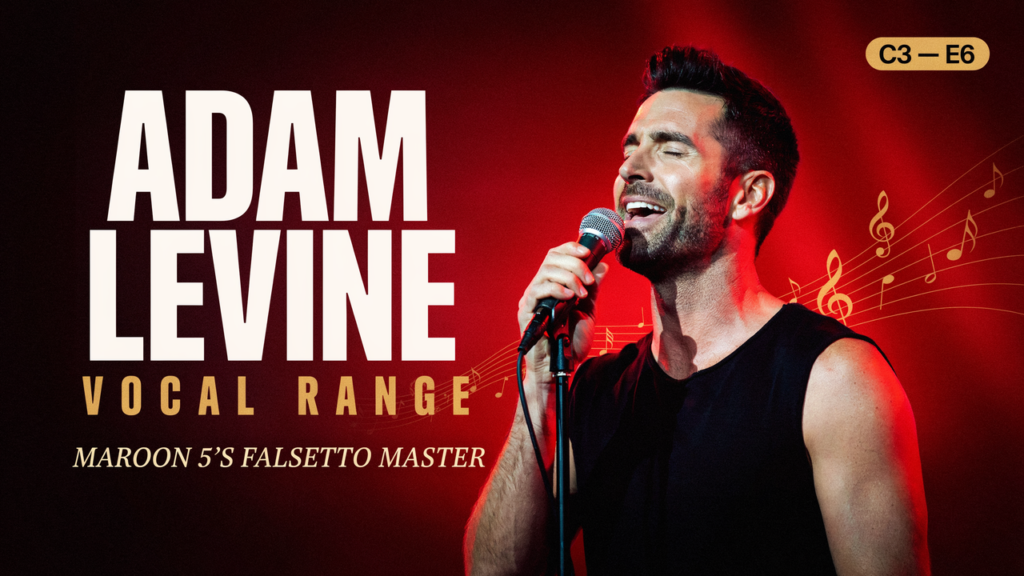
Adam Levine’s vocal range is commonly estimated at around three octaves, with a high tenor tessitura and frequent use of head voice and light falsetto. There is no officially verified vocal range measurement, but his recordings and live performances clearly show comfort in the upper male register, which defines his instantly recognizable pop-rock sound.
Why “Adam Levine vocal range” is hard to pin down precisely
For contemporary pop singers, vocal ranges are rarely measured in a formal or clinical way. In Adam Levine’s case:
- Songs are written and transposed to suit his voice
- Studio recordings include layering and production choices
- Falsetto and head voice are often confused by listeners
- Live performances prioritize consistency over extremes
Because of this, any exact lowest or highest note you see online should be treated as an estimate, not a fact.
Vocal range vs tessitura: the key distinction
To understand Adam Levine’s voice, it’s essential to separate two ideas:
- Vocal range: the full span of notes a singer can produce
- Tessitura: the range where a singer performs comfortably and consistently
For pop singers, tessitura matters far more than extreme notes—and Adam Levine’s tessitura is clearly high.
Adam Levine’s tessitura and voice type
Across Maroon 5’s catalog, Adam Levine consistently sings:
- In a high male tessitura
- Above where many tenors feel comfortable
- With ease in the upper middle and high registers
This strongly supports classifying him as a high tenor.
Important clarification
Online discussions sometimes label Adam Levine as “just a falsetto singer.” This is misleading.
- He does use falsetto frequently
- But much of his singing is head voice or light mix
- Falsetto is a stylistic color, not his only coordination
A more accurate description is:
How Adam Levine uses vocal registers
Adam Levine’s vocal identity comes from how he uses registers, not just how high he goes.
Chest voice
- Relatively light and narrow
- Rarely pushed into heavy territory
- Used mainly in lower verses
This keeps his sound agile and avoids strain.
Mixed voice
- Subtle rather than powerful
- Bridges chest and head voice smoothly
- Helps maintain pitch accuracy without belting
Unlike rock belters, Adam Levine does not rely on heavy mix.
Head voice
- A defining feature of his sound
- Clear, forward, and controlled
- Used extensively in choruses and hooks
Many listeners mistake this for falsetto, but it often has more closure and stability.
Falsetto
- Used frequently for color and ease
- Light, airy, and expressive
- Helps him stay high without vocal fatigue
Falsetto is a choice, not a limitation.
Estimated vocal range (with necessary caveats)
Commonly cited estimates place Adam Levine’s vocal range around:
- Lower notes: approximately C3–D3
- Upper notes: approximately B5–C6 (using head voice and falsetto)
This suggests a span of roughly three octaves, depending on how falsetto notes are counted.
Why estimates vary:
- Some analysts include falsetto; others exclude it
- Live keys change for endurance
- Studio production can exaggerate perceived range
From a practical standpoint, his usable tessitura is more important than the raw number.
Why Adam Levine’s voice sounds higher than many male singers
Even singers with similar ranges often sound lower than Adam Levine. Why?
Several factors raise the perceived pitch of his voice:
- High tessitura
- Light chest coordination
- Early transition into head voice
- Bright vowel choices
- Forward placement
Together, these create the impression of a singer who is “always high,” even when the notes themselves are not extreme.
Live performance realities
Live, Adam Levine often:
- Modifies melodies slightly downward
- Uses head voice instead of full chest
- Avoids prolonged high belting
- Prioritizes consistency and stamina
This reinforces the idea that his range is functional and stylistic, not built on vocal brute force.
Common myths about Adam Levine’s vocal range
Myth: “Adam Levine sings everything in falsetto.”
Reality: He uses a mix of head voice, light mix, and falsetto.
Myth: “He has an unusually huge vocal range.”
Reality: His range is solid, but not extreme by elite standards.
Myth: “Anyone can sing like him by using falsetto.”
Reality: Control, placement, and coordination matter more than register choice.
Myth: “Range is why he’s successful.”
Reality: Songwriting, tone, and stylistic consistency are just as important.
How Adam Levine compares to other male pop singers
Compared to artists like:
- Bruno Mars: wider stylistic range, stronger chest mix
- The Weeknd: similar use of head voice and falsetto
- Justin Timberlake: more mix-driven upper register
Adam Levine stands out for his persistent high tessitura and light coordination rather than raw power.
What singers can learn from Adam Levine
From a technical and musical perspective, Adam Levine demonstrates that:
- Singing high doesn’t require shouting
- Light coordination can be sustainable
- Tessitura matters more than range size
- Consistency beats occasional extremes
- Style and identity matter as much as technique
For singers with naturally higher voices, his career shows the value of leaning into your natural placement instead of fighting it.
Why this search keeps ranking
People keep searching “Adam Levine vocal range” because:
- His voice defies typical male expectations
- His tone is instantly recognizable
- Many singers try to imitate his style
The real explanation isn’t just numbers—it’s how he uses his voice.
Final verdict
- Adam Levine’s vocal range is commonly estimated at around three octaves
- There is no officially verified range measurement
- He is best described as a high tenor
- His sound relies on head voice, light mix, and falsetto
- His success proves that stylistic consistency matters more than extreme range
For singers analyzing vocal ranges, Adam Levine offers a clear lesson:
Build a sound that works night after night, not one that only works once.
Related Articles:
- His bright pop-tenor span is laid out in this artist range profile.
- Placing his voice type is easier after reading this tenor versus baritone guide.
- Many of his melodies sit within what this two-octave reference explains about usable range.
- Understanding how his light tone is produced starts with this vocal cord primer.
- Singers trying to match his pop flexibility can work through this range exercise resource.
- The breathy color in his delivery is clarified in this whispering overview.
- Comparing his tenor sound with a deeper male voice is easier using this baritone versus bass article.

John Mayer is a vocal analysis and music education writer specializing in vocal range testing, voice type analysis, pitch recognition, and singing improvement tools for singers, musicians, performers, and beginners. He creates practical content focused on vocal training, singing techniques, and voice analysis tools to help users better understand and improve their vocal abilities.