
When I first tried to find my vocal range, I made the same mistake most people do:
I chased the highest and lowest sounds my voice could make.
The result?
I ended up with a range that looked impressive on paper—but didn’t actually work when I sang real songs.
Only later did I realize that finding your vocal range isn’t about extremes. It’s about discovering the notes your voice can use consistently, comfortably, and without tension.
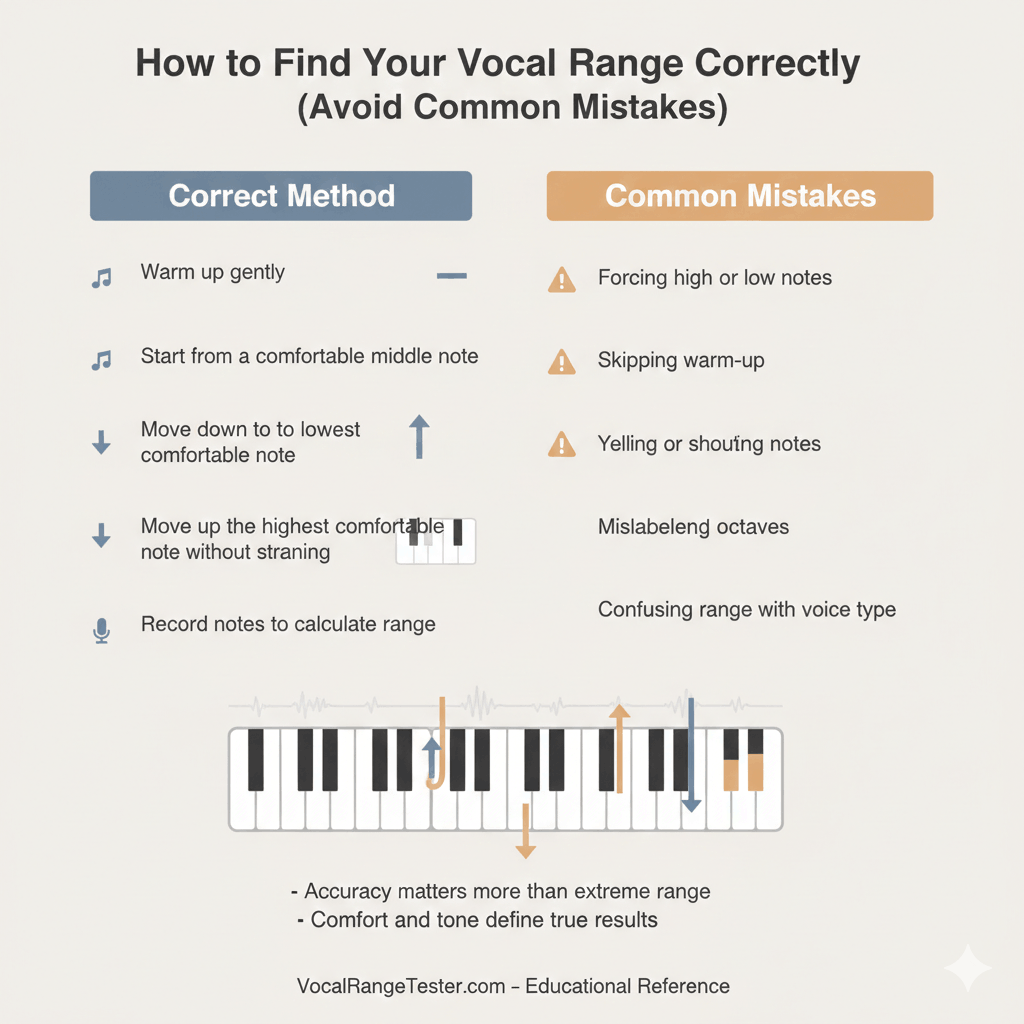
To find your vocal range correctly, warm up first, then sing from your lowest comfortable note to your highest clear note without strain. Avoid forcing high notes, counting breathy tones, or using untrained falsetto to ensure accurate results. Try the vocal range testing tool before training.
What Vocal Range Really Means
Your vocal range is the span between the lowest and highest notes you can sing comfortably and repeatably.
Early on, I counted:
- Vocal fry lows
- Tight, shouted high notes
- One-time “lucky” sounds
That inflated my range—but made it useless.
Once I learned the real definition of vocal range, explained clearly in what vocal range actually means, my range number got smaller—and my singing got better.
That’s the trade-off most beginners don’t expect.
How to Find Your Vocal Range
Comfort > extremes. Always.
Step-by-Step: How to Find Your Vocal Range (What Actually Works)
1. Warm Up (Skipping This Cost Me Accuracy)
The first few times I tested my range, I skipped warming up.
My “highest note” changed every time—and sometimes by a lot.
A short warm-up makes range testing more stable and honest. Gentle humming or light scales are enough (see vocal warm-up exercises).
2. Find Your Lowest Comfortable Note (Don’t Chase the Bottom)
I used to push for ultra-low notes because they felt impressive.
But most of them were breathy and inconsistent.
Your lowest note should:
- Sound clear
- Feel relaxed
- Be repeatable
If you can’t sing it twice in a row, it doesn’t count.
3. Find Your Highest Comfortable Note (Where I Made the Biggest Mistake)
This is where I went wrong the longest.
I counted notes that:
- Tightened my throat
- Lost pitch stability
- Only worked once
Your highest note should feel supported, not squeezed.
When tension shows up, stop.
That one decision instantly made my range more realistic—and usable.
4. Measure Your Range Properly
Once you know your lowest and highest usable notes, measure the distance between them in octaves.
Doing this manually is error-prone. I miscounted several times before using a vocal range calculator, which removed the guesswork completely.
How Many Octaves Should You Expect? (Reality Check)
Before testing properly, I assumed “normal” meant 3+ octaves.
In reality:
- Most people sing comfortably within 1.5–2 octaves
- That range is healthy, normal, and musical
This is clearly shown when you compare results to the average vocal range instead of celebrity claims.
Realizing this removed a lot of unnecessary pressure.
Why Your Range Changes Day to Day (And Why That’s Normal)
I used to panic when my range felt smaller on some days.
Common reasons include:
- Fatigue
- Stress
- Poor sleep
- Dehydration
- No warm-up
Your voice didn’t shrink—your coordination just changed. Testing occasionally, not obsessively, gives more reliable insight.
Range vs Tessitura: What Matters More for Singing
Two singers can have the same range, but:
- One sounds free
- The other sounds strained
That’s because tessitura—where your voice feels best—matters more than raw range.
This is why voice classification isn’t based on numbers alone. If you’re curious how range fits into voice categories, explore voice types explained.
Can You Find Your Vocal Range Online?
Yes—and honestly, online tools were more consistent for me than guessing with a piano.
Online tools:
- Measure pitch objectively
- Remove counting errors
- Track changes over time
They don’t judge tone or skill—but for range measurement, they’re reliable when used correctly.
What to Do After You Find Your Vocal Range
This part matters more than the number itself.
Once I knew my real range:
- Song choices became easier
- High notes stopped feeling scary
- My voice felt more consistent
Range knowledge should guide decisions, not labels.
- Vocal range is about usable notes, not extremes
- Most people sing within 1.5–2 octaves
- Miscounting is extremely common
- Warm-ups change results more than anatomy
- Comfort beats bragging rights
Frequently Asked Questions
1. How do I find my vocal range at home?
Warm up, find your lowest and highest comfortable notes, then measure the distance between them.
2. Do I need a piano to find my vocal range?
No. Online tools and pitch apps work well when used correctly.
3. Why did my range shrink compared to before?
You’re likely measuring more accurately now.
4. Is vocal fry part of vocal range?
No. Only clear, repeatable notes count.
5. How many octaves is normal?
Most people fall between 1.5 and 2 octaves.
6. Can beginners measure their range accurately?
Yes, if they avoid forcing and extremes.
7. Does vocal range equal singing skill?
Not at all. Control matters more.
8. Should I test my range every day?
No. That often leads to forcing and confusion.
9. Can training increase my range?
Training improves usability more than total size.
10. What’s the biggest beginner mistake?
Confusing extreme sounds with usable singing range.
Related Articles:
- Many mistakes happen when people skip fundamentals, so reviewing this explanation of vocal range basics helps set the right foundation.
- To avoid guessing, it’s useful to follow a structured way to measure your range step by step.
- Misjudging limits is common without context, which is why this human vocal range overview is helpful.
- Results are often skewed without preparation, making proper vocal warm-ups an important first step.
- Understanding where notes actually sit is easier when referencing a clear vocal range notes guide.
- If classification feels confusing, comparing outcomes with a voice type reference can prevent mislabeling.
- For added accuracy and validation, many singers confirm findings using an AI-based voice analysis tool.