
Barry Gibb’s voice is one of the most recognizable in pop history. People talk about his falsetto like it’s a superpower — and honestly, it kind of is. But the real story isn’t just “how high can he sing.” It’s how he uses registers, resonance, and consistency to make high singing sound effortless.
Barry Gibb’s vocal range is the span between the lowest and highest notes he has sung in recordings and performances. His range is often discussed in two parts: his modal voice (his natural speaking-style singing) and his falsetto, which extends much higher. His signature sound comes from stable falsetto technique, not just pitch.
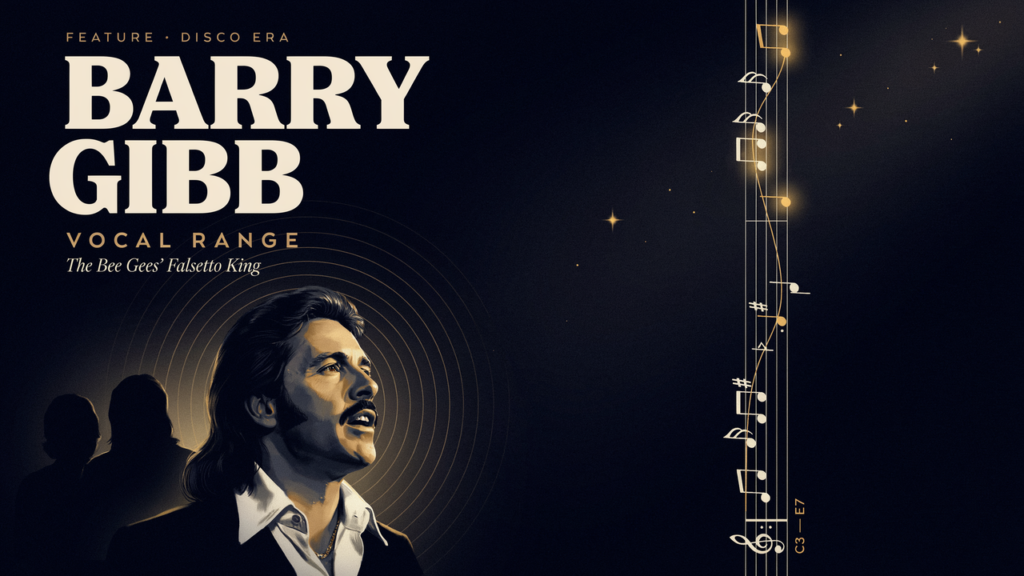
The Quick Answer (What Most People Mean by “His Range”)
When people search for Barry Gibb’s vocal range, they usually want:
- his lowest note
- his highest note
- how many octaves that covers
But with Barry, there’s one extra question that matters more than the number:
Does falsetto count as part of his vocal range?
Yes — but it needs to be explained correctly, or the range numbers become misleading.
If you want the basics first, it helps to understand what vocal range actually means so you’re not comparing apples to oranges.
Does Falsetto Count in a Vocal Range?
Falsetto absolutely counts as part of your range — if you can sing it musically and consistently.
But it’s also fair to separate range into two categories:
- Modal range (full voice: chest/mix/head coordination)
- Falsetto range (lighter register, different fold closure)
Barry Gibb’s “headline range” is so big because his falsetto is unusually strong, stable, and usable in real songs.
This is also where a lot of online range claims go wrong: they give one huge number without explaining what register those notes came from.
The vibrato checker gives fast feedback for vocal technique work.
Barry Gibb’s Voice Type (Tenor, Baritone, or Something Else?)
Barry is most often described as a tenor, but with a twist.
Why “tenor” makes sense
His singing voice tends to sit comfortably in a higher male tessitura, especially in the Bee Gees era where falsetto dominated the melodies.
Why people get confused
Barry’s falsetto is so iconic that many listeners assume:
- his whole voice is “naturally that high,” or
- he’s a countertenor
In practical singing terms, Barry is best understood as a tenor with an exceptional falsetto system — not a classical countertenor.
If you want a clean reference for classification, your voice types guide supports this discussion without getting overly academic.
Range vs Tessitura: What Barry Actually Sings Most
Here’s the coaching truth:
Barry’s most famous songs don’t just use extreme highs — they sit in a repeatable tessitura that he could perform night after night.
Tessitura is the range where your voice sounds most consistent and musical. It’s what determines what you can sing in real life, not what you can squeak out once.
That’s why understanding what tessitura means is essential when you’re looking at any singer’s “range.”
Why Barry’s Falsetto Sounds Strong (Not Weak and Airy)
Most singers have a falsetto that sounds:
- breathy
- disconnected
- thin
- unstable
Barry’s doesn’t.
He has better vocal fold closure
A strong falsetto requires the vocal folds to stay connected enough to create a clear tone. When falsetto is too airy, it’s usually because the folds aren’t closing efficiently.
He uses resonance like a spotlight
Barry’s falsetto is bright, focused, and forward. That focus makes it carry.
Think of resonance like lighting:
- unfocused resonance = dim room light
- focused resonance = stage spotlight
Barry’s falsetto is a spotlight.
He treats falsetto like a real singing register
This is the big one. Barry doesn’t use falsetto as a gimmick. He uses it like a main voice, with phrasing and musical intention.
A Practical Range Breakdown (Modal vs Falsetto)
Instead of obsessing over one “octave number,” it’s more accurate to think of Barry Gibb’s range as two overlapping ranges.
The Barry Gibb range table
| Range area | What it sounds like | What’s happening | Why it matters |
|---|---|---|---|
| Lower modal range | Warm, grounded | Chest-dominant singing | Shows he isn’t “only falsetto” |
| Mid modal range | Clear, bright | Chest/mix balance | Where many verses live |
| Upper modal range | Energetic, ringing | Mix strategy | Bridge into high choruses |
| Falsetto range | Light but strong | Falsetto with closure | His signature sound |
| Falsetto peak notes | Very high, intense | Narrow resonance | Not necessary for most singers |
To visualize where these notes sit, your vocal range chart helps people understand what “high” actually means.
Step-by-Step: How to Build a Strong Falsetto Like Barry (Safely)
Barry’s falsetto is a skill. You can train the building blocks — even if you’ll never sound exactly like him.
Here’s the safest progression I teach.
Step 1: Find a clean, easy falsetto first
Start on a comfortable high note and sing “oo” softly.
If you feel throat squeeze, stop. Falsetto should feel light, not forced.
Step 2: Reduce airiness (without pushing)
Most singers try to fix breathiness by squeezing. That’s the wrong move.
Instead, use a gentle “ng” feeling (like the end of “sing”) and then open to “oo.” This encourages cleaner closure without tension.
Step 3: Strengthen falsetto with short pulses
Try 3–5 tiny pulses on one note, like:
“oo-oo-oo-oo”
Keep it light. Your goal is stability, not volume.
Step 4: Connect falsetto to your modal voice
This is where the magic happens.
Practice sliding from a comfortable mid note up into falsetto and back down, staying smooth.
If you crack, don’t fight it — just repeat gently. Cracks are coordination, not failure.
Step 5: Add brightness (the Bee Gees flavor)
Barry’s falsetto has a bright edge. You can train this with a slightly forward “ee” feeling, but don’t let it become nasal or squeezed.
If you want a safe framework for warming up before doing this work, your vocal warm-up exercises page fits perfectly.
One Numbered List: A 7-Minute Falsetto Routine
Do this 3–4 days a week. Stop immediately if you feel pain, burning, or hoarseness.
- Lip trills up to light high notes (1 minute)
- Soft “oo” falsetto holds (1 minute)
- Falsetto pulses (1 minute)
- Slide up and down across the break (2 minutes)
- “Nay” (bright) at low volume (1 minute)
- Sing one chorus phrase lightly (1 minute)
This routine builds closure, coordination, and consistency — the exact ingredients behind Barry’s sound.
If you want variety without losing structure, your vocal warm-up generator can keep your practice consistent.
Quick Self-Check: Is Your Falsetto Actually Singing (or Just Air)?
A lot of people think they’re singing falsetto when they’re mostly blowing air.
The 30-second test
Sing a falsetto note on “oo” and hold it for 3 seconds.
Now do it again, but put your hand 2 inches in front of your mouth.
If you feel a strong stream of air the entire time, your falsetto is likely too breathy. A clean falsetto feels more like a focused tone than a constant exhale.
Pitch stability check
If the note wobbles or slides, your coordination isn’t stable yet.
This is where your pitch accuracy analyzer is genuinely helpful, because falsetto often drifts sharp or flat without the singer noticing.
One Bullet List: What Barry Gibb Teaches Every Singer
Even if you never sing falsetto in performance, Barry’s voice is a masterclass in control.
- Falsetto can be a real register, not a gimmick
- Light singing still needs clarity and closure
- Resonance focus makes high notes carry
- Consistency matters more than extreme notes
- The best singers choose keys that match their tessitura
- Style works when it’s repeatable, not forced
- Longevity comes from efficiency, not pushing
If you want to compare your own voice to typical male ranges, it helps to look at pages like tenor vocal range and baritone vocal range so you know what’s normal.
Common Mistakes When Trying to Sing Like Barry Gibb
Mistake 1 — pushing falsetto for volume
Falsetto isn’t supposed to feel like belting. If you push, you’ll either crack or strain.
Barry’s falsetto is strong because it’s efficient, not loud.
Mistake 2 — singing too breathy
Breathy falsetto feels easy at first, but it’s unstable and tiring.
A slightly clearer falsetto is healthier long-term and easier to tune.
Mistake 3 — squeezing the throat to “connect”
Connection comes from coordination, not tension.
If your neck tightens or your jaw locks, you’re forcing it.
Mistake 4 — skipping the transition training
Most people practice only the falsetto notes, not the transition between registers.
Barry’s magic is that he can move between registers smoothly. That’s what makes his singing sound professional.
Mistake 5 — ignoring vocal fatigue
Falsetto shouldn’t hurt, but it can still fatigue you if you overdo it.
If your voice feels scratchy afterward, you need less intensity and more recovery. Your vocal health tips page is a good safety reference here.
Realistic Expectations (So You Don’t Chase the Wrong Goal)
Barry Gibb’s falsetto is rare — not because it’s impossible, but because most singers never train it properly.
You can absolutely improve:
- your falsetto strength
- your transition smoothness
- your tuning
- your stamina
But don’t measure success by “hitting the highest note.” Measure it by whether you can sing a full phrase cleanly, comfortably, and consistently.
That’s the real Bee Gees skill.
FAQs
1) What is Barry Gibb’s vocal range?
Barry Gibb is known for a wide range that includes both his modal voice and his famous falsetto. His falsetto extends his highest notes dramatically, which is why his octave span looks so large. The most accurate way to describe his range is to separate modal range and falsetto range.
2) Does falsetto count as vocal range?
Yes, falsetto counts as part of your range if you can sing it reliably and musically. However, it’s helpful to label it separately from modal voice because it uses different coordination. That’s especially important for singers like Barry Gibb, where falsetto is central to the style.
3) Is Barry Gibb a tenor or baritone?
He’s most commonly described as a tenor, especially based on his typical tessitura and his comfort singing high. Some people assume he’s a different category because his falsetto is so strong. In practical terms, he’s a tenor with exceptional falsetto technique.
4) What is Barry Gibb’s highest note?
Barry’s highest moments are usually in falsetto, sometimes reaching extremely high notes depending on the song and performance. Exact “highest note ever” claims vary because of live differences and stylized singing. For most singers, the more useful focus is building a stable falsetto across phrases.
5) What is Barry Gibb’s lowest note?
Barry can sing lower notes in his modal voice, especially in verses and earlier material. His low range is not the main feature of his sound, but it exists and is musically usable. The important takeaway is that he isn’t “only falsetto.”
6) How can I make my falsetto stronger like his?
Start by reducing breathiness and improving stability at low volume. Train short falsetto holds, pulses, and smooth slides across the transition. Avoid pushing for volume until the coordination feels easy and repeatable.
7) Is it safe to practice falsetto every day?
It can be safe if you practice lightly and stop at the first sign of fatigue. Falsetto shouldn’t cause pain, burning, or hoarseness. If it does, reduce intensity, shorten sessions, and prioritize recovery before training again.

John Mayer is a vocal analysis and music education writer specializing in vocal range testing, voice type analysis, pitch recognition, and singing improvement tools for singers, musicians, performers, and beginners. He creates practical content focused on vocal training, singing techniques, and voice analysis tools to help users better understand and improve their vocal abilities.