
Benson Boone has one of those modern pop voices that sounds effortless, emotional, and high — the kind that makes singers think, “Wait… how is he doing that without yelling?” His range gets talked about a lot, but the real reason he stands out is how he uses mix, vowel strategy, and intensity control.
Benson Boone’s vocal range is the span between the lowest and highest notes he sings across recordings and live performances. He’s typically heard in a high male tessitura with strong mixed voice, and he can access higher notes using head voice and occasional falsetto. Exact note limits vary by song key, production, and performance.
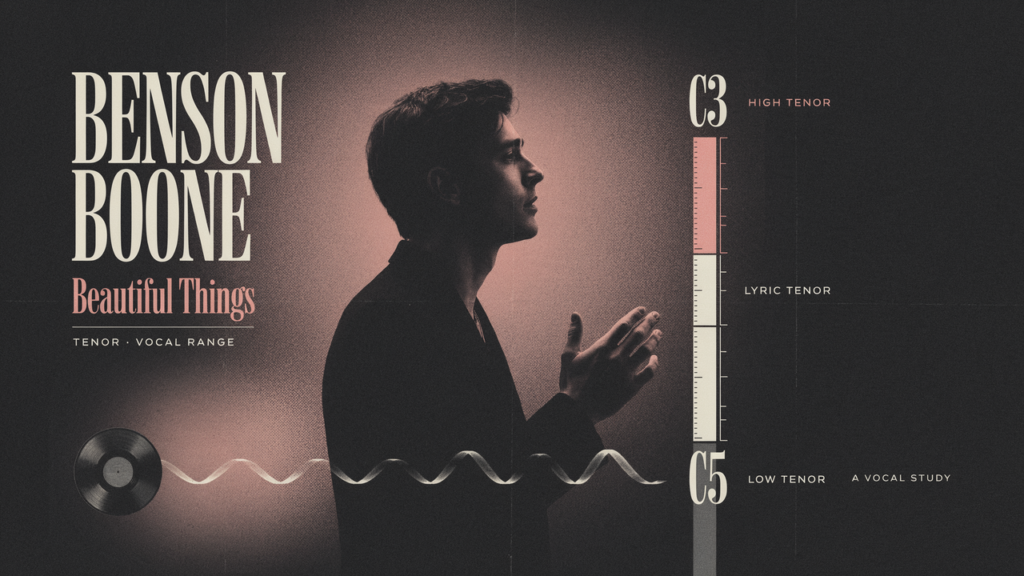
The Quick Answer (What People Mean by “His Range”)
Most people searching this want three things:
- his lowest note
- his highest note
- how many octaves that covers
That’s fair — but here’s the coaching truth:
Benson’s signature isn’t just range. It’s repeatable high tessitura.
He spends a lot of time singing in the upper part of the male voice, and he does it with coordination, not brute force.
If you’re new to this topic, start with what vocal range means so you don’t get trapped by random octave numbers online.
What Voice Type Is Benson Boone?
Benson is most often described as a tenor, and that’s a reasonable label based on how his songs sit.
Why he reads as a tenor
He frequently sings with:
- a high, bright tone
- choruses that live in the upper midrange
- a mix-dominant approach rather than chest-heavy belting
Why some people think he’s “not really that high”
Modern pop production can blur reality:
- doubled vocals
- stacked harmonies
- tuned sustain
- compressed dynamics
That doesn’t mean he can’t sing it — it means the studio version may sound more “perfect” than any human performance.
If you want a clear overview of how classification works, your voice types guide is the best place to ground this discussion.
Range vs Tessitura: Why His Songs Feel So Hard
This is the most important section for singers.
Range is the total span of notes you can hit once.
Tessitura is where you can sing comfortably for an entire song.
Benson Boone songs often sit in a tessitura that is:
- high
- sustained
- emotionally intense
That’s why they feel hard even for singers who “technically” have the notes.
To understand this properly, your article on what tessitura is is a perfect companion.
Why Benson Boone Sounds So High (Even When the Notes Aren’t Extreme)
A lot of singers assume his voice is “just naturally high.” Some of it is, but most of what you’re hearing is technique.
He uses a bright mix
His choruses often sit in a mix that stays:
- forward
- energized
- narrow enough to ring
- not heavy enough to strain
He modifies vowels early
This is one of his biggest secrets.
Most singers try to keep vowels the same as they go higher. Benson-style singing requires small vowel changes so the voice stays free.
A simple analogy:
Trying to sing high with a heavy vowel is like running uphill in boots.
Modifying vowels is like switching to running shoes.
He controls intensity (even when it sounds huge)
The emotional delivery is intense, but the vocal setup is usually not “max volume.” He often starts phrases softer and lets them bloom.
That’s why it feels dramatic without sounding like shouting.
Use the vibrato control tool to track improvement over time.
A Practical Breakdown of How His Voice Works
Because Benson is a modern pop singer, the most useful way to talk about his range is by zones rather than obsessing over one “highest note ever.”
Benson Boone singing zones table
| Zone | What it sounds like | What he’s likely doing | What singers should copy |
|---|---|---|---|
| Low range | Breathier, intimate | Light chest voice | Don’t over-darken |
| Mid range | Clear, emotional | Chest/mix balance | Clean vowels and phrasing |
| Upper midrange | Big, ringing | Strong mixed voice | Vowel modification + twang |
| High peaks | Bright, intense | Mix into head coordination | Keep it light, not shoved |
| Falsetto moments | Airy or sweet | Falsetto/head voice | Control air and tuning |
This is also why using a visualization tool can help. If you want to see where notes land on a keyboard, your vocal range chart makes it easier to understand what “high” actually means.
Step-by-Step: How to Sing Benson Boone Choruses Without Strain
If you want to sing his music, don’t start by copying the final chorus at full intensity. That’s how people blow out their voices.
Here’s the coach-approved progression.
Step 1: Map your comfortable range first
Before you attempt any Benson song, you need your baseline.
Use your vocal range calculator to find:
- your lowest comfortable note
- your highest comfortable note
- your stable “everyday” singing zone
Step 2: Choose the key based on the chorus
The chorus is where Benson songs live. Pick the key where the chorus sits in your best tessitura.
If you choose the original key and it sits too high, you’ll either:
- squeeze
- go flat
- shout
- or flip into weak falsetto
Lowering the key is not cheating. It’s smart musicianship.
Step 3: Practice the chorus at 60% intensity
Sing it like a rehearsal, not a performance.
You’re training coordination:
- clean onset
- stable vowel
- consistent pitch
Once that’s stable, intensity becomes safe.
Step 4: Use vowel modification (the real secret)
If you’re singing “eh” or “ee” vowels high, you will almost always need to slightly round them.
Examples:
- “eh” can lean toward “uh”
- “ee” can lean toward “ih” or “oo”
- “ah” can lean toward “aw”
This keeps the throat open and prevents squeezing.
Step 5: Add brightness with resonance, not force
If the chorus needs more cut, don’t push volume.
Instead:
- aim the sound forward
- keep the vowel focused
- keep the breath steady
If you want a full breakdown of this skill, your how to sing high notes page fits perfectly here.
One Numbered List: A 6-Minute Benson-Style High Mix Drill
Do this gently. Stop if you feel pain, burning, or hoarseness.
- Lip trills up to the top of your comfortable range (1 minute)
- “Mum” on a 5-note scale in the upper midrange (1 minute)
- “Nay” (bright, light) at low volume (1 minute)
- Slide from chest into mix on “noo” (1 minute)
- Sing the chorus melody softly (1 minute)
- Sing it again with emotion but the same vocal setup (1 minute)
This teaches you the most important skill: intensity without strain.
If you want a consistent warm-up before doing this, your vocal warm-up exercises page is a great foundation.
Quick Self-Check: Can You Actually Sing This Song Comfortably?
This is the fastest way to avoid vocal damage and frustration.
H3: The 90-second chorus test
Sing the chorus three times:
- soft
- medium
- slightly louder
If the third time feels tight or your pitch drops, the key is too high for your current tessitura.
Then sing it one whole step lower. If it suddenly feels easy and more in tune, you’ve found the right key for your voice today.
H3: Pitch stability check
Benson’s style is exposed. If your pitch wobbles, it will sound like strain even if you’re not actually straining.
This is where your pitch accuracy analyzer is extremely useful, because it helps you separate emotion from pitch control.
One Bullet List: Why Benson Boone Songs Feel “Hard” to Sing
This isn’t in your head. His songs are genuinely challenging.
- High tessitura for long stretches
- Emotional intensity that tempts you to oversing
- Choruses that require stable mixed voice
- Vowels that must be modified early
- Long sustained notes that expose pitch drift
- Big dynamic builds that require breath pacing
- Modern production that makes the studio version sound effortless
Common Mistakes When Singing Like Benson Boone
Mistake 1 — pushing chest voice too high
This is the #1 issue.
If you try to carry heavy chest voice into the chorus, you’ll either strain or go flat. Benson’s choruses are usually mix-dominant.
Mistake 2 — keeping vowels too wide
Wide vowels make the voice feel “stuck.” If you don’t modify vowels, the throat tightens as you go up.
The fix is subtle. You’re not changing the word — you’re adjusting the shape.
Mistake 3 — singing the climax at full volume too early
You need to earn intensity.
Train the chorus softly first. Then add emotion. Then add volume.
H3: Mistake 4 — using falsetto as an escape hatch
Falsetto can work stylistically, but if you flip because you can’t mix, the chorus will sound weak.
A stronger plan is to build mix gradually and keep falsetto as a choice, not a panic button.
Mistake 5 — ignoring fatigue signs
If your voice feels scratchy after practice, your body is telling you something.
Don’t “push through.” Rest, hydrate, and reduce intensity next session. Your vocal health tips page is a good safety reference if you’re unsure what warning signs look like.
Realistic Expectations (The Truth That Helps You Improve)
Benson Boone is a naturally gifted singer, but his sound is also the result of:
- smart key choices
- trained coordination
- efficient mix
- strong pitch control
- controlled intensity
If you’re not there yet, that’s normal.
Your goal isn’t to hit his highest note. Your goal is to sing your chorus cleanly, in tune, with a free throat — and then gradually expand your comfort zone over time.
That’s how real singers improve.
FAQs
1) What is Benson Boone’s vocal range?
Benson Boone is known for a wide range with a high male tessitura and strong mixed voice. Exact lowest and highest notes vary by song and performance. The more consistent takeaway is that he sustains a high tessitura comfortably, which is harder than simply “hitting a high note.”
2) How many octaves does Benson Boone have?
He’s often credited with multiple octaves, but octave numbers can be misleading without context. Modern production and live variation can change what people count. For singers, it’s more useful to focus on his tessitura and the notes he repeats across choruses.
3) Is Benson Boone a tenor or baritone?
He is most commonly described as a tenor based on where his songs sit and how he approaches high choruses. Some baritones can sing his songs, but they usually need key changes. Voice type is better judged by tessitura than by one extreme note.
4) Does Benson Boone use falsetto?
Yes, he can use falsetto or head-voice coordination, but much of his “big chorus” sound is mixed voice. That’s why his high notes still sound strong and emotional. Falsetto is usually a stylistic color, not the main engine.
5) Why do Benson Boone songs feel so high to sing?
Because they often sit in a sustained upper tessitura rather than giving you lots of rest in the midrange. The choruses are also emotionally intense, which makes singers oversing. Add modern pop production, and the original recording can feel deceptively effortless.
6) Can baritones sing Benson Boone songs?
Yes — but usually not comfortably in the original key. Lowering the key by a step or two can make the chorus sit in a healthier tessitura. A good performance is about control and emotion, not matching the exact pitch level.
7) How can I sing his high notes without straining?
Train mixed voice first at low volume, then add intensity gradually. Modify vowels earlier than you think, and avoid pushing chest voice upward. If your throat feels tight, lower the key and focus on clean, repeatable coordination.

John Mayer is a vocal analysis and music education writer specializing in vocal range testing, voice type analysis, pitch recognition, and singing improvement tools for singers, musicians, performers, and beginners. He creates practical content focused on vocal training, singing techniques, and voice analysis tools to help users better understand and improve their vocal abilities.