
Eddie Vedder’s vocal range refers to the lowest and highest notes he sings across Pearl Jam recordings and live performances. He’s known for a dark, baritone-leaning tone, gritty distortion, and chest-dominant rock belting. Exact range numbers vary, so the most accurate view separates his usable tessitura from occasional extreme highs and lows.
If you’re searching this because you want a simple “range number,” you’ll find plenty online. But if you’re a singer, the real value is understanding how he uses his range, why his voice sounds so big, and how to train that style without wrecking your throat.
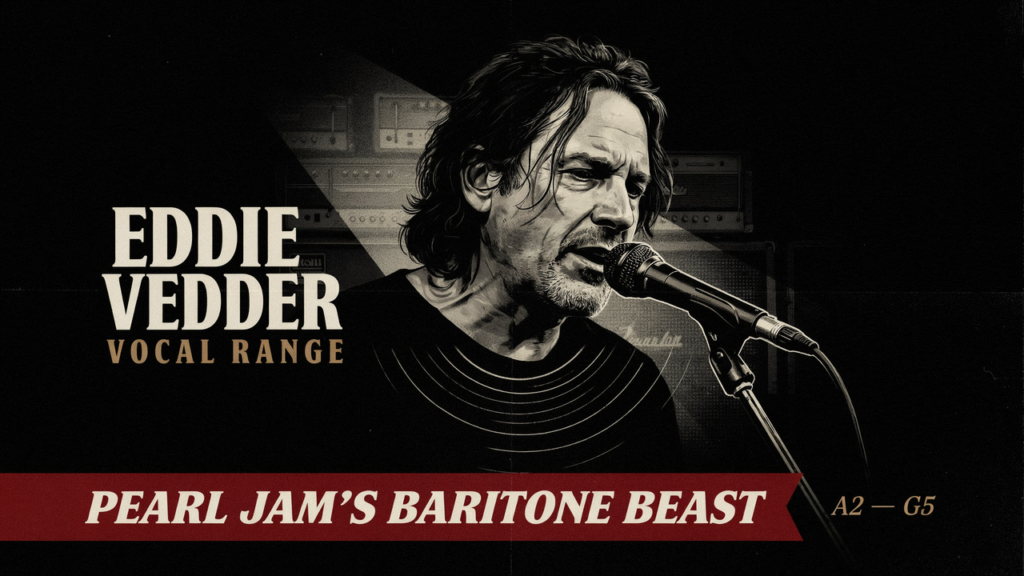
Eddie Vedder’s Voice in One Sentence
Eddie Vedder is a baritone-leaning rock vocalist who sings like a storyteller: heavy midrange, strong chest coordination, and controlled grit layered on top of a solid, centered pitch.
That combination is why he sounds instantly recognizable—even when he’s not singing high.
If you want the basics before diving deeper, start with what vocal range means so you don’t get trapped in “highest note obsession.”
Range vs Tessitura: The Key to Understanding Eddie Vedder
Range is the extremes
Range is the lowest note to the highest note a singer can produce—sometimes only briefly.
Tessitura is where the singing actually happens
Tessitura is the zone where a singer can perform full phrases repeatedly with control, tone, and stamina.
Eddie Vedder’s power isn’t that he has a freakish top end. It’s that his tessitura is strong and thick, and he can live there for an entire set.
If you want to understand how notes and octaves are labeled correctly, vocal range notes will save you from a lot of internet misinformation.
The key analysis tool is helpful for arranging harmonies.
Is Eddie Vedder a Baritone or a Tenor?
This question shows up constantly, and it’s a good one.
Most singers and coaches would describe Eddie as baritone-leaning, but with enough upper extension to confuse people. In modern terms, you could call him a “baritenor,” but that label can be more confusing than helpful.
Here’s the practical truth:
- His voice sounds naturally dark.
- His comfortable zone sits lower than most classic rock tenors.
- His high notes are often chest-dominant and gritty, not bright and clean.
If you want a solid framework for classification, voice types gives you the real criteria (tessitura and behavior, not just tone).
And if you want to compare the categories clearly, tenor vs baritone is the most useful breakdown for this exact debate.
Why Eddie Vedder Sounds So Dark and Powerful
A lot of singers assume Eddie’s sound is “just genetics.” Genetics matter, but his sound is also built on technique and style choices.
1) He uses heavier vocal weight
He sings with a thick, chest-based tone for much of his range. That creates the “big rock voice” feeling.
2) His vowels are often rounded and covered
This makes the sound darker and more dramatic, especially in sustained notes.
3) He uses controlled edge (twang) underneath the darkness
This is important. Without a little edge, a dark sound becomes muddy.
Think of it like coffee:
Dark roast without brightness tastes flat.
Dark roast with a little acidity tastes powerful.
The Grit Question: How Eddie Vedder Sings Raspy
Eddie’s grit is one of the biggest reasons people want to copy him.
But grit is also one of the fastest ways to injure yourself if you do it wrong.
What grit should feel like
Healthy distortion feels like texture on top of a stable tone, not like squeezing the throat.
What grit should NOT feel like
If you feel:
- burning
- sharp pain
- sudden loss of voice
- increased hoarseness the next day
That’s not “rock.” That’s your body warning you.
A safe way to think about it:
Clean tone is the engine.
Distortion is the paint job.
If you don’t have the engine, the paint doesn’t matter.
Eddie Vedder’s Real Strength: Rock Belting in a Baritone-Friendly Zone
Eddie belts, but not like a bright tenor belter.
He belts with:
- darker vowels
- thick chest coordination
- controlled grit
- strong emotional intensity
This is why many baritones love his songs. His melodies often sit in a range that feels more reachable than classic high-rock repertoire.
If you want context for where baritones usually sit, baritone vocal range helps you understand why his style feels “baritone-friendly.”
Step-by-Step: How to Train Eddie Vedder Style Without Hurting Your Voice
This is the coaching section. Don’t rush it.
Step 1: Build a clean tone first (no grit)
Before you add rasp, you need to be able to sing the same phrase cleanly with:
- stable pitch
- steady airflow
- relaxed jaw
If you can’t sing it clean, grit will only hide problems and increase strain.
Step 2: Find your “rock speaking pitch”
Speak a line like you’re telling a story with intensity:
“This is my voice. This is my truth.”
Now sing it on one pitch without getting louder.
That pitch is often close to your best rock tessitura.
Eddie’s power lives here—not in extreme notes.
Step 3: Learn controlled intensity without pushing volume
Many singers try to sound intense by singing louder.
Eddie often sounds intense because of:
- tone weight
- vowel shape
- phrasing
- grit texture
Not raw volume.
Step 4: Lighten slightly as you go higher
This is where most singers fail.
Eddie’s high notes may sound thick, but there is usually a subtle shift:
- a bit more resonance focus
- a bit less brute-force chest
- slightly narrower vowels
If you try to drag full chest upward, you’ll hit a wall fast.
If you need a safe framework for upper range, how to sing high notes is the healthiest path.
Step 5: Add “edge” before you add “ASP (Angry Squeeze Pressure)
If you want rock tone, you need edge. But edge is not squeeze.
A safe edge cue:
Say “hey!” like you’re getting someone’s attention across the street—firm, not yelled.
Then sing a short phrase with that same “ping.”
Step 6: Add grit last—and only lightly
If you add grit, it should be a small amount.
Start with 10% grit, not 80%.
If you can’t control it lightly, you can’t control it at all.
A Simple Eddie Vedder Practice Routine (Numbered List)
Use this 10–15 minute routine 4 days a week:
- Warm up with gentle hums and lip trills for 2 minutes
- Sing 5-note scales on “mum” in your comfortable midrange
- Repeat on “yeah” with clear, forward tone (not loud)
- Practice one chorus phrase cleanly at 70% volume
- Narrow the vowel slightly as you go higher
- Add a small amount of edge (not grit)
- If everything feels easy, add 5–10% rasp for 2–3 repetitions only
This routine builds the real foundation: control first, texture second.
One Bullet List: What Makes Eddie Vedder’s Style Work
- Thick midrange coordination (chest-dominant)
- Dark vowels that create weight and drama
- Forward resonance so the sound doesn’t get muddy
- Strong phrasing that feels like storytelling
- Controlled grit layered on top of clean tone
- Emotional intensity without constant yelling
If you want to measure your own range and see where your comfortable zone sits, the vocal range calculator can help you choose better keys.
Quick Self-Check: Are You Singing This Style Safely?
After practicing a rock chorus, ask yourself:
- Can I repeat it 3 times without tightening?
- Does my throat feel normal 30 minutes later?
- Am I getting intensity from tone and phrasing—not shouting?
- Are my high notes stable, not squeezed?
- Is my rasp optional (I can turn it off)?
If you can’t turn the rasp off, it’s probably tension, not technique.
If you want objective feedback on pitch stability, a pitch accuracy analyzer is a great reality check—especially when grit makes your ears less reliable.
Common Mistakes When Trying to Sing Like Eddie Vedder
Mistake 1: Creating rasp by squeezing the throat
This is the #1 injury pattern in rock singing.
If the rasp comes from tightness, it will get worse the longer you sing.
Mistake 2: Over-singing every phrase at full intensity
Eddie’s performances feel intense, but he still uses dynamics.
If you sing everything at 100%, you lose stamina and pitch control.
Mistake 3: Dragging chest voice too high
This is where singers blow out their voices.
The fix is not “push harder.”
The fix is better vowel strategy and a subtle mix shift.
Mistake 4: Making the tone too dark
Dark is great, but too dark becomes swallowed and pitchy.
You need a little brightness under the darkness so the voice stays focused.
Mistake 5: Ignoring fatigue signals
If your voice gets hoarse, that’s not “progress.”
Hoarseness is usually swelling or irritation. Respect it.
Table: Range vs Tessitura vs Rock Belt Zone
| Concept | What it means | How it applies to Eddie Vedder |
|---|---|---|
| Total range | Lowest to highest possible notes | Interesting, but not the main story |
| Tessitura | Comfortable performance zone | His real strength and signature sound |
| Rock belt zone | Where choruses sit for intensity | Chest-dominant with controlled edge |
| Distortion layer | Texture added to tone | Works only when the clean tone is stable |
This is why Eddie Vedder is a great singer to study: he’s not a “highest note” vocalist. He’s a control and character vocalist.
Final Coach Take
Eddie Vedder’s vocal range is only part of what makes him great.
His real mastery is:
- a strong baritone-leaning tessitura
- thick, controlled rock belting
- grit that enhances the tone instead of destroying it
If you train the style the smart way—clean first, edge second, grit last—you can capture the vibe without paying for it with your vocal health.
FAQs
1) What is Eddie Vedder’s vocal range?
Eddie Vedder’s range is usually described as moderate-to-wide for a rock singer, with a strong low-to-mid focus. Exact lowest and highest notes vary depending on the song and whether you use studio or live performances. The more important point is his powerful tessitura and stamina in that zone.
2) Is Eddie Vedder a baritone or tenor?
He’s most often considered baritone-leaning because of his darker tone and where he sings comfortably. Some people call him a “baritenor” because he can reach higher rock notes when needed. In practical terms, his voice behaves more like a baritone with strong upper extension.
3) What is Eddie Vedder’s highest note?
His highest notes are typically delivered with a chest-dominant rock approach, often with grit. The exact note depends on the song and performance. What matters for singers is that he uses vowel strategy and resonance focus to avoid pure throat pushing.
4) What is Eddie Vedder’s lowest note?
His low notes tend to be strong and grounded, but they’re usually used musically rather than as “super-low flex” notes. Low notes in rock can be hard to measure because of microphone and mix effects. His low end is more about tone and character than extreme depth.
5) How does Eddie Vedder sing with rasp?
His rasp is best understood as controlled distortion layered on top of a stable tone. Healthy rasp should not feel painful, burning, or tight. If you can’t turn it off easily, you’re likely using tension instead of technique.
6) Did Eddie Vedder damage his voice from singing gritty?
Over a long career, many rock singers experience changes from touring, fatigue, and vocal load. That doesn’t automatically mean “damage,” but it does show why smart technique matters. The safest approach is to treat grit as optional and keep clean singing as your foundation.
7) Can I learn to sing like Eddie Vedder safely?
Yes, you can learn the principles: strong midrange, controlled edge, clear phrasing, and light distortion on top of clean tone. Start with clean singing, then add intensity without yelling, and only add grit in small doses. If you feel pain or persistent hoarseness, back off and reset.

John Mayer is a vocal analysis and music education writer specializing in vocal range testing, voice type analysis, pitch recognition, and singing improvement tools for singers, musicians, performers, and beginners. He creates practical content focused on vocal training, singing techniques, and voice analysis tools to help users better understand and improve their vocal abilities.