
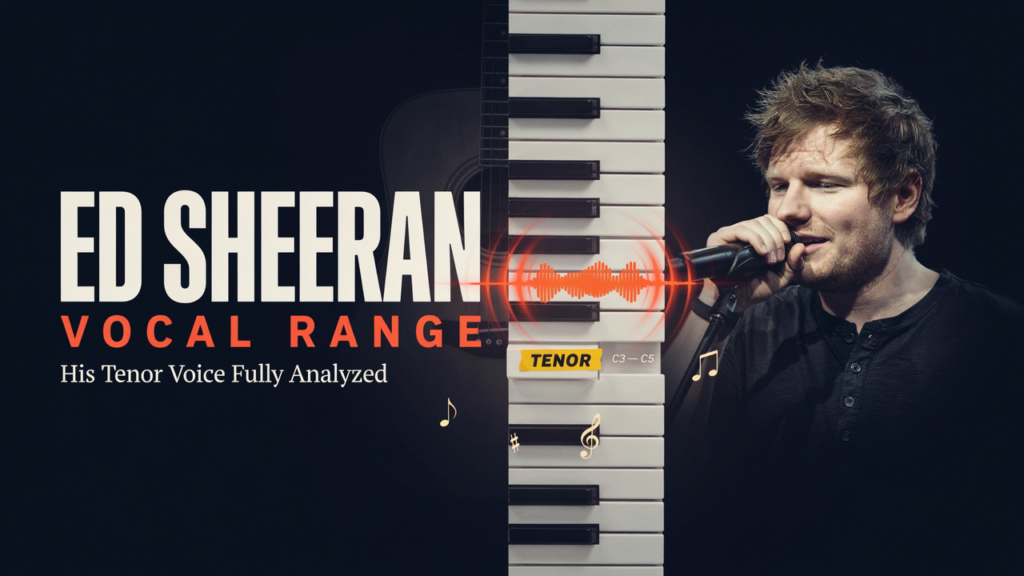
Ed Sheeran’s vocal range refers to the lowest and highest notes he sings across recordings and live performances. While his total range is often described as moderate-to-wide, his real strength is a comfortable midrange tessitura, clean pitch control, and smooth use of mix and falsetto. Range numbers vary by song and performance.
If you searched this because you want a quick “range number,” you’ll find plenty online. But if you’re a singer, the more important question is:
Why do Ed Sheeran songs feel so high and exposed even when they don’t sound “big”?
That’s what we’ll tackle—practically, like a real coach.
Ed Sheeran’s Voice in One Sentence
Ed Sheeran is a clean, mix-dominant pop tenor-leaning vocalist who relies more on pitch accuracy, vowel control, and phrasing than on big belting or extreme high notes.
His voice is a great example of this truth:
Soft singing is not easy singing.
If you want a clear foundation before we go deeper, start with what vocal range means.
Range vs Tessitura: Why Ed’s Songs Feel High
Range is the extremes
Range is the lowest and highest notes you can make, even briefly.
Tessitura is where you can actually sing
Tessitura is the part of your voice where you can sing full phrases with control, repeat them, and still sound good.
Ed Sheeran’s songs often live in a tessitura that sits right in the “mix zone” for many singers—especially men.
That mix zone is where singers tend to:
- push chest voice too far
- flip too early
- go flat from breathiness
If you ever get confused by note names and octaves, vocal range notes will make the rest of this much easier to understand.
Is Ed Sheeran a Tenor or Baritone?
This is one of the most searched questions about his voice.
In practical pop terms, Ed is tenor-leaning, but not a bright, theatrical tenor. His tone is often warm and conversational, which makes some people assume baritone.
Here’s the coaching truth:
- Tone color (warm/dark/bright) is not the same as voice type.
- Voice type is better predicted by tessitura and passaggio behavior.
Ed’s comfortable melodic zone and the way he navigates higher phrases point more toward tenor than baritone.
If you want a solid framework for classification, voice types explains it without the common myths.
And if you want context for where tenors usually sit, tenor vocal range gives a practical reference point.
Why Ed Sheeran Sounds So “Easy” (But Is Hard to Copy)
Ed’s style can sound simple: clean tone, smooth lines, gentle dynamics.
But this style is brutally honest because it exposes everything.
1) His pitch has to be clean
There’s no loud belt hiding the pitch.
2) His breath has to be stable
Breathy singing often goes flat. Ed stays centered.
3) His vowels are consistent
His tone doesn’t wobble wildly between “eh,” “ah,” and “uh.”
4) His phrasing is conversational
He sings like he’s talking, but with musical control.
Think of it like drawing with a pen instead of a pencil.
With pencil, you can shade and hide mistakes.
With pen, every line is visible.
That’s Ed’s vocal style: clean pen lines.
The key finder for singers makes it easier to choose a comfortable range.
Does Ed Sheeran Use Falsetto?
Yes—Ed uses falsetto and lighter head-dominant sounds in certain moments, especially for contrast and emotion.
But here’s the important part:
Ed doesn’t use falsetto as a “panic button.”
He uses it as a color.
That’s why it sounds musical instead of weak.
A lot of singers make the mistake of flipping into falsetto because their mix isn’t trained yet. That creates an obvious gear change.
Ed’s transitions are usually smoother because his mix coordination is solid.
If you want to compare your voice to typical male ranges (and stop guessing), the vocal range chart is a helpful reference.
The Real Challenge in Ed Sheeran Songs (And Why People Struggle)
Most singers don’t struggle because Ed sings extremely high.
They struggle because:
1) The songs sit in a “thin ice” zone
Many choruses hover where chest voice starts to feel heavy, but full falsetto feels too weak.
That middle zone requires coordination, not effort.
2) The vocal is exposed
Ed’s production often leaves space. You can’t hide behind a wall of sound.
3) The melodies are repetitive
If your technique is inefficient, repetition will fatigue you fast.
4) The pitch standard is high
Modern pop demands clean tuning. Small pitch drift is obvious.
If you want objective feedback on how stable you are, a pitch accuracy analyzer can show you what your ears miss—especially when you’re focused on guitar.
Step-by-Step: How to Sing Ed Sheeran Songs Without Strain
This is the part that actually makes you better.
Step 1: Pick the right key first
Ed’s original keys are not sacred.
If you feel like the chorus sits “just a little too high,” that’s a huge red flag. That’s where singers start pushing.
Lowering the key by even 1–2 semitones can turn strain into control.
Step 2: Train a light mix, not a heavy chest
Ed’s choruses usually need a mix-dominant sound.
If you try to muscle them in full chest, you’ll:
- tighten
- go sharp
- fatigue quickly
A good cue:
Sing the chorus like you’re speaking confidently, not like you’re yelling.
Step 3: Keep the vowels narrow on higher notes
Most singers go wide as they go up (“AAAH!”).
Ed often keeps vowels more speech-like and slightly narrower.
This helps the vocal folds stay efficient and keeps pitch stable.
Step 4: Don’t let breathiness become your default
A little breath can be stylistic.
But too much breath makes:
- pitch unstable
- tone weak
- high notes harder
If you hear yourself getting airy as the chorus rises, you’re probably leaking too much air.
Step 5: Use micro-dynamics, not big volume
Ed gets emotion through phrasing and lyric intention.
He doesn’t need huge volume swings.
Think of it like acting for a camera, not acting on a theater stage.
Small choices read bigger up close.
A 10-Minute Ed Sheeran Practice Routine (Numbered List)
Use this routine 4–5 days a week:
- Hum gently for 60 seconds, then do a light siren (no pushing)
- Sing 5-note scales on “mum” in your comfortable midrange
- Repeat on “nee” to build forward clarity without shouting
- Sing the chorus melody on “doo” at 60% volume
- Add lyrics and keep the same easy feeling
- Practice the chorus twice more, staying relaxed
- Finish by singing one verse like spoken storytelling
This builds what Ed’s style demands: clean pitch, efficient mix, and stable vowels.
One Bullet List: What Makes Ed Sheeran’s Singing Work
- Strong midrange tessitura (songs sit where his voice is comfortable)
- Clean pitch and controlled breath
- Smooth mix coordination instead of heavy belting
- Consistent vowels and clear diction
- Conversational phrasing that feels natural
- Emotional delivery without oversinging
If you want to find your own range and match songs more intelligently, the vocal range calculator is the fastest way to stop guessing.
Quick Self-Check: Can You Sing Ed Sheeran Comfortably?
After singing a chorus, check these:
- Can you sing it twice without tightening?
- Does your jaw stay loose on “ee” and “ay” vowels?
- Do you stay in tune when you get softer?
- Does your voice feel normal 30 minutes later?
- Can you choose to sing clean OR slightly airy?
If you can’t repeat the chorus without fatigue, you’re likely in the wrong key or pushing chest too high.
If you want to verify your highest and lowest comfortable notes, the pitch detector is a simple tool for that.
Common Mistakes When Covering Ed Sheeran
Mistake 1: Singing too breathy and going flat
This is extremely common.
Breathiness feels easy at first, but it often causes pitch problems and vocal fatigue.
Mistake 2: Trying to belt the chorus like a rock singer
Ed’s choruses aren’t usually belt choruses.
If you treat them like belting workouts, you’ll strain fast.
Mistake 3: Dragging chest voice too high
This is the classic “just one more note” trap.
That’s where singers start squeezing the throat instead of coordinating mix.
Mistake 4: Not modifying vowels on high notes
Wide vowels are the enemy of clean pop singing.
A tiny vowel adjustment can make a high note 5x easier.
Mistake 5: Practicing only at full speed
Ed’s lines sound simple, but they require precision.
Slow practice reveals where you lose pitch, breath, or vowel stability.
Table: Ed Sheeran Technique vs What You Should Train
| What you hear in Ed’s voice | What it actually is | What to practice |
|---|---|---|
| “Easy” high choruses | Efficient mix coordination | Light mix and vowel control |
| Smooth tone | Stable breath + clean onset | Gentle, consistent airflow |
| Emotional softness | Micro-dynamics | Phrase shaping, not volume |
| Clean pitch | Strong internal tuning | Slow practice + pitch feedback |
| Falsetto moments | Color choice | Controlled transitions |
This table is the shortcut: don’t chase his tone first—train the mechanics that make his tone possible.
Final Coach Take
Ed Sheeran’s vocal range matters less than how he uses it.
His real superpower is:
a comfortable tessitura, clean pitch, and smooth mix coordination that lets him sing exposed melodies night after night.
If you want to sing Ed Sheeran songs well, don’t try to sound “bigger.”
Try to sound cleaner, steadier, and more controlled.
That’s the real Ed Sheeran skill.
FAQs
1) What is Ed Sheeran’s vocal range?
Ed Sheeran’s range is generally described as moderate-to-wide, but exact note numbers vary depending on the song and performance. His most consistent strength is his midrange tessitura and clean delivery. For singers, that’s more important than the single highest note.
2) Is Ed Sheeran a tenor or baritone?
He’s typically considered tenor-leaning in pop terms, mainly based on where his melodies sit comfortably. His warm tone can make people assume baritone, but tone color isn’t the same as voice type. Tessitura and passaggio behavior are better indicators.
3) What is Ed Sheeran’s highest note?
His highest notes are usually delivered with a light mix or falsetto rather than a heavy belt. Different songs and performances show different extremes. What matters most is that he stays controlled and doesn’t sound strained.
4) Does Ed Sheeran use falsetto?
Yes, Ed uses falsetto in certain moments for contrast and emotional color. He tends to blend it smoothly so it doesn’t sound like a sudden flip. The key is that his falsetto is a choice, not an emergency escape.
5) Why do Ed Sheeran songs feel high?
Many of his choruses sit in the mix zone where singers either push chest voice too far or flip too early. His clean, exposed style also makes pitch and vowel issues more obvious. A small key change often makes a huge difference.
6) Can baritones sing Ed Sheeran songs?
Yes, but many baritones will need to lower the key slightly for comfort. Trying to force the original key often leads to pushing and fatigue. The goal is control and tone, not matching the exact recording.
7) What’s the safest way to sing Ed Sheeran choruses?
Start in a comfortable key, sing at 70% volume, and build a light mix before adding intensity. Keep vowels slightly narrower as you go higher and avoid breathy leaking. If your throat feels tight or tired afterward, back off and adjust the key.

John Mayer is a vocal analysis and music education writer specializing in vocal range testing, voice type analysis, pitch recognition, and singing improvement tools for singers, musicians, performers, and beginners. He creates practical content focused on vocal training, singing techniques, and voice analysis tools to help users better understand and improve their vocal abilities.