
Ella Fitzgerald’s vocal range refers to the full span of notes she could sing from her lowest pitch to her highest, across chest voice, head voice, and lighter jazz-style coordinations used in scat. She’s widely credited with a range of roughly three octaves, but her true superpower was control, agility, and a comfortable midrange tessitura.
If you came here for one simple answer: Ella is often estimated at about a 3-octave range, with a voice that sits comfortably in the middle but can float impressively high—especially in scat passages.
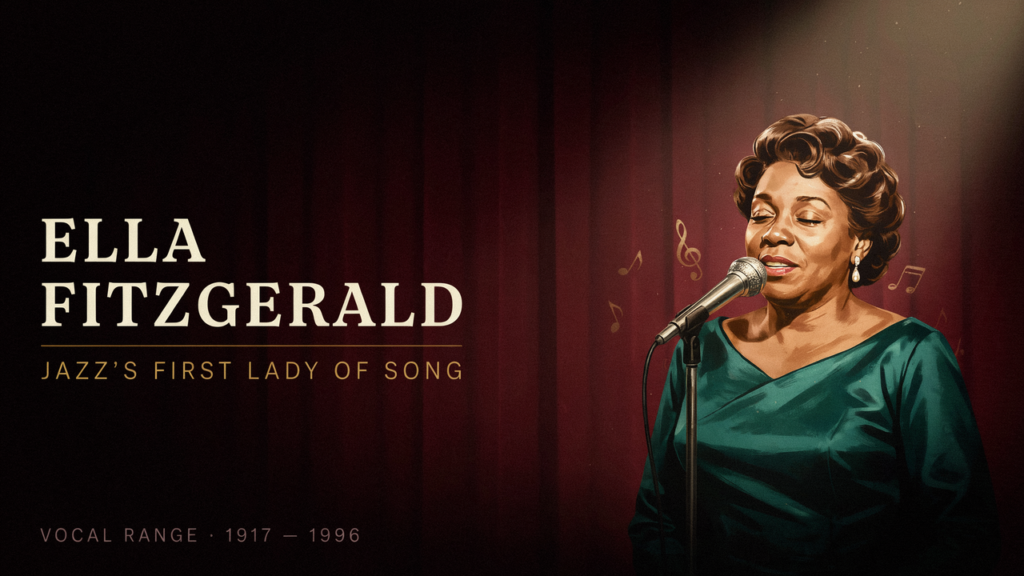
What Made Ella’s Range Special (It Wasn’t Just “High Notes”)
A lot of singers chase range like it’s a trophy. Ella’s voice teaches a better lesson: range only matters if it’s usable in music.
She could sing low, but she didn’t live there. She could sing high, but she didn’t force it. Her “wow” factor came from three things working together:
- A stable, effortless middle
- A flexible upper register
- Agility that stayed clean at speed
If you’re still learning how range works, start with what vocal range means so you don’t confuse “one-time notes” with real singing range.
If you’re covering a song, the key detection tool saves a lot of time.
Range vs Tessitura: The One Concept That Explains Everything
People argue about Ella’s voice type because they confuse range with tessitura.
Vocal range
This is the total distance from your lowest note to your highest note.
Tessitura
This is the part of your voice where you can sing for a long time with:
- stable tone
- good pitch
- relaxed effort
Ella’s tessitura sat in a comfortable, warm midrange, which is why her singing sounds so conversational and free.
If you want the clean definition and how it’s used in real classification, see what tessitura is.
What Voice Type Was Ella Fitzgerald?
Here’s the honest, coach-style answer: Ella doesn’t fit neatly into one box.
She’s often described as:
- contralto (because of her warmth and depth)
- mezzo-soprano (because of her flexibility and upper range)
In practical terms, Ella sang like a mezzo-leaning contralto in jazz: warm in the middle, strong enough down low, and extremely capable up top when she used lighter coordination.
Why the label debate exists
Classical voice type labels are built around operatic demands: projection, sustained high notes, and long phrases over an orchestra.
Ella’s world was different. Jazz rewards:
- tone color
- agility
- phrasing
- rhythmic precision
- improvisation
So the best way to understand her isn’t “What box is she?” but “How did she use her voice?”
For a broader guide to classification, voice type categories will help you make sense of the terms.
A Practical “Ella Range” Map You Can Actually Use
Instead of obsessing over one “highest note,” it’s more helpful to map her voice into zones.
This table gives you a singer-friendly way to think about it.
| Zone | What it sounds like | What Ella did well here | What you should copy |
|---|---|---|---|
| Low register | warm, grounded | used sparingly, never forced | relaxed low tone, not breathy |
| Midrange (home base) | clear, rich, speech-like | most melodies sit here | phrasing + pitch stability |
| Upper register | bright, floating | used for climaxes and scat | lighter coordination, clean vowels |
| High extension (scat) | agile, flute-like | fast runs and jumps | speed + precision, not volume |
This is also why many listeners feel like her range is even bigger than it is: her upper register was so clean that it sounded effortless.
If you want to understand note naming and octave labeling clearly, how vocal range notes are labeled makes it much easier.
Why Scat Singing Makes Her Range Seem Huge
Scat is basically vocal improvisation using syllables instead of lyrics. It often includes:
- fast pitch jumps
- wide intervals
- playful vowels
- light, high coordination
Here’s the key: scat is usually sung with less vocal weight. That’s why Ella could move quickly and go high without sounding strained.
Think of it like this:
- Singing a belted high note is like lifting a heavy suitcase.
- Singing a light scat line is like tossing a tennis ball.
Both can go high. One requires brute force. The other requires coordination.
Step-by-Step: How to Train “Ella-Style” Range (Safely)
You’re not trying to copy Ella’s exact voice. You’re training the skills behind it: freedom, agility, and clean register shifts.
Step 1: Build a stable midrange first
If your midrange is shaky, your range will always feel unstable.
Train:
- comfortable scales
- slow melodies
- sustained notes
A fast way to check your midrange stability is using a pitch accuracy test after singing a verse at a comfortable volume.
Step 2: Learn to “lighten” as you go up
Most singers push upward by adding pressure. Ella went up by reducing weight.
A simple rule:
- Higher notes = smaller, cleaner vowels + less heaviness
If your throat tightens above a certain pitch, you’re not “too weak.” You’re carrying too much weight upward.
Step 3: Practice agility on easy syllables
Ella’s agility didn’t come from tension. It came from clarity.
Use syllables like:
- “doo”
- “dee”
- “nah”
- “bop”
Avoid harsh ones at first (like “gah”) because they can make the throat grab.
Step 4: Use short phrases, not long battles
If you train range like a war, you’ll lose your voice.
Instead, train like a jazz musician:
- short runs
- clean starts
- easy releases
- lots of repetition with low effort
If you’re not sure where your current limits are, test your own vocal range so you’re practicing inside your real zone.
Step 5: Add “scat-style” movement
Once your upper register is stable, practice small jumps:
- 1–3–5
- 5–3–1
- 1–5–1
Keep it light. The goal is speed and accuracy, not loudness.
Step 6: Protect your voice like a pro
Ella sang for decades. That only happens with good vocal habits.
If you feel:
- scratchy throat
- sudden hoarseness
- burning sensation
- loss of top notes
Stop and reset. Pushing through is not “training.” It’s damage.
A good reference for keeping your voice reliable is vocal health tips.
One Bullet List: The “Ella Skills” That Matter Most
- Stable pitch in the midrange
- Smooth register transitions
- Fast articulation without jaw tension
- Light upper notes without breathiness
- Rhythmic precision (swing feel)
- Clean vowel shapes on quick runs
One Numbered List: A 10-Minute Ella-Inspired Practice Routine
- 2 minutes: hum lightly on a 5-note scale (easy range)
- 2 minutes: lip trills up and down (no pushing)
- 2 minutes: “doo-doo-doo” on 1–3–5–3–1
- 2 minutes: light “nee” on 1–5–1 (keep it tiny)
- 2 minutes: improvise a simple scat line on 3 notes only
This routine builds range the right way: through coordination, not force.
If your goal is specifically higher notes with less strain, how to sing high notes is the skill bridge between “range” and “control.”
Quick Self-Check: Are You Training Range Like Ella (Or Like a Struggle)?
Use this quick check after practice.
Check 1: Can you repeat your top note 3 times?
If you can’t, it’s probably not a functional note yet.
Check 2: Does your jaw stay loose?
If your jaw locks, you’re trying to “hold” the note with tension.
Check 3: Is your voice normal the next day?
A little tired is okay. Hoarse is not.
Check 4: Can you sing a phrase around the note?
Range is musical. A single squeak doesn’t count.
If you want a structured method for this, measure your range safely and track it over time.
Common Mistakes People Make When Studying Ella’s Range
Mistake 1: Chasing the highest note instead of the cleanest note
Ella’s high notes worked because they were clean, not because they were extreme.
If you sound thin, tight, or unstable, you’re not “doing Ella.” You’re doing panic.
Mistake 2: Singing scat like belting
Scat is usually light and agile. If you try to do it loud, your tongue and throat will stiffen.
Mistake 3: Confusing head voice with breathiness
Light does not mean airy.
A healthy light tone still has:
- pitch clarity
- resonance
- steady airflow
Mistake 4: Skipping the midrange foundation
Ella’s range didn’t float on talent alone. It floated on a strong, controlled center.
Mistake 5: Practicing too long in the upper range
Upper work should be short and clean.
A good guideline: stop before fatigue. That’s how you build coordination instead of strain.
Realistic Expectations: What You Can Learn From Ella (Even If You Don’t Have Her Range)
Ella Fitzgerald was an outlier—one of the most skilled vocal technicians in popular music history.
But you can absolutely develop the same type of skills:
- better agility
- cleaner register shifts
- stronger pitch
- smoother high notes
- more musical phrasing
The goal isn’t to become Ella. The goal is to sing with the same kind of freedom.
If you want a grounded comparison point, it helps to understand the average vocal range so you don’t set unrealistic expectations.
FAQs
1) How many octaves did Ella Fitzgerald have?
Ella is commonly credited with roughly a three-octave range. Exact numbers vary depending on what you count as a “real note” versus a light scat extension. What’s consistent is that she had an unusually flexible upper register and excellent control.
2) What was Ella Fitzgerald’s highest note?
Different recordings and analyses report different peaks, especially in scat passages. The more important point is that her high notes were clean and agile, not forced. If you’re studying her, focus on coordination and ease rather than chasing a single top note.
3) What was Ella Fitzgerald’s lowest note?
Ella could sing low notes with warmth, but she didn’t live in the bottom register. Her music mostly sits in the midrange, where her tone is strongest and most expressive. Low notes should feel relaxed and supported, not breathy.
4) Was Ella Fitzgerald a contralto?
She’s often labeled contralto because of her warmth and comfortable midrange. However, her flexibility and upper extension also fit mezzo-soprano traits. In jazz, voice type is best understood through tessitura and technique, not just range extremes.
5) Did Ella Fitzgerald use whistle register?
Not in the same way modern pop whistle singers do. Some of her very high scat tones can sound “whistle-like,” but they’re usually a light head coordination rather than true whistle register. If you try to imitate those notes, do it softly and stop if your throat tightens.
6) Why does scat singing make her range sound bigger?
Scat often uses lighter syllables, smaller vowels, and quick movements that reduce vocal weight. That lets the voice travel higher and faster with less strain. It’s like sprinting with good technique instead of stomping uphill.
7) How can I train Ella-style agility without hurting my voice?
Start in your comfortable range and practice short, clean patterns on easy syllables. Keep the volume moderate and stop before fatigue. If you feel tightness or hoarseness, reset and focus on lighter coordination rather than more effort.

John Mayer is a vocal analysis and music education writer specializing in vocal range testing, voice type analysis, pitch recognition, and singing improvement tools for singers, musicians, performers, and beginners. He creates practical content focused on vocal training, singing techniques, and voice analysis tools to help users better understand and improve their vocal abilities.