
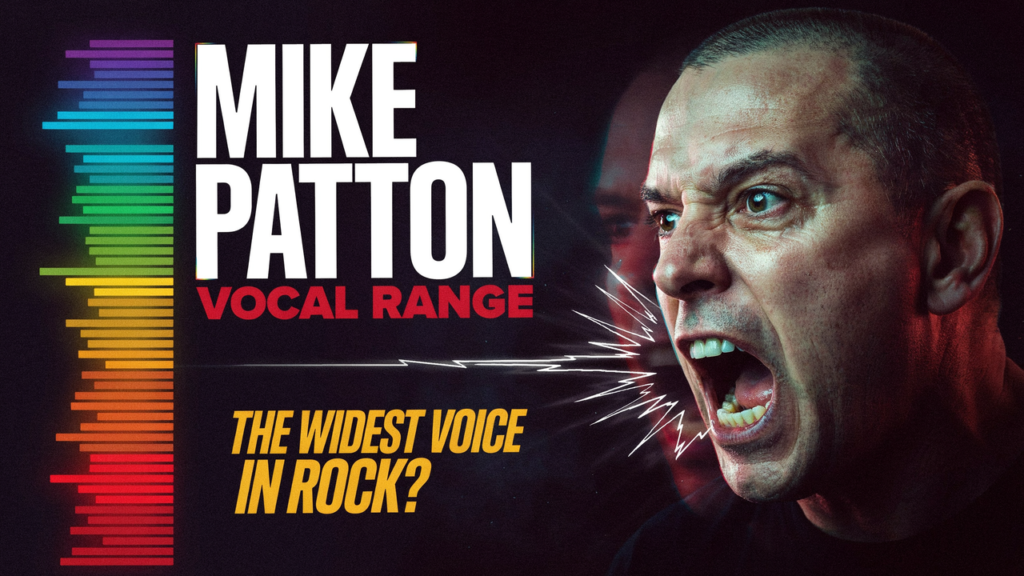
Mike Patton’s vocal range is the span between the lowest and highest pitches he can produce across clean singing and extreme techniques like falsetto, vocal fry, growls, and screams. He’s famous for a “huge octave range,” but the real story is that his clean range is smaller, while his total pitch span is expanded by effects.
Mike Patton is one of the most misunderstood vocalists on the internet.
People love to throw around giant numbers like “six octaves” and call it a day. But if you’re a singer, that doesn’t actually help you. Because Patton’s talent isn’t just range—it’s range + control + style-switching at a level almost nobody can match.
This article will give you a clear, practical breakdown of what his range means, what counts, and what you can learn from it safely.
What Is Mike Patton’s Vocal Range?
Depending on the measurement method, Mike Patton is often credited with a range that can stretch from extremely low fry/growl sounds up to very high falsetto and scream pitches, sometimes reported around six octaves.
But here’s the coach’s reality check:
Patton has two “ranges”
- Clean sung range (notes he sings as musical pitches with a stable tone)
- Extended technique range (notes created with fry, distortion, screams, and other effects)
Both are real. But they are not the same thing.
If you want a solid foundation for how range is normally defined, start with what vocal range actually means. It prevents 90% of range myths.
Why Mike Patton’s Range Is So Hard to Measure
Patton’s voice is difficult to measure for one simple reason:
Some of his most extreme sounds are not “clean singing,” but they still contain pitch.
For example:
- a vocal fry can have a pitch center
- a scream can be pitched
- a growl can imply pitch, but not always clearly
This is why you’ll see wildly different numbers online. People are measuring different things.
A useful way to stay grounded is to think in categories instead of one giant number.
Try the in-tune practice tool before recording vocals.
Clean Singing vs Extreme Techniques (The Most Important Distinction)
Here’s the simplest explanation:
Clean singing range
This is what most people mean when they say “vocal range.”
It’s the notes you can sing musically, repeatedly, and clearly.
Extreme technique range
This includes:
- vocal fry lows
- distorted screams
- growls
- noisy effects that still carry pitch
This range can be massive, but it’s not the same as clean singing range.
If you want to see how note naming works (so you don’t get lost), vocal range notes explained is the best quick reference.
Mike Patton’s Range Zones (Practical Breakdown)
This table gives you a singer-friendly view of what’s going on. It’s not meant to “prove” a specific number. It’s meant to explain how his voice functions.
| Range Category | What it sounds like | What’s happening |
|---|---|---|
| Clean lows | dark, grounded, clear | chest voice with control |
| Clean highs | bright, flexible | mix/head coordination |
| Falsetto highs | thin to ringing | falsetto with focus |
| Fry lows | creaky, sub-bass illusion | vocal fry pulses (not full singing) |
| Distorted screams | aggressive, pitched intensity | distortion mechanisms + resonance |
This is the key: Patton isn’t just going high and low. He’s switching systems.
Does Screaming Count as Vocal Range?
This is the question people actually want answered, even if they don’t say it out loud.
The honest answer
Screaming can be pitched, but it isn’t the same as singing.
If a scream has a stable pitch center, it can be measured. But it doesn’t mean the singer has that note available in clean singing.
So if someone says Patton hits an extremely high note in a scream, that may be true. But it doesn’t automatically mean he can sing that note cleanly.
This is why “octave count” arguments online are usually pointless. They’re mixing apples and chainsaws.
What Makes Mike Patton Truly Rare (It’s Not Just the High Note)
If I had to coach a singer on what to learn from Patton, I’d focus on three things.
1) He has extreme coordination control
He can switch between:
- clean tone
- falsetto
- distortion
- whispery textures
- aggressive attacks
…without losing musical timing.
That’s rare.
2) He has a huge palette of resonance choices
Patton changes the shape of the sound like a voice actor. He can make his voice feel:
- wide
- narrow
- bright
- dark
- metallic
- hollow
That’s resonance control.
3) He can “aim” a pitch even in chaos
A lot of screamers are just noise-makers. Patton can place pitch even when the sound is ugly.
That’s a musician’s ear.
If you want to train that part of the skill set, building pitch stability matters more than people think, and how to improve pitch accuracy is a strong starting point.
Step-by-Step: How to Learn From Patton Without Hurting Your Voice
I’m going to be very clear here:
You should not copy Mike Patton’s extreme sounds until you have clean fundamentals.
Extreme vocals are like stunt driving. You don’t start on the highway doing spins.
Step 1: Measure your clean range first
Before you chase extremes, you need a baseline. Use measure your vocal range so you know what your voice actually does.
Step 2: Build a reliable clean midrange
Patton can do extremes because his normal voice is stable.
Practice:
- 5-note scales
- medium volume
- clean vowels
- no strain
This is boring—but it’s the foundation.
Step 3: Train light falsetto control
Falsetto is one of the safest “extreme” tools when done gently.
Practice:
- soft “oo” slides
- no pushing
- no breath dumping
You want stability, not loudness.
Step 4: Learn what “distortion” is (and what it isn’t)
Distortion should never feel like:
- scraping
- burning
- choking
- throat pain
If it does, stop immediately.
Safe distortion (when trained correctly) is usually built from resonance and airflow coordination—not brute force.
Step 5: Add intensity through resonance first
Most singers try to scream louder. That’s backwards.
Intensity comes from:
- focused resonance
- vowel narrowing
- controlled airflow
Not volume.
If you’re still learning to coordinate higher notes without strain, how to sing high notes safely is the clean skill that protects you before you touch distortion.
Step 6: Keep sessions short
Extreme technique training should be short and spaced out.
If you’re hoarse the next day, you didn’t “train hard.” You irritated tissue.
The One Numbered List: A Safe 10-Minute “Patton-Inspired” Practice Session
This routine trains the skills behind Patton’s versatility without forcing screams.
- 2 minutes: gentle humming in midrange
- 2 minutes: clean 5-note scales on “oh”
- 2 minutes: falsetto slides on “oo” (quiet)
- 2 minutes: staccato “nay-nay-nay” (light, bright)
- 2 minutes: sing one phrase clean, then repeat it softer with more resonance
This is how you build control first. Patton-level extremes come later.
The One Bullet List: What You Should Copy From Mike Patton
- Range control instead of range bragging
- Clean-to-falsetto switching without panic
- Resonance variety (bright/dark/metallic)
- Musical timing even in aggressive sounds
- Clear pitch intention
- Smart use of texture as a stylistic tool
That’s the real blueprint.
Common Mistakes When People Try to Do “Mike Patton Vocals”
This is where singers get hurt.
Mistake 1: Treating screaming like “free high notes”
A scream can be pitched, but it’s not a shortcut to range. If you scream your way upward, you’ll build bad habits fast.
Mistake 2: Forcing distortion from the throat
If it feels like your throat is grinding, it’s wrong.
Safe distortion is not throat pain. Pain is tissue warning.
Mistake 3: Skipping clean singing fundamentals
If you can’t sing cleanly in tune and on pitch, your extremes will be unstable and risky.
Mistake 4: Practicing extremes daily
Extreme techniques require recovery. Patton’s career works because he has control and experience—not because he “goes hard every day.”
Mistake 5: Confusing vocal fry lows with true low singing
Vocal fry can create incredibly low-sounding effects, but it doesn’t mean you have those notes as full, resonant singing pitches.
If you want to understand where your voice fits in the bigger picture, voice type basics helps you set realistic expectations.
Quick Self-Check: Are Your Extreme Sounds Safe?
Use this immediately after any aggressive practice.
Green lights
- your speaking voice is unchanged
- no scratchiness
- you can sing a clean scale afterward
- your throat feels neutral
Yellow/red lights (stop and rest)
- hoarseness
- a “raw” feeling
- loss of high notes
- pain when swallowing
- fatigue that lasts into the next day
A healthy extreme sound should feel more like coordination than effort.
The Real Takeaway: Patton’s “Range” Is a Skill Stack
Mike Patton’s reputation is built on range, but the deeper truth is:
His superpower is versatility
He can:
- sing cleanly
- sing softly
- sing aggressively
- switch textures instantly
- keep musical timing through all of it
Range is only one part of that.
If you want a visual reference for where your notes sit compared to standard ranges, range chart reference helps you keep everything grounded.
And if you’re curious how modern analysis tools interpret complex vocals, your AI voice analysis page is a relevant next step for users who want to explore their own voice data.
FAQs
1) What is Mike Patton’s vocal range?
Mike Patton is often credited with an extremely wide range that can approach six octaves when you include falsetto, vocal fry, and extreme techniques. His clean sung range is smaller, but still impressive. The huge reputation comes from his ability to produce pitch across many different vocal textures.
2) How many octaves does Mike Patton have?
The famous number is around six octaves, but that usually includes vocal fry lows and extreme highs produced with falsetto or screams. If you measure only clean singing, the octave count is lower. Both measurements can be “true,” depending on the rules.
3) Is Mike Patton’s 6-octave range real?
It can be real in the sense that he can produce pitches across that span using multiple techniques. But it’s misleading if you assume those notes are all clean, repeatable singing. The smarter way to describe it is “clean range + extended technique range.”
4) Does screaming count as vocal range?
A scream can count if it has a stable pitch center, but it isn’t the same as clean singing. Many screams are partly noise-based, which makes exact note measurement unreliable. It’s best to separate “sung range” from “effect range.”
5) What technique is Mike Patton using for extremely low sounds?
Many of his lowest sounds are produced with vocal fry or fry-based textures rather than full chest voice singing. Fry can create very low pitch sensations, but it’s not the same as a resonant sung note. That’s why “lowest note” claims vary so much.
6) How does Mike Patton switch styles so fast?
That comes from coordination and experience: he can change register, resonance, and airflow quickly without losing timing. Most singers can’t do this because they tense up during transitions. Patton stays flexible and treats the voice like an instrument with multiple settings.
7) Can I learn to sing like Mike Patton safely?
You can learn the skills behind his versatility, but you should start with clean singing fundamentals first. Extreme sounds should be trained gradually and in short sessions, with plenty of rest. If you ever feel pain or hoarseness, stop and rebuild technique at a lighter intensity.

John Mayer is a vocal analysis and music education writer specializing in vocal range testing, voice type analysis, pitch recognition, and singing improvement tools for singers, musicians, performers, and beginners. He creates practical content focused on vocal training, singing techniques, and voice analysis tools to help users better understand and improve their vocal abilities.