
Gladys Knight’s vocal range is the full span of notes she can sing from her lowest pitch to her highest, across chest voice, mixed voice, and lighter upper coordination. She’s commonly described as an alto or contralto-leaning singer with roughly a 2–3 octave range, but her true signature is power, control, and emotional phrasing—not extreme high notes.
If you’re here for a single “highest note ever,” you’ll find guesses online. If you want to understand why Gladys sounded so strong and timeless, keep reading.
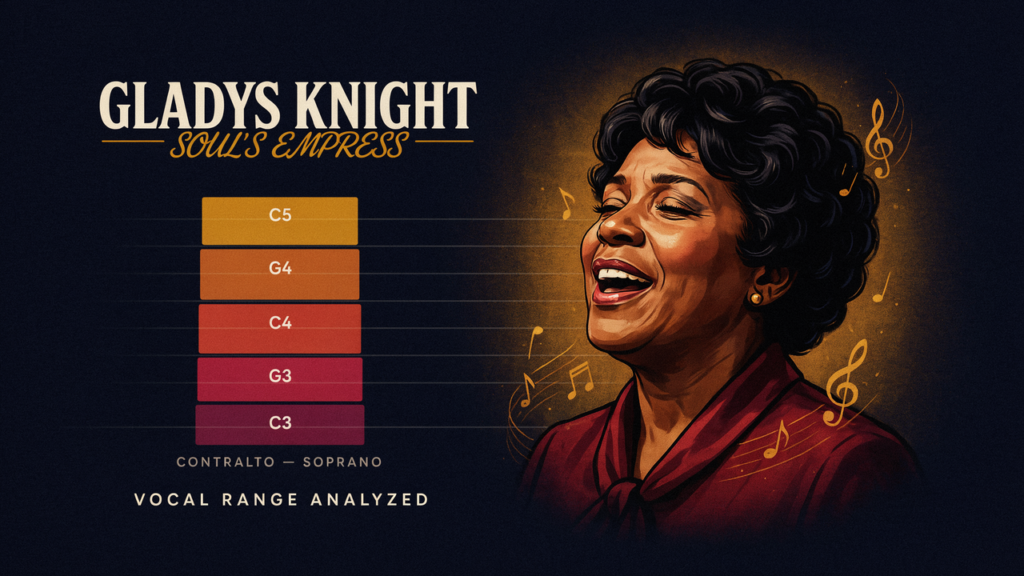
Why Gladys Knight’s Voice Sounds So Deep (Even When She Isn’t Singing Super Low)
Gladys is a great example of something singers misunderstand:
A voice can sound low without having an unusually low range.
Her “deep” sound comes from:
- a chest-dominant approach
- a warm, dark tone color
- strong consonants and speech-like phrasing
- confident resonance (not breathiness)
She doesn’t need to sing extremely low to sound grounded. She sounds grounded because her voice is centered.
If you want the basics first, what vocal range means will help you understand why “tone” and “range” aren’t the same thing.
The pitch precision tool helps you identify whether you drift sharp or flat.
Range vs Tessitura (The Key to Her Voice Type)
People argue whether Gladys is an alto, contralto, or mezzo. That debate usually happens because people focus on the extremes.
Vocal range
Your total lowest to highest notes.
Tessitura
Where your voice sits comfortably for most of the song.
Gladys’s tessitura sits lower than many pop singers. That’s why she’s often labeled alto/contralto.
If you want a clear explanation that actually helps singers, what tessitura is is the most important concept in this entire topic.
What Voice Type Is Gladys Knight?
Here’s the coach answer: Gladys Knight is best described as an alto with contralto color.
That means:
- her comfortable singing zone is low-mid
- her voice stays powerful without needing high belting
- her tone is warm and dark
- her upper notes are strong, but she doesn’t live in a soprano-style tessitura
Why “contralto” gets used so often
Contralto is rare, and people love the label. But most of the time, Gladys sings like a strong alto with an unusually rich color.
For the bigger picture of classification, voice types will help you place her voice realistically.
A Practical “Gladys Range Map” You Can Use
Most people want a number. As a coach, I want you to understand the zones she actually uses.
| Vocal zone | What it sounds like in Gladys’s style | What’s happening | What you should copy |
|---|---|---|---|
| Low chest | intimate, grounded | relaxed chest voice | clear tone without airiness |
| Midrange (home base) | rich, soulful | stable chest/mix | phrasing + pitch control |
| Upper mix | powerful, emotional | resonance + vowel tuning | intensity without shouting |
| Light highs | occasional lift | reduced weight | ease, not force |
If you ever get confused by note labels when reading range claims, vocal range notes makes it much easier to interpret them correctly.
What Made Gladys Knight a Vocal Monster (In the Best Way)
Gladys wasn’t trying to impress you with vocal gymnastics.
She impressed you with three harder skills:
1) She could sing loud without yelling
That’s a rare skill.
Her power came from resonance and timing, not throat force.
2) She could hold notes with control
Many singers can hit a note. Few can stay on it beautifully.
Gladys could sustain with:
- steady pitch
- steady vibrato
- consistent tone
3) She could phrase like she meant every word
That’s the part people feel.
And it’s why her voice still hits you emotionally decades later.
Step-by-Step: How to Sing Gladys Knight Songs Without Strain
Gladys’s songs can feel deceptively hard. Not because they’re “high,” but because they demand control and power.
Step 1: Learn to sing low without pushing down
A lot of singers try to copy her depth by forcing the larynx down.
That creates:
- swallowed tone
- fatigue
- pitch problems
- loss of upper range later
Low notes should feel like comfortable speaking, just pitched.
Step 2: Build a strong midrange first
Gladys lives in the midrange. That’s where her power is.
Train:
- sustained notes
- simple 5-tone scales
- clean consonants
If you want to check how stable your pitch is in that range, a pitch accuracy test will show you where you drift flat (which is common in soulful phrasing).
Step 3: Learn “soul mix” instead of belting
Gladys’s big moments aren’t screaming.
They’re a strong mix with resonance.
A good mental image:
- belting is like pushing a car
- mixing is like steering a car with power steering
Same direction, totally different effort.
Step 4: Use vowel tuning to get power
If you try to sing her climactic notes on wide vowels, you’ll strain.
As you go higher:
- narrow the vowel slightly
- keep the mouth tall, not wide
- keep the tongue relaxed
If you want a clear guide for this, how to sing high notes is the skill bridge that prevents yelling.
Step 5: Control your breath like a slow leak, not a blast
Soul singing tempts people to take huge breaths.
Then they dump air into the phrase, and the throat tightens to control it.
Instead:
- inhale quietly
- release air steadily
- let resonance do the work
Step 6: Add grit only after the tone is stable
Gladys sometimes uses grit/edge for emotion.
But grit should sit on top of a stable tone.
If you add rasp before you have control, you’ll get:
- scratchiness
- tension
- vocal fatigue
If your voice feels hoarse after practice, stop and reset.
For long-term reliability, vocal health tips matter more than hitting one big note.
One Bullet List: The Gladys Knight Skills That Matter Most
- Strong low-mid tessitura control
- Clean pitch even with soulful phrasing
- Powerful mix without shouting
- Sustained notes with steady vibrato
- Clear diction and emotional timing
- Resonance-driven volume (not throat-driven volume)
One Numbered List: A 10-Minute Gladys-Inspired Practice Routine
- 2 minutes: hum gently on 1–3–5–3–1 (comfortable range)
- 2 minutes: sing a verse at 70% volume (focus on words)
- 2 minutes: sustain one midrange note for 6 seconds, twice
- 2 minutes: practice the chorus in light mix (no yelling)
- 2 minutes: repeat chorus with taller vowels and less air
This routine trains what Gladys actually used: control, stability, and mix.
If you’re unsure where your range truly sits, use a vocal range calculator before you start forcing keys that don’t fit.
Quick Self-Check: Can You Sing Gladys Knight Comfortably?
After you sing one verse and one chorus, check these.
Check 1: Do your low notes stay clear?
If they get airy, you’re under-supporting or dropping too much resonance.
Check 2: Do you feel throat pressure on the chorus?
If yes, you’re belting instead of mixing.
Check 3: Does your pitch drift flat?
This is extremely common in soul singing. You need more pitch focus, not more volume.
Check 4: Is your voice normal the next day?
It should be. If you’re hoarse, your technique is too aggressive.
If you want context for where Gladys sits compared to typical singers, alto vocal range is the most relevant baseline.
Common Mistakes (That Make People Strain on Gladys Songs)
Mistake 1: Forcing a “deep voice”
Gladys’s depth is natural resonance, not a pushed-down larynx.
Fake depth always costs you later.
Mistake 2: Yelling the big notes
Her power is resonance, not volume.
If you yell, you’ll lose control and go sharp.
Mistake 3: Singing wide vowels on higher notes
Wide vowels are a fast path to strain.
Gladys’s vowels stay tall and tuned.
Mistake 4: Trying to copy grit before you have control
Grit is not a beginner technique.
If your voice feels scratchy, you’re doing too much.
Mistake 5: Treating range like the goal
Gladys’s greatness is not her “highest note.”
It’s how reliably she could deliver emotion with control.
If you want a reality check for expectations, comparing yourself to the average vocal range keeps your training grounded and healthy.
Realistic Expectations: What You Can Learn From Gladys (Even If You Don’t Have Her Voice)
Gladys Knight is a once-in-a-generation singer.
But the skills behind her sound are trainable:
- stable pitch
- mix coordination
- vowel control
- sustained note stamina
- emotional phrasing
The goal isn’t to become Gladys.
The goal is to build a voice that’s strong, reliable, and expressive—the same way hers was.
FAQs
1) What is Gladys Knight’s vocal range?
Gladys Knight is commonly estimated around a 2–3 octave range depending on the songs and how notes are counted. Her functional strength is in the low-mid tessitura, where her tone stays rich and powerful. Her range is impressive, but her control is even more impressive.
2) Is Gladys Knight an alto or contralto?
She’s best described as an alto with contralto color. Her voice sits low and warm, which makes people call her contralto, but classification depends on tessitura and how the voice behaves across registers. In practical terms, she sings like a powerful low female voice.
3) What is Gladys Knight’s highest note?
Different songs and performances show different peak notes, and not all high notes are sustained. The more meaningful measure is what she could sing repeatedly with control. Gladys’s high moments are usually strong mix notes rather than extreme soprano highs.
4) What is Gladys Knight’s lowest note?
Gladys has a comfortable low register, often used for intimacy in verses. Her low notes sound supported and clear rather than breathy. If you try to copy her lows by forcing your larynx down, you’ll strain quickly.
5) Why does Gladys Knight sound so powerful?
Because her sound is resonance-driven and her breath timing is excellent. She uses vowel tuning and mix coordination instead of shouting. That’s why her big notes sound strong without sounding strained.
6) Can beginners sing Gladys Knight songs?
Yes, but you should start with easier keys and focus on the verse phrasing first. The choruses often require mix coordination and sustained notes. If you feel throat tightness, back off and rebuild with lighter volume.
7) How can I belt like Gladys Knight safely?
Start by learning mix rather than pushing chest voice. Keep vowels tall and slightly narrower as you go higher, and control your airflow instead of blasting it. If you get hoarse, stop—power should never cost your voice.

John Mayer is a vocal analysis and music education writer specializing in vocal range testing, voice type analysis, pitch recognition, and singing improvement tools for singers, musicians, performers, and beginners. He creates practical content focused on vocal training, singing techniques, and voice analysis tools to help users better understand and improve their vocal abilities.