
Mitski’s vocal range is the span of notes she has sung in recordings and live performances, from her lowest usable pitch to her highest. Most analyses place her roughly around D#3 to D#5 (about 2 octaves), with the strongest, most expressive part of her voice living in the mid-range where lyrics stay clear and emotional.
Before we go further: range estimates vary because different songs, keys, and live performances can shift what you hear. The most useful thing isn’t obsessing over the “highest note,” but understanding where her voice sits comfortably and how she uses it.
If you’re new to this, read this first: what is vocal range.
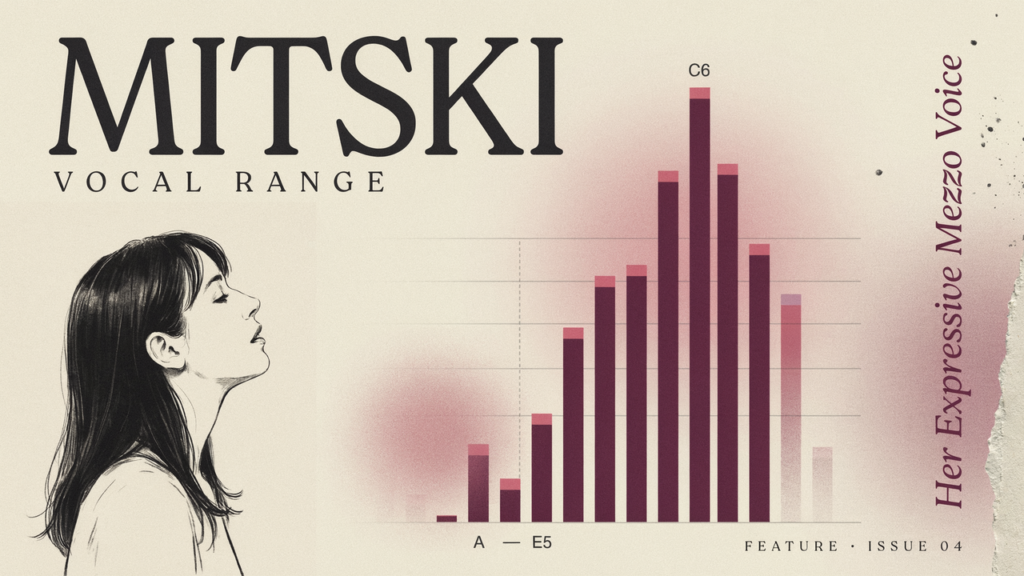
Mitski’s Range in Plain English
Mitski isn’t known for extreme whistle notes or huge belting peaks. She’s known for something harder to copy: controlled intensity, a focused mid-range, and a voice that can sound soft, fragile, or raw without losing pitch.
Her sound is often built from:
- speech-like singing (clear words, conversational tone)
- mid-range melodies (comfortable, emotionally direct)
- intentional strain effects (careful—these are stylized, not “bad technique”)
If you want to compare your notes to hers accurately, use a tool like the vocal range calculator to map your lowest and highest stable notes.
The intonation test is a great way to track progress over time.
A Practical Range Snapshot (What It Means for You)
Here’s a singer-friendly way to interpret Mitski’s approximate range:
| Range Area | Approx Notes | What You’ll Hear |
|---|---|---|
| Low | D#3–F3 | darker, grounded, intimate tone |
| Mid (most used) | G3–C5 | clear lyrics, emotional storytelling |
| Upper | C#5–D#5 | brighter intensity, higher emotional peaks |
This table is not a “scorecard.” It’s a map.
If you’re unsure what those note names mean, start with vocal range notes so the labels stop feeling like a foreign language.
Why Mitski’s Voice Type Is Hard to Label
People love to ask: “Is Mitski a soprano? Mezzo? Alto?”
That’s understandable, but voice type labels come from classical singing and don’t always fit modern indie singers cleanly. Mitski’s voice behaves like a mezzo-soprano or light alto-leaning mezzo, mostly because her strongest expressive zone sits in the lower-to-mid female range rather than living in constant high soprano territory.
To get your own voice type without guessing, try the voice type classifier and treat it as a starting point—not a permanent identity.
The Real Secret: Mitski’s Tessitura (Not Just Range)
Range is what you can sing.
Tessitura is what you sing most comfortably and consistently.
Mitski’s tessitura is typically in the mid-range. That’s why her songs feel intimate: she’s not constantly reaching for notes that force her into “performance mode.” She’s often singing where the voice can stay honest, speech-like, and emotionally direct.
If you want a deeper understanding of this concept, read what is tessitura.
How Mitski Uses Her Voice (And Why It Works)
She sings like she’s speaking (on pitch)
A lot of singers try to “sound like a singer.”
Mitski often sounds like a person talking, but musical.
That creates:
- immediate connection
- clear storytelling
- a raw, believable tone
She keeps the sound narrow and focused
Instead of spreading vowels wide (which can sound “musical theater”), she often uses a more contained shape. This keeps the tone concentrated and emotionally tense.
She uses breathiness as a color—not a habit
Breathiness can be beautiful in small doses. But if you copy it constantly, you’ll fatigue faster and lose pitch stability.
If breathiness makes your notes wobbly, work on steadiness using a pitch accuracy test.
Step-by-Step: How to Sing in Mitski’s Range Safely
This is the practical part. Don’t aim for “Mitski’s voice.” Aim for “Mitski’s approach” inside your voice.
1) Find your comfortable speaking pitch
Say this sentence out loud:
“I’m telling you something important.”
Notice where your voice naturally sits. That’s your baseline.
Now sing a simple 5-note scale starting from that pitch. Keep it easy.
2) Build a clean mid-range first
Mitski’s power lives here.
Practice singing a verse melody (any song) in a comfortable key where:
- you can pronounce every word clearly
- your throat stays relaxed
- your volume doesn’t need to push
If you don’t know your range boundaries, check them with how to find your vocal range.
3) Add intensity without pushing volume
A common mistake is thinking intensity = loud.
Instead, try:
- slightly firmer consonants (t, k, p)
- clearer vowels
- stronger emotional intention
Think of it like speaking with urgency, not shouting.
4) Approach higher notes with “narrow vowels”
When you go higher, wide vowels can feel like hitting a wall.
Try subtly narrowing:
- “ah” → “uh/aw”
- “eh” → “ih”
- “ee” → “ih/ee” blend
This reduces strain and helps you stay in tune.
5) Use a controlled edge (optional)
Mitski sometimes uses a slightly gritty edge for emotion.
Important: if you feel burning, pinching, or soreness, stop. That’s not style—that’s strain.
A safe approach is to add edge only at moderate volume, and only for short phrases.
One Bullet List: What Mitski’s Style Is Built On
- A mid-range tessitura that supports storytelling
- Speech-like phrasing with clear consonants
- Controlled breathiness for emotional color
- Focused, narrow tone instead of wide “big singing”
- Intensity through intention, not volume
One Numbered List: 7-Minute Practice Routine (Mitski-Inspired)
- 1 minute: gentle humming on 3 notes (comfortable pitch)
- 1 minute: lip trills sliding up and down (no pushing)
- 1 minute: speak a lyric slowly, then speak it on rhythm
- 1 minute: sing the lyric on one note (monotone) for clarity
- 1 minute: sing the real melody softly (mid-range only)
- 1 minute: repeat with stronger diction (not louder)
- 1 minute: sing once with emotional intention, then stop
If your voice feels tired after this, the issue is almost always too much air, too much volume, or too high a key.
Self-Check: Are You Singing This Style Correctly?
Use this quick check after you sing a verse.
Your technique is probably on track if:
- you can sing the verse twice without your throat tightening
- your words stay understandable
- your pitch stays stable at softer volume
You’re likely pushing if:
- your neck tightens on higher notes
- your jaw starts working harder
- your voice feels scratchy afterward
A great way to confirm is to record yourself and compare pitch consistency with a pitch accuracy analyzer.
Common Mistakes (That Make People Think Mitski Is “Hard to Sing”)
Mistake 1: Copying the breathiness nonstop
Breathiness is a color. If it becomes your default, you’ll lose vocal closure and tire quickly.
Fix: sing the line clearly first, then add a touch of air.
Mistake 2: Singing in the original key when it doesn’t fit you
A lot of Mitski songs sit in a specific mid-range pocket. If your voice is naturally higher or lower, forcing the key will make you strain.
Fix: transpose the song until the verse feels easy.
Mistake 3: Trying to “sound emotional” by squeezing
Emotion is not throat tension.
Fix: reduce volume, increase diction, and commit to the lyric.
Mistake 4: Confusing range with voice type
You can sing Mitski songs without having her exact range. Many of her melodies are adaptable.
Fix: focus on tessitura and comfort, not labels.
Realistic Expectations (And Vocal Health)
If you’re working on this style, expect progress in:
- clarity
- pitch stability at low volume
- emotional delivery
Don’t expect:
- instant tone copying
- “grit” without training
- higher notes without gradual conditioning
If your voice feels sore, hoarse, or scratchy after singing, treat that as a stop sign. Rest, hydrate, and return later with lower volume and easier keys.
For general protection habits, keep a simple routine from vocal health tips.
The Best Way to Compare Your Range to Mitski’s (Without Guessing)
If you want a direct comparison, do this:
- Test your lowest comfortable note
- Test your highest comfortable note
- Identify your strongest middle zone
- Compare that zone to Mitski’s likely mid-range use
A tool like find my vocal range online helps you measure quickly—but always trust your comfort more than the number.
FAQs
1) What is Mitski’s vocal range?
Most estimates place Mitski around D#3 to D#5, roughly two octaves. The more important detail is that she uses her mid-range heavily, which supports clear storytelling. Exact numbers can vary depending on the song key and performance.
2) Is Mitski a soprano or mezzo-soprano?
She most often fits a mezzo-soprano profile in practical pop terms, mainly because of where her voice sounds strongest and most natural. Classical labels don’t perfectly apply to indie singers, but mezzo is the closest match for most listeners.
3) What part of Mitski’s voice is the strongest?
Her most consistent strength is the mid-range, where she can keep diction clear and tone emotionally direct. That’s where most of her melodies live, and it’s a big reason her songs feel intimate rather than “showy.”
4) Do I need Mitski’s exact range to sing her songs?
No. Many Mitski songs work well when transposed to fit your voice. If the verse feels tight or the chorus feels strained, you’re simply in the wrong key—not “the wrong voice type.”
5) Why do some sources list different ranges for Mitski?
Because different people measure different songs, and some include brief background notes or studio effects. Also, “highest recorded note” is not the same as “highest comfortable note.” The most reliable approach is looking at multiple songs and focusing on consistent use.
6) How can I sing Mitski-style without hurting my voice?
Keep the volume moderate, avoid forcing breathiness, and don’t push for gritty effects. If you feel throat tightness or scratchiness afterward, lower the key and simplify the tone. This style is about intention and clarity, not power.
7) What’s the difference between vocal range and tessitura in Mitski’s music?
Range is the total span of notes she can hit at least once. Tessitura is the smaller zone where she sings most of the time with comfort and control. Mitski’s tessitura sits mostly in the mid-range, which is why her vocals often feel conversational and emotionally close.

John Mayer is a vocal analysis and music education writer specializing in vocal range testing, voice type analysis, pitch recognition, and singing improvement tools for singers, musicians, performers, and beginners. He creates practical content focused on vocal training, singing techniques, and voice analysis tools to help users better understand and improve their vocal abilities.