
Ozzy Osbourne’s vocal range is the span of notes he has sung in recordings and performances, from his lowest usable pitch to his highest. Most estimates place him in a high male rock range of around two octaves, with a mid-to-high tessitura that supports his bright, cutting tone. Exact notes vary by era and song key.
If you’re here because you want to sing Ozzy songs: good news. You don’t need a freakishly huge range. What you need is the right placement, vowel strategy, and rock-style coordination.
If you want a quick refresher on the concept itself, start with what vocal range means.
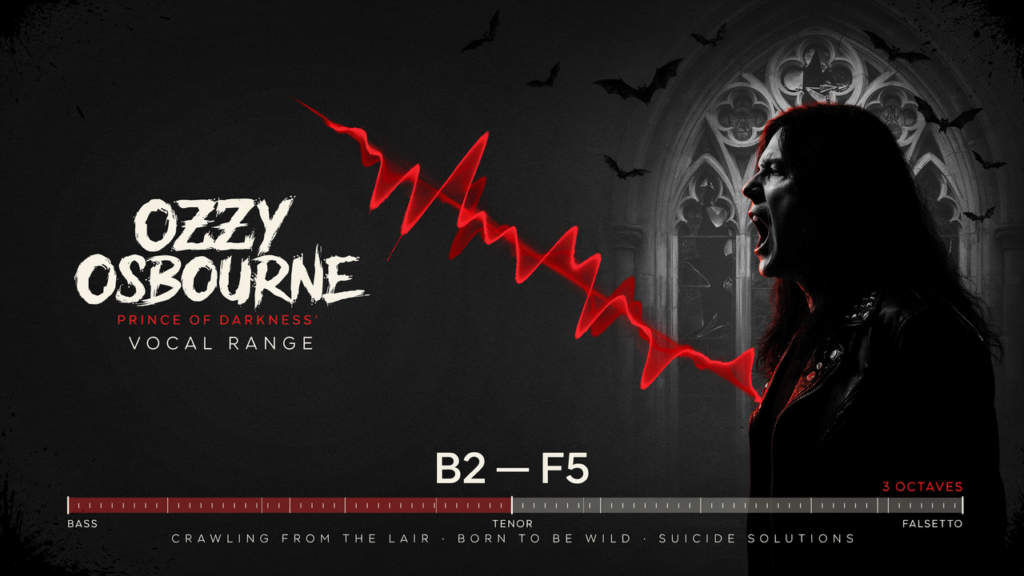
Why Ozzy Sounds “High” Even When the Notes Aren’t Extreme
A lot of singers hear Ozzy and assume he’s doing something impossible.
But Ozzy’s “high” sound comes more from tone strategy than raw range.
The Ozzy sound = brightness + focus
Ozzy’s tone is famously:
- bright
- narrow
- slightly nasal-sounding
- cutting through loud guitars
That’s not an accident. It’s a very functional rock setup.
Think of it like a laser pointer versus a floodlight.
A floodlight is big and warm, but it doesn’t cut through a wall of guitars.
A laser is smaller, sharper, and easier to hear.
Ozzy is the laser.
If you want fast feedback, open the pitch checker and sing a single note.
Nasality vs nasal resonance (important distinction)
A lot of singers try to imitate Ozzy by singing “through the nose.”
That usually creates pinching.
Instead, the goal is nasal resonance, not nasal airflow. You want the sound to feel forward and buzzy, but you should still be able to pinch your nose without the tone collapsing completely.
Ozzy’s Tessitura: Where He Actually Lives
Most of Ozzy’s iconic melodies sit in a zone that’s demanding, but repeatable.
That zone is his tessitura.
Tessitura matters more than range because it tells you:
- where his voice is strongest
- where his songs are most often written
- why his choruses feel tiring if you use the wrong technique
If you want the clearest explanation of this concept, read what tessitura is.
Is Ozzy a Tenor or Baritone?
This is one of the biggest questions in the SERP.
In practical rock terms, Ozzy behaves like a tenor-leaning voice, mainly because:
- his melodies sit high for a typical male singer
- his tone stays bright and forward
- he spends a lot of time in the upper mid-range
However, voice type labels can get messy in rock because:
- keys are chosen for the band
- studio vocals are layered
- live vocals shift over decades
A helpful way to understand where he sits is comparing the typical ranges in tenor vocal range and baritone vocal range.
One Table: A Singer-Friendly “Ozzy Range Map”
This is not a claim of exact notes. It’s a practical map of what singers experience when covering Ozzy.
| Range Zone | How it feels | What it usually requires |
|---|---|---|
| Low-mid | easy, speech-like | relaxed throat, clear diction |
| Mid | stable rock zone | firm closure, steady breath |
| Upper mid | where Ozzy lives | twang + vowel narrowing + mix |
| High peaks | short bursts | focus, not volume |
If you want to track your own notes accurately, you’ll get more value if you understand note labels like C4 and G4 instead of guessing.
The Core Technique: Twang (Without Strain)
If there’s one skill that unlocks Ozzy songs, it’s twang.
What twang actually is
Twang is not yelling.
Twang is a resonance strategy that makes the voice:
- brighter
- more focused
- easier to hear over instruments
It’s the difference between:
- “Hey…” (soft, airy)
- “HEY!” (bright, pingy, forward)
Ozzy uses a lot of that ping.
A safe twang test
Say:
“Nyeh! Nyeh! Nyeh!”
Like a bratty cartoon character.
Now soften it and put it into a sung note.
That “forward ping” is the foundation of Ozzy’s cutting tone.
Step-by-Step: How to Sing Ozzy Songs Safely
Ozzy songs are deceptively demanding. Not because they’re ultra-high, but because they require sustained brightness and intensity.
Here’s how to build it safely.
1) Choose the right key (this is not cheating)
If the chorus makes your neck tighten, the key is too high for your current coordination.
In rock singing, smart singers change keys all the time.
Your goal is to train the coordination, not prove something.
If you want to measure your usable range quickly, use test your vocal range and write down your comfortable zone.
2) Build the chorus at 60% volume first
Most singers start loud, then wonder why it hurts.
Instead:
- sing the chorus quietly
- keep the tone forward
- keep the throat relaxed
If you can’t sing it quietly, you’re not coordinating efficiently yet.
3) Narrow the vowel as you go higher
Ozzy’s vowels are rarely wide on high notes.
That’s part of why his voice stays focused.
Examples:
- “ah” becomes “uh/aw”
- “eh” becomes “ih”
- “oh” becomes “oo/oh” blend
This keeps the vocal tract from spreading and pulling the larynx up.
4) Use “edge” instead of “pressure”
Rock intensity should feel like:
- focused tone
- firm cord closure
- steady airflow
Not:
- neck tension
- jaw clenching
- throat squeeze
If you feel squeeze, lower the key and rebuild.
5) Treat grit as optional
Ozzy’s tone can sound gritty in places, but forcing grit is one of the fastest ways to irritate your vocal folds.
If you want to experiment with rock edge, do it later, and only at moderate volume.
If you ever feel burning, sharp pain, or hoarseness afterward, stop. That’s not training—it’s damage risk.
For healthy habits, it’s worth revisiting vocal health basics.
One Bullet List: What Makes Ozzy’s Singing Work
- Bright, forward placement that cuts through guitars
- Twang-driven resonance (not “more air”)
- Narrow vowels on higher notes
- Speech-like phrasing that keeps lyrics clear
- A consistent upper-mid tessitura that defines his style
One Numbered List: 7-Minute Ozzy-Style Practice Routine
- 1 minute: hum gently on 3 notes in your comfortable range
- 1 minute: “nyeh nyeh nyeh” on one note (forward and buzzy)
- 1 minute: lip trill slides up and down (no pushing)
- 1 minute: sing a chorus line on “gee” at low volume
- 1 minute: sing the same line on lyrics at 60% volume
- 1 minute: repeat with slightly brighter tone (not louder)
- 1 minute: cool down with soft humming
If you feel worse after this routine, it usually means you’re using too much pressure or singing too high too soon.
Quick Self-Check (So You Don’t Blow Out Your Voice)
After you sing a chorus, take 10 seconds and check:
Green flags
- you can speak normally right away
- your throat feels neutral
- you could repeat the chorus again
Yellow flags
- slight tightness that fades quickly
- jaw tension
- pitch getting shaky on repeated lines
Red flags
- scratchy voice
- burning sensation
- hoarseness
- pain on swallowing
If you hit red flags, stop and rest. Rock singing should feel athletic, not injurious.
If you want help stabilizing pitch in high rock phrases, practice with how to sing high notes safely and treat volume as the last step, not the first.
Common Mistakes (And the Fix That Actually Works)
Mistake 1: Copying Ozzy by squeezing your nose and throat
That creates pinching, not resonance.
Fix: aim for forward buzz with an open throat. Use the “nyeh” test to find twang without tension.
Mistake 2: Shouting the chorus to “sound metal”
Shouting is not the Ozzy sound.
Fix: sing it quietly first, then build intensity through focus and diction.
Mistake 3: Keeping wide vowels on high notes
Wide vowels are a common reason singers crack or strain.
Fix: narrow the vowel slightly as you go up. You’ll feel the note “lock in” with less effort.
Mistake 4: Using too much air
Too much air makes the voice unstable and forces the throat to compensate.
Fix: aim for efficient closure and steady breath, like controlled steam.
Mistake 5: Trying to match the original key too early
Ozzy’s tessitura is high for many male singers.
Fix: transpose the song until you can sing it twice without tightness. Then train upward gradually.
Realistic Expectations (What You Can Improve)
Ozzy’s sound is achievable for many singers, but it takes time because you’re training coordination, not just “strength.”
With consistent practice, most singers can improve:
- upper-mid stamina
- resonance focus
- chorus stability
- rock-style brightness without yelling
What you should not expect:
- instant “Ozzy tone”
- permanent rasp
- effortless high notes in a week
Progress in rock singing is usually measured by one thing:
How good you sound at lower effort.
That’s the goal.
FAQs
1) What is Ozzy Osbourne’s vocal range?
Most estimates place Ozzy in a high male rock range of around two octaves, depending on era and song selection. The more useful insight is his tessitura: he spends a lot of time in the upper mid-range. That’s why his songs can feel tiring if you don’t use twang and vowel strategy.
2) Is Ozzy Osbourne a tenor or baritone?
In practical rock terms, Ozzy behaves more like a tenor-leaning voice because of where his melodies sit and how bright his tone stays. However, rock voice types aren’t as strict as classical categories. The safest approach is matching keys to your own comfort rather than chasing labels.
3) Why does Ozzy’s voice sound so nasal?
Because he uses strong forward resonance and twang, which can sound nasal-like without actually sending lots of air through the nose. Many singers confuse this and pinch their tone. You want the buzz, not the squeeze.
4) Did Ozzy use head voice a lot?
Ozzy’s classic sound is more about a bright, chest-dominant mix than pure head voice. He often keeps the tone focused and cutting rather than floaty. Some lighter coordination may appear on certain lines, but his signature is upper-mid rock intensity.
5) How do I sing Ozzy songs without straining?
Lower the key if needed, practice the chorus quietly first, and narrow vowels as you go higher. Use twang for brightness instead of pushing volume. If your throat tightens, stop and rebuild at lower intensity.
6) What’s the hardest part of singing Ozzy?
Sustaining that bright, cutting tone for an entire song without fatigue. The notes aren’t always extreme, but the coordination has to stay consistent. Stamina and efficiency matter more than raw range.
7) Is it safe to imitate Ozzy’s grit?
Only if you can sing the line cleanly first and you add edge lightly at moderate volume. Forcing rasp can irritate your vocal folds quickly. If you feel burning, pain, or hoarseness afterward, stop and rest.

John Mayer is a vocal analysis and music education writer specializing in vocal range testing, voice type analysis, pitch recognition, and singing improvement tools for singers, musicians, performers, and beginners. He creates practical content focused on vocal training, singing techniques, and voice analysis tools to help users better understand and improve their vocal abilities.