
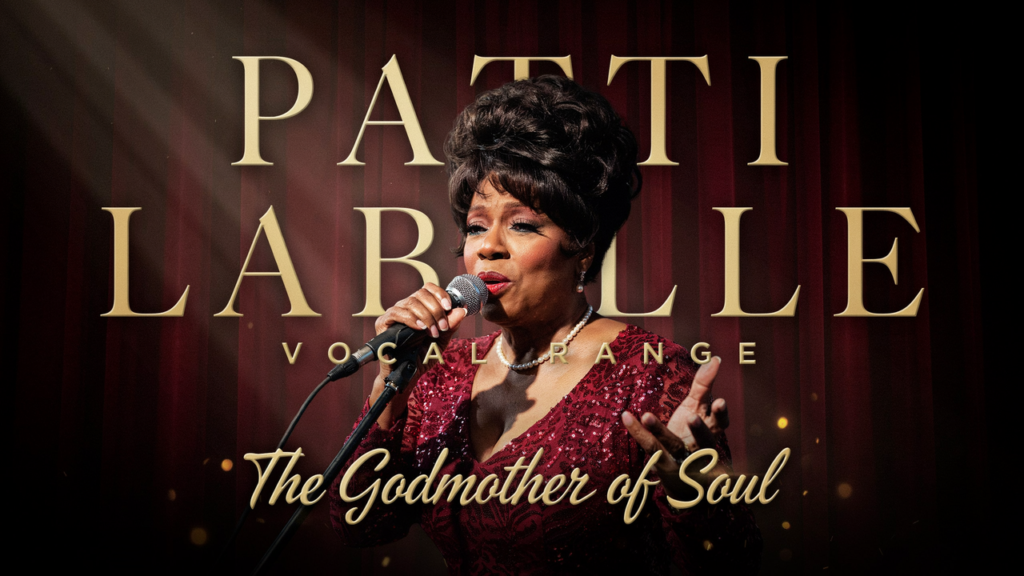
Patti LaBelle’s vocal range is the span of notes she has sung in recordings and performances, from her lowest usable pitch to her highest. She’s widely known for explosive high belts and upper-register peaks, with most singer-focused estimates placing her at two octaves or more depending on era, song choice, and whether brief peaks are counted.
If you’re here as a singer, I want you to take one pressure off immediately: you do not need Patti’s extreme top notes to learn from her. The real lesson is how she builds power, clarity, and stamina through the range she uses most.
If you want the basics first, start with what vocal range means.
Why Patti LaBelle’s Voice Feels “Bigger Than Range”
A lot of people confuse range with greatness.
Patti is great because she combines:
- intensity
- control
- resonance
- phrasing
- stamina
Her voice doesn’t just hit high notes. It lands on them.
Range is the edges. Tessitura is the real story.
Range is the outer boundary: lowest to highest.
Tessitura is where the voice lives most comfortably and repeatedly. Patti’s tessitura often sits in a strong upper-middle zone for a female voice, which is why her choruses feel like fireworks: she’s singing where many people feel challenged.
If you want to understand this clearly, read what tessitura is.
Patti LaBelle’s Voice Type (Soprano or Mezzo?)
In real-world soul/pop terms, Patti is often described as a soprano-leaning voice with a powerful middle, or a dramatic pop soprano.
Here’s the honest truth: in pop and soul music, voice type labels are less important than how the voice behaves.
Patti’s voice behaves like a singer who can:
- sustain intensity in the upper-middle range
- belt with a bright, ringing resonance
- flip into lighter upper register moments when needed
If you’re curious about your own category, the voice type classifier is a good starting point—just don’t let it box you in.
The Whistle Register Question (And What Matters More)
People love to ask: “Does Patti LaBelle sing whistle notes?”
Sometimes you’ll hear very high, squeal-like peaks in live performances. But here’s the important coaching point:
Even if a singer hits a brief ultra-high pitch, that doesn’t mean they have a usable whistle register like a specialist.
Patti’s signature is not whistle. It’s her belt, her mix, and her command of resonance.
So for singers, the useful goal is:
- learn her belt strategy
- learn her stamina
- learn her phrasing and emotional control
Not chasing the highest squeal.
Use the real-time pitch tool to monitor pitch stability across a phrase.
One Table: A Singer-Friendly “Patti Range Map”
This isn’t about exact notes. It’s about what you’ll actually feel if you sing her material.
| Zone | What you hear in Patti’s singing | What it demands from you |
|---|---|---|
| Low-mid | warmth, authority | relaxed throat + steady breath |
| Mid | storytelling and groove | clear vowels + pitch control |
| Upper mid | signature power zone | mix/belt coordination + focus |
| High peaks | climactic moments | vowel strategy + stamina (not force) |
If you want to measure your own notes accurately, it helps to learn note labels like C4 and F5 so you can track progress without guessing.
The Real Technique: How Patti Belts So High
Patti’s high notes don’t work because she’s “pushing harder.”
They work because she’s doing three smart things:
- focusing resonance forward
- narrowing vowels as she rises
- managing breath pressure instead of blasting air
H3: Belt vs Mix vs Head Voice (in soul singing)
A lot of singers call everything loud “belting.”
But there are differences:
- Belt: chest-dominant, bright, intense
- Mix: still powerful, but more balanced and efficient
- Head voice: lighter, more floating, less weight
Patti often lives in a chest-dominant mix that sounds like a belt but stays organized.
The “ring” is the secret
Patti’s voice has ring—an overtone brightness that cuts through a band.
Think of it like a trumpet.
A trumpet isn’t loud because the player forces air.
It’s loud because the instrument is tuned for resonance.
Your job as a singer is to “tune the instrument” of your vocal tract.
Step-by-Step: How to Sing Patti LaBelle Songs Safely
If you want to sing this style without strain, follow this exact order.
1) Pick the right key (seriously)
Patti’s original keys are not a test of your worth.
If you’re straining, you’re not training. You’re just surviving.
A smart singer transposes so the chorus sits in a stable zone.
To find your usable top notes quickly, use test your range and write down your comfortable high notes—not your “lucky” ones.
2) Build the chorus at 60% volume first
This is the fastest way to improve.
Sing the chorus with:
- medium volume
- clear consonants
- steady pitch
If you can only sing it when you go loud, your coordination isn’t stable yet.
3) Narrow the vowel as the pitch rises
High notes fail when vowels spread wide.
Try these shifts:
- “ah” → “uh/aw”
- “eh” → “ih”
- “ay” → “eh/ih” blend
This keeps the note from feeling like you hit a wall.
4) Use “cry” tone to prevent shouting
A tiny “cry” sensation (like you’re about to tear up) helps the voice:
- stay connected
- stay efficient
- avoid brute-force yelling
If you feel throat squeeze, you’re not crying—you’re pushing.
5) Train stamina like an athlete
Patti’s singing is athletic.
Don’t practice by blasting full choruses repeatedly.
Practice by doing:
- short reps
- rest breaks
- clean technique
This builds endurance without inflammation.
6) Treat grit and distortion as optional
Patti’s power is mostly clean.
If you add rasp too early, you’ll lose pitch and fatigue quickly.
If you ever feel:
- burning
- hoarseness
- pain
…stop and rest. That’s not “working hard.” That’s a warning sign.
For safety habits that protect your voice long-term, revisit vocal health tips.
One Bullet List: What Makes Patti LaBelle’s Voice So Iconic
- Upper-middle tessitura with consistent power
- Ringing resonance that cuts through instruments
- Belt-like intensity without sloppy shouting
- Strong vibrato and emotional phrasing
- Stamina to repeat big climaxes live
One Numbered List: 8-Minute Patti-Style High Note Routine
- 1 minute: gentle humming on 3 comfortable notes
- 1 minute: lip trills sliding upward (no pushing)
- 1 minute: “ng” sirens (as in “sing”) to connect resonance
- 1 minute: “hey!” calls (focused, not loud)
- 1 minute: sing a chorus line on “gee” at low volume
- 1 minute: sing it on lyrics at 60% volume
- 1 minute: repeat once with brighter focus (not louder)
- 1 minute: cool down with soft humming
If your throat feels worse afterward, the issue is almost always too much pressure, too much air, or a key that’s too high.
Quick Self-Check (After You Sing a Chorus)
This is a 15-second check that prevents months of bad habits.
Green flags
- you can speak normally right away
- the throat feels neutral
- you could repeat the chorus again
Yellow flags
- jaw tension
- tongue tightness
- pitch wobble on repeated lines
Red flags
- scratchy voice
- burning sensation
- hoarseness
- pain when swallowing
If you hit red flags, stop. Rest and come back later in a lower key with less volume.
If pitch stability is your weak spot, use a pitch accuracy test to see whether you drift sharp or flat when you add intensity.
Common Mistakes (And the Fix That Actually Works)
Mistake 1: Shouting instead of mixing
This is the #1 soul belting mistake.
Fix: sing the phrase quietly first, then build intensity through resonance and diction.
Mistake 2: Spreading vowels on high notes
Wide vowels make high notes feel impossible.
Fix: narrow the vowel slightly as you rise. The note will feel more stable immediately.
Mistake 3: Using too much breath to create power
Too much air causes instability and forces throat tension.
Fix: aim for steady airflow and firm closure—like controlled steam, not a hair dryer.
Mistake 4: Chasing whistle notes
This is a distraction for most singers.
Fix: build a strong upper-middle mix first. That’s where 95% of soul singing lives.
Mistake 5: Practicing at full performance intensity every time
That’s like sprinting every day.
Fix: practice at medium volume most of the time, and “perform” only occasionally.
If you want a technique foundation for high notes, study how to sing high notes safely and apply it specifically to soul-style choruses.
Realistic Expectations (What You Can Actually Improve)
Patti LaBelle’s voice is elite-level coordination.
But you can absolutely improve in the same direction.
With consistent practice, most singers can improve:
- upper-middle stamina
- mix/belt coordination
- resonance focus
- vibrato stability
- pitch control under intensity
What you should not expect:
- instant “Patti power”
- effortless high belts in a week
- safe distortion without training
Progress in this style is measured by one thing:
How strong you sound at lower effort.
That’s the real win.
If you want to see how your voice compares to typical ranges, you can reference average vocal range as a reality check—but don’t use it as a limit.
FAQs
1) What is Patti LaBelle’s vocal range?
Most singer-focused estimates place Patti LaBelle at two octaves or more, depending on the era and what notes are counted. She’s especially known for her upper-middle power and explosive high climaxes. Exact note numbers vary because live performances and brief peaks can differ from studio recordings.
2) Does Patti LaBelle sing whistle register?
You may hear extremely high peaks in some performances, but Patti’s signature is not whistle singing in the specialist sense. Her most reliable and repeatable power comes from belting and chest-dominant mix. For most singers, training whistle is far less useful than training mix and stamina.
3) Is Patti LaBelle a soprano or mezzo-soprano?
In practical soul/pop terms, she’s often described as a soprano-leaning voice with a powerful middle. She has the brightness and ring needed for high climaxes, but also strong authority in the mid-range. Classical labels don’t perfectly fit soul singing, so treat this as a guide.
4) Why do Patti LaBelle’s high notes sound so powerful?
Because she uses focused resonance (“ring”), strong vowel strategy, and efficient breath pressure. She’s not simply getting louder—she’s getting more concentrated. That concentration makes the note cut through without needing brute force.
5) Can beginners sing Patti LaBelle songs safely?
Yes, but you should start by lowering the key and keeping the volume moderate. Focus on clean pitch and clear vowels before trying to match her intensity. If your throat tightens, stop and rebuild in an easier range.
6) What’s the biggest mistake people make when copying Patti?
Trying to shout the high notes and treating power as volume. That leads to strain and pitch problems quickly. The safer path is learning twang, vowel narrowing, and mix coordination.
7) What should I do if I get hoarse after singing her songs?
Stop and rest, and don’t try to “push through” hoarseness. Next time, lower the key, reduce volume, and practice in short reps with breaks. If hoarseness keeps happening, focus on technique and vocal health before returning to big choruses.

John Mayer is a vocal analysis and music education writer specializing in vocal range testing, voice type analysis, pitch recognition, and singing improvement tools for singers, musicians, performers, and beginners. He creates practical content focused on vocal training, singing techniques, and voice analysis tools to help users better understand and improve their vocal abilities.