
Rihanna’s vocal range is the span between the lowest and highest notes she can sing in recorded performances, usually described with note names (like F3 to C6) and an octave count. The most useful view splits her range into registers—chest, mix, and head voice—because that shows what she can sing consistently, not just once.
Rihanna is a great case study because her vocal power isn’t about extreme high notes. Her strength is tone, phrasing, and midrange control—the exact skills that make singers sound professional.
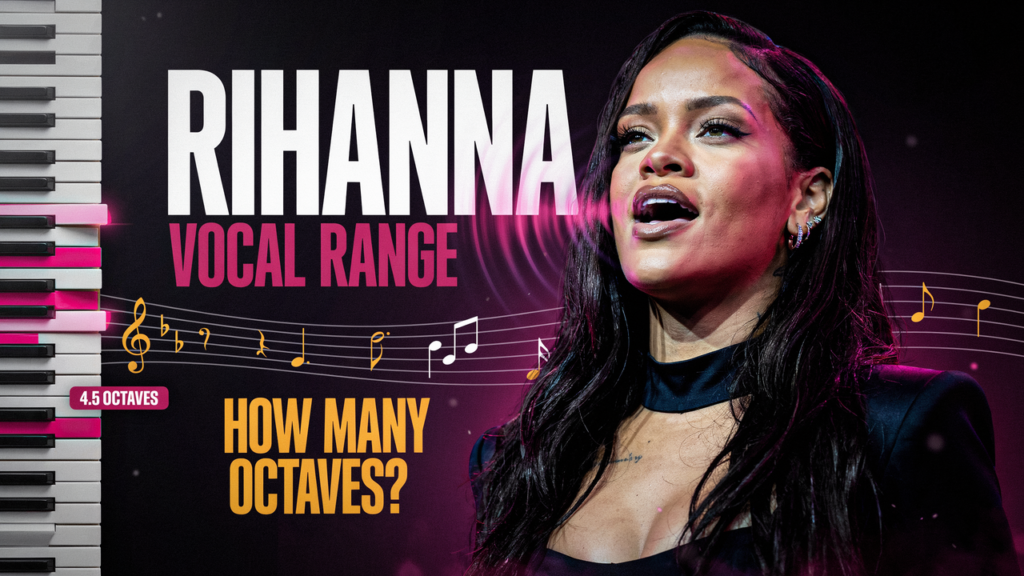
Rihanna’s Likely Voice Type (And Why People Argue About It)
When people ask “Is Rihanna an alto?” what they usually mean is: Does she have a naturally low-sounding voice?
Rihanna is often described as mezzo-soprano leaning low or alto-leaning in tone, depending on the song. She has a darker color than many pop singers, and she frequently sits in a comfortable midrange.
But here’s the key coaching truth: tone color is not voice type. Some singers sound dark because of vowel choices and resonance, not because they have a low voice.
If you want a grounded overview before you label yourself, read voice types explained and treat it like a map, not a verdict.
Range vs tessitura (the part that matters most)
Rihanna’s songs often live in a range that feels comfortable for many singers. That’s tessitura: the notes you can sing repeatedly without fatigue.
If you’ve never worked with tessitura before, it’s worth learning what tessitura means because it explains why you can “hit” a note but still struggle through a whole song.
What Rihanna’s Range Really Looks Like (In Practical Terms)
You’ll see different note ranges listed online. That’s normal. Recordings vary, keys change, and studio layers can hide what’s happening.
Instead of obsessing over one “official” range number, focus on what her singing consistently shows:
- A stable, expressive midrange
- A controlled upper midrange that can brighten when needed
- A head voice that appears selectively, not constantly
- Lower notes that exist, but aren’t the main showcase
If you want to understand note labels (like F3 or C5) in a way that actually helps, keep note names in singing bookmarked for quick reference.
The 3 Registers Rihanna Uses Most (And How They Sound)
Rihanna’s technique is a masterclass in pop efficiency. She doesn’t oversing. She uses just enough coordination to stay clean and expressive.
Chest voice: the “speaking” register
This is where Rihanna’s voice feels most recognizable. Her chest voice often sounds direct, slightly edgy, and conversational.
Think of chest voice like walking. It’s your default movement. If you try to run a marathon by sprinting, you burn out. Same with singing: chest voice is great, but pushing it too high causes fatigue fast.
the “brightened chest” bridge
Mix is where many singers fall apart, because they try to keep chest voice heavy while going higher.
Rihanna often uses a lighter, speechy mix—more like “talking on pitch” with attitude than belting like a theatre singer.
If you’re working on this, start with how to sing high notes safely so you build coordination instead of pressure.
Head voice: the “float”
Rihanna uses head voice strategically. When she does, it’s usually for emotional lift or contrast, not constant fireworks.
This is an important lesson: you don’t need a huge head voice range to be a successful singer. You need control, style, and consistent pitch.
If you’re worried about noise, the decibel meter gives you a quick reading.
A Simple Range Map (So You Stop Chasing the Wrong Notes)
This table is a practical way to think about Rihanna’s voice. It helps singers understand what to train.
| Range Area | What you hear in Rihanna | What you should train |
|---|---|---|
| Low range | Warm, sometimes breathy | Relaxation + steady airflow |
| Midrange | Strongest, most consistent | Pitch control + clean vowels |
| Upper midrange | Bright, edgy, expressive | Light mix + vowel tuning |
| High range | Used selectively | Head voice freedom + softness |
If you want to measure your own notes accurately, use a vocal range calculator and track your repeatable notes, not your one-time extremes.
Step-by-Step: How to Sing Rihanna Songs Without Strain
Rihanna’s music is deceptively hard. It’s not hard because it’s high. It’s hard because it’s exposed.
A singer who can belt huge notes can still struggle with Rihanna, because the phrasing demands control.
Step 1: Pick the right key (don’t “prove” anything)
If a song sits too high or too low, it will force your technique into survival mode.
The goal is not to sing it in the original key. The goal is to sing it well.
Step 2: Train your midrange like it’s the main event
Most of Rihanna’s hooks sit in a midrange where every pitch is obvious.
This is where you want your voice to feel like a laser: steady, centered, and clean.
A quick way to improve this is by running a pitch accuracy test on a short chorus and checking where you drift.
Step 3: Use “speech-level” energy
Rihanna’s style often lives close to speech.
Try this: speak the lyric rhythmically first, then sing it with the same attitude. If you suddenly get louder and heavier when you sing, you’re oversinging.
Step 4: Brighten with vowels, not force
When you go higher, don’t push more air. Instead, slightly narrow vowels.
Example:
- “Ah” can become a little closer to “uh”
- “Eh” can become a little closer to “ih”
It’s like aiming a flashlight. You don’t need more electricity—you need better focus.
Step 5: Keep consonants crisp
Rihanna’s phrasing relies on rhythmic clarity.
If your consonants are lazy, the performance feels flat even if the notes are correct.
One Rihanna-Style Drill That Works (And Why)
This drill builds the exact coordination Rihanna uses: controlled midrange, clean rhythm, and a stable mix.
The “Mum-Mum” Groove Scale
How to do it
- Use “mum” (as in “muhm”), medium volume
- Sing a 5-note scale up and down
- Keep it slightly bratty (not pretty)
Why it works
“Mum” naturally balances the voice. It discourages breathiness and stops you from spreading vowels too wide.
Do it for 2–3 minutes, then sing your chorus again. You should feel more centered with less effort.
If you want a routine that rotates exercises without overdoing one pattern, use a vocal warm-up generator and keep sessions short and consistent.
Quick Self-Check: Are You Singing Like Rihanna or Just Copying Her Tone?
Rihanna’s tone is tempting to imitate. But copying tone without technique is how singers get tired.
Use this quick check:
- Your throat feels normal after singing
- Your pitch stays steady in the midrange
- You can repeat the chorus 3 times without fatigue
- Higher notes feel lighter, not louder
- Your speaking voice feels unchanged afterward
If you fail two or more, you’re probably pushing or singing too breathy.
A lot of Rihanna-style singing uses controlled airflow. If you’re constantly airy, you’ll tire quickly. It’s like driving with the handbrake slightly on.
Common Mistakes When Singing Rihanna (And How to Fix Them)
Mistake 1: Singing too breathy
Rihanna sometimes uses breathy tone as a stylistic choice. Many singers turn that into a habit.
Fix: Practice the same phrase with a clearer tone first, then add a touch of air on purpose.
Mistake 2: Oversinging the chorus
Rihanna’s choruses often sound powerful because of attitude and layering, not because she’s yelling.
Fix: Sing the chorus at 80% volume and focus on rhythm and pitch. If it sounds better, you were pushing.
Mistake 3: Pushing chest voice too high
This is the classic strain trap.
Fix: lighten earlier. If your neck tightens, you waited too long to mix.
Mistake 4: Ignoring rhythm
Rihanna’s vocal style is rhythmic. If your timing is off, it won’t feel like the song.
Fix: clap the rhythm, speak the lyric, then sing it.
Mistake 5: Trying to sound “low” on purpose
Many singers force a lowered larynx to mimic her darker tone.
Fix: keep the throat neutral. Let tone come from vowels and placement, not from pushing the voice down.
Realistic Expectations (The Coach Talk You Actually Need)
You can learn Rihanna’s style. You can strengthen your mix. You can improve your pitch and phrasing.
But you can’t copy:
- her exact vocal fold thickness,
- her natural resonance shape,
- or the studio production choices that shape her final sound.
Think of it like handwriting. You can learn the same alphabet, but your handwriting will still be yours.
Your goal is to take what’s useful:
- midrange control,
- clean pitch,
- confident phrasing,
- and efficient high notes.
If you want context for how your range compares to typical singers, check average vocal range and use it as a reality anchor.
The 5 Skills Rihanna’s Singing Teaches Every Vocalist
Here’s the biggest takeaway—this is the part singers should steal.
- Control beats volume.
- Midrange matters more than extremes.
- Rhythm is a vocal skill.
- Tone is a choice, not a personality.
- Efficiency keeps you consistent.
If you build those, your voice will improve even if your range never changes dramatically.
FAQs
1) What is Rihanna’s vocal range?
Different sources list different ranges, but Rihanna is generally described as a midrange-strong singer with access to higher notes when needed. The most reliable view is her usable range across chest, mix, and head voice. Her consistency matters more than one extreme note.
2) Is Rihanna an alto?
Rihanna is often called an alto because her tone is darker and her songs sit comfortably in the midrange. But “alto” is frequently used online as a synonym for “low female voice,” which isn’t always accurate. A better question is where her tessitura sits most often.
3) How many octaves can Rihanna sing?
Most estimates place her around the typical pop-singer range, with usable notes spanning multiple octaves. Exact numbers vary because recordings and keys differ. Focus on repeatable notes rather than one-time extremes.
4) What is Rihanna’s highest note?
Her highest note depends on the specific track and whether the note is sung in head voice or in a stronger mix. Many lists confuse background vocals and layered studio notes with a single sung note. The more practical question is her highest comfortable note live.
5) What is Rihanna’s lowest note?
Rihanna can sing lower notes, but her music doesn’t typically showcase extreme lows. Many “lowest note” claims come from moments where the tone is spoken, layered, or produced. Her true functional low range is best judged by sustained, pitched notes.
6) Why do Rihanna songs feel hard even if they aren’t super high?
Because they’re exposed and rhythm-dependent. Rihanna’s phrasing requires steady pitch, clean timing, and controlled airflow. If you’re even slightly flat or late, it becomes obvious.
7) What’s the safest way to practice Rihanna songs?
Start in a comfortable key and focus on midrange pitch and rhythm first. Keep volume moderate and avoid forcing breathy tone for long periods. If your throat feels tight or scratchy, stop and reset—progress comes from consistency, not pushing.

John Mayer is a vocal analysis and music education writer specializing in vocal range testing, voice type analysis, pitch recognition, and singing improvement tools for singers, musicians, performers, and beginners. He creates practical content focused on vocal training, singing techniques, and voice analysis tools to help users better understand and improve their vocal abilities.