
Josh Groban is often described as having a “huge” and “operatic” voice. But as a singer, what you really need to understand is how high and low he sings consistently, what voice type he fits into, and what that means for you.
Let’s break it down clearly and practically.
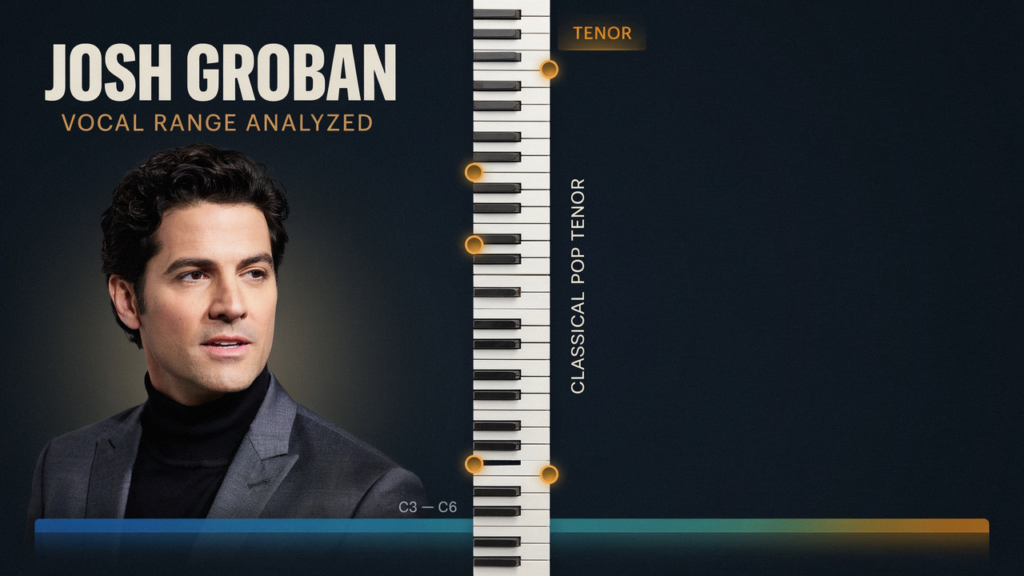
Quick Definition
Josh Groban’s vocal range refers to the span between his lowest and highest sung notes in recordings and live performances. While exact extremes vary by source, his most consistent singing sits in a lyric baritone tessitura with strong upper extension, supported by classical crossover technique rather than full operatic tenor range.
The Big Question: Baritone or Tenor?
Groban is most commonly classified as a lyric baritone with exceptional upper extension.
That means:
- His core strength sits in the baritone range.
- He can sing high notes comfortably using mix and head voice.
- His tone stays warm even in upper phrases.
If you need context for where baritones typically sit, review the baritone vocal range guide. To compare upper classifications, you can also study the tenor vocal range guide.
The reason people debate his type is simple: he sings high notes with confidence, but his tessitura sits lower than most tenors.
Range vs. Tessitura (This Is Where Singers Get Confused)
Range is your total stretch.
Tessitura is where you live.
Groban’s songs often:
- Begin in comfortable baritone territory
- Climb gradually
- Peak with sustained high phrases
- Return to mid-range strength
If you don’t understand this difference, read what vocal range actually means before comparing yourself.
You might technically reach his high notes once—but if you can’t sustain them repeatedly, your tessitura doesn’t match his.
How Groban Uses His Registers
Chest Voice
His lower and mid-range notes are rich and grounded.
The sound is resonant, not forced. He doesn’t over-darken.
Mix
As melodies rise, he doesn’t shove chest voice upward. He transitions gradually.
His mix is:
- Balanced
- Supported
- Controlled
- Stable
Head Voice
For sustained climactic notes, he often relies on head-dominant coordination.
This is why his high notes sound powerful but not shouted.
If you’re unsure how these registers feel in your own voice, measure your usable span first with the vocal range calculator.
Why His High Notes Sound Effortless
Groban’s power doesn’t come from pushing air.
It comes from:
- Early register transition
- Strong breath management
- Clear vowel shaping
- Consistent vibrato
- Resonance focus
Think of it like lifting a heavy object with proper form. It looks easy because the mechanics are correct.
If you’re testing voice tools, start with the browser mic test first.
Step-by-Step: How to Approach a Josh Groban Song
Many singers strain because they wait too long to adjust coordination.
Use this method instead.
Step 1: Identify the highest repeated note
Ignore the single highest climax note.
Look at the highest note that repeats throughout the song. That determines difficulty.
Step 2: Practice the chorus on “mum”
Keep volume moderate.
This prevents vowel spreading and over-brightening.
Step 3: Lighten before the passaggio
If you feel your voice tightening, you’re carrying too much chest weight.
Shift slightly lighter two notes before the high phrase.
Step 4: Maintain vertical space, not width
As pitch rises, avoid stretching your mouth wide.
Think tall and narrow, not wide and loud.
If high notes feel unstable, focus on singing high notes safely before pushing intensity.
A Practical Warm-Up Plan (Numbered)
Use this 10-minute sequence before attempting a Groban ballad:
- Lip trills in mid-range for 2 minutes.
- Five-note scales on “gee” moving upward gradually.
- Light sirens from mid to upper range.
- Sing the highest phrase softly once.
- Repeat at 80% volume without pushing.
This prepares coordination before emotion.
If your pitch wavers during sustained notes, strengthen control with exercises from pitch accuracy training.
One Table That Helps You Avoid Strain
| What you feel | What’s happening | What to adjust |
|---|---|---|
| Neck tightens | Too much chest weight | Lighten earlier |
| Note cracks | Late register shift | Transition sooner |
| Tone spreads | Vowel too wide | Narrow slightly |
| High notes tire you | Over-singing volume | Reduce intensity |
| Sound feels thin | Too much head dominance | Add gentle mix balance |
Self-Check: Can You Sing Groban Comfortably?
After practicing a chorus, ask:
- Can I repeat it without fatigue?
- Does my speaking voice feel normal afterward?
- Are my high notes stable at medium volume?
- Am I lifting with control rather than pushing?
- Does my jaw stay relaxed?
If your voice feels strained or hoarse, stop. Sustainable singing never feels painful.
If you’re unsure whether your voice type aligns, compare classifications in the overview of voice type categories.
Common Mistakes When Singing Josh Groban
Mistake 1: Trying to “sound operatic”
Groban is classical crossover, not full opera.
Forcing heavy, exaggerated vibrato will tire you quickly.
Fix: Keep tone natural and supported.
Mistake 2: Carrying chest voice too high
This is the most common cause of strain.
Fix: Shift to mix earlier.
Mistake 3: Increasing volume for emotion
Power does not equal loudness.
Fix: Use resonance and breath support instead.
Mistake 4: Ignoring tessitura
You might hit the high note—but not repeatedly.
Fix: Focus on where most notes sit.
Mistake 5: Skipping proper range assessment
If you don’t know your true span, you’re guessing.
Measure it first by learning how to find your vocal range.
Classical Crossover vs Opera
Groban’s technique blends classical resonance with contemporary phrasing.
Key differences from full opera:
- Less extreme projection
- More speech-like vowel clarity
- Shorter sustained high climaxes
- More mix-based transitions
If you want to see how his placement compares to standard classifications, review typical male ranges on the vocal range chart.
Realistic Expectations
Groban’s upper extension is strong—but it’s built on years of disciplined technique.
You do not need:
- Massive belting
- Excessive breath force
- Artificial darkness
You do need:
- Controlled airflow
- Early register transitions
- Balanced resonance
If you experience pain, tightness, or persistent hoarseness, rest and reassess. Progress happens through coordination—not force.
Final Coaching Perspective
Josh Groban’s voice is impressive because it is controlled.
His range works because:
- He respects his tessitura.
- He transitions smoothly.
- He avoids shouting.
- He supports every sustained note.
If you focus on those fundamentals, you’ll improve faster than by chasing extreme highs.
FAQs
1) What is Josh Groban’s vocal range?
Exact note limits vary by source, but his most consistent singing sits in a lyric baritone tessitura with strong upper extension. He can sing sustained high phrases using mix and head voice. His usable range matters more than isolated extremes.
2) Is Josh Groban a baritone or tenor?
He is generally classified as a lyric baritone with exceptional upper extension. While he can sing high notes, his core strength and tessitura align more closely with baritone territory. Voice type depends on comfort and transition points, not just high notes.
3) How many octaves can Josh Groban sing?
His total octave span appears wide for a crossover singer, but not extreme compared to trained operatic tenors. What stands out is his consistency across that span. Control and resonance make his range effective.
4) What is Josh Groban’s highest note?
His highest sustained notes typically occur in climactic ballads and are achieved using mix or head-dominant coordination. Exact pitches vary depending on performance. More important is how consistently he reaches them without strain.
5) Can beginners sing Josh Groban songs?
Some songs are accessible if transposed to a comfortable key. The challenge lies in sustained high phrases and breath control. Beginners should avoid forcing climactic notes.
6) Why do my high notes strain when I sing his songs?
You may be carrying too much chest voice upward or increasing volume instead of transitioning. Lighten earlier and reduce intensity. Stable high notes feel supported, not squeezed.
7) Do I need classical training to sing like Josh Groban?
Formal training helps, but the essential skills are breath support, smooth register transitions, and balanced resonance. Focus on coordination first. Style develops from control, not imitation.

John Mayer is a vocal analysis and music education writer specializing in vocal range testing, voice type analysis, pitch recognition, and singing improvement tools for singers, musicians, performers, and beginners. He creates practical content focused on vocal training, singing techniques, and voice analysis tools to help users better understand and improve their vocal abilities.