
Ronnie Radke’s vocal range refers to the lowest and highest pitches he has sung in recordings with Falling in Reverse, including both clean singing and distorted screams. He is typically described as a high tenor with strong upper-register flexibility and the ability to transition between melodic lines and aggressive vocal textures.
Ronnie Radke is often praised for versatility. But range debates around him usually mix up clean pitch and distorted texture. If you want the truth, you have to separate those two.
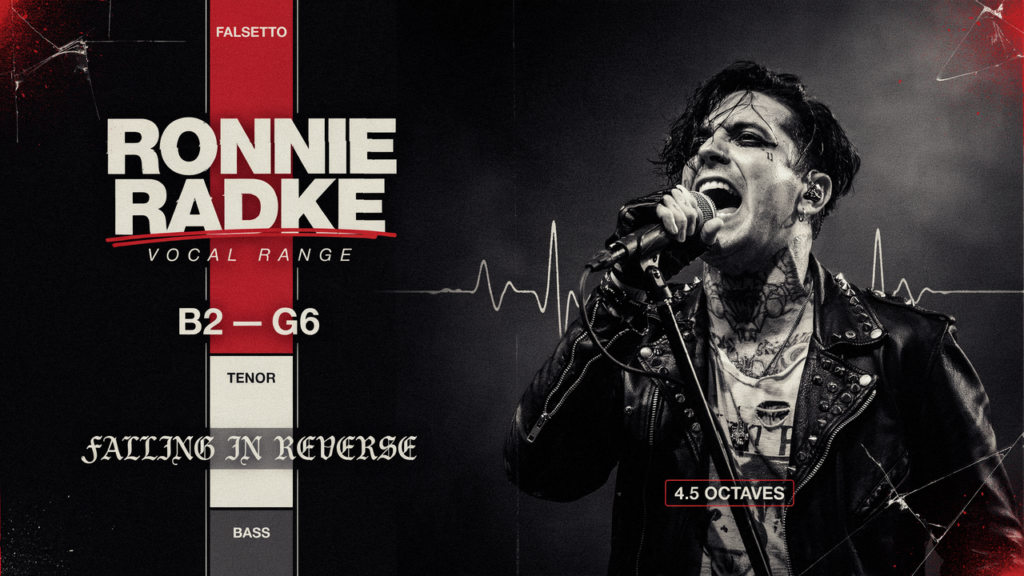
How Wide Is Ronnie Radke’s Vocal Range?
Most estimates place his overall range around four octaves when counting clean notes plus extended upper screams.
However, not all high sounds are equal.
A screamed high note may sound extreme, but the underlying pitch often sits within a mix or falsetto range. Distortion adds grit, not extra semitones.
If you’re unsure how pitch labeling works, review note names in singing so you understand what those numbers really represent.
Run the microphone check when switching headphones or audio interfaces.
Clean Singing vs Screamed Notes (This Is Critical)
Ronnie Radke moves between clean melodic lines and intense screams. That versatility creates confusion about his true range.
Think of distortion like turning up the saturation on a photo. The image looks more dramatic, but the size doesn’t change.
Clean singing
This includes chest voice, mix, and falsetto. These are pitched tones that can be sustained clearly.
Distorted screams
These often use compression and fry. The pitch is still there, but the texture masks it.
Understanding that difference prevents exaggerated octave claims.
For context, compare his upper notes to a typical tenor vocal range and you’ll see why he’s usually classified as a high tenor.
What Voice Type Is Ronnie Radke?
Ronnie Radke is generally considered a tenor. His melodies frequently sit in an upper male range, especially in choruses.
But tone color alone doesn’t define voice type.
If you want clarity before labeling your own voice, study voice types explained and focus on tessitura rather than just extremes.
Tessitura matters more than one high note
Tessitura is where you can sing repeatedly without strain.
Many of Radke’s songs sit in an upper-mid tenor zone, which supports the tenor classification.
If that concept is unclear, revisit what tessitura means and apply it to how often he lives in that range.
Register Breakdown: Where His Power Comes From
Ronnie Radke’s versatility comes from control across multiple registers.
| Register | Sound Quality | Function |
|---|---|---|
| Chest voice | Strong, direct | Speech-based clarity |
| Mix | Bright, focused | Controlled upper power |
| Falsetto | Lighter, flexible | Melodic lift |
| Distorted extension | Aggressive, compressed | Texture over pitch |
Notice something important: the highest textures are not always the highest pitches.
To see how unusual this is compared to normal male voices, check the broader human vocal range so you don’t assume every singer can access these extremes.
Step-by-Step: Building High Rock Notes Without Strain
If you want to approach Ronnie Radke–style upper range safely, build skill in layers.
1. Strengthen your midrange foundation
If your middle notes are unstable, your high notes will collapse.
Sing five-note scales on “mum” at moderate volume. Keep it speech-like, not shouted.
2. Develop head voice flexibility
Slide gently upward on “ng” (like the end of “sing”).
It should feel lighter as you ascend. If it feels heavier, you’re forcing.
3. Blend mix gradually
Say “yeah” at pitch and gently move upward.
Mix should feel like energized talking, not yelling.
If your neck tightens, reset and lighten.
4. Add distortion last
Only after you can sing the note cleanly should you experiment with texture.
Distortion is decoration. Pitch control is the foundation.
5. Measure usable range
Don’t rely on guesswork.
Use a vocal range calculator and log only notes you can repeat comfortably.
Consistency matters more than peak attempts.
If you’re trying to expand upward over time, follow principles that help you increase vocal range gradually instead of chasing dramatic jumps.
The 5 Real Skills Behind His High Notes
Ronnie Radke’s upper range isn’t random.
- Efficient breath support
- Balanced vocal fold closure
- Controlled compression
- Strategic vowel shaping
- Stylistic confidence
High notes feel bigger when vowels narrow slightly.
Think of aiming a flashlight. You don’t increase electricity — you focus the beam.
Quick Self-Check: Are You Coordinating or Forcing?
Before you attempt extreme highs, ask yourself:
- Can I sing the note softly first?
- Does my throat feel relaxed?
- Can I repeat it three times?
- Is my jaw loose?
- Does my speaking voice feel normal afterward?
If two or more answers are “no,” you’re pushing.
High notes should feel lighter as you improve, not heavier.
If pitch control slips under pressure, run a pitch accuracy test to confirm you’re not drifting sharp or flat when intensity increases.
Common Mistakes When Copying Ronnie Radke
Confusing distortion with pitch
Texture doesn’t equal range.
You can sound aggressive without being higher.
Forcing chest voice upward
This creates tension quickly.
Let the sound thin as you ascend.
Singing too loudly
Volume and pitch are separate controls.
If you can’t sing it at medium volume, you don’t own it yet.
Ignoring recovery
Scream-style vocals require rest.
If your voice feels hoarse or scratchy, stop.
Review foundational vocal health tips so ambition doesn’t override safety.
Comparing anatomy
Ronnie Radke’s resonance structure and vocal fold thickness are unique.
Your goal is skill development, not imitation.
For perspective, compare your numbers to the average vocal range instead of extreme performers.
Realistic Expectations
Not every tenor will develop extreme upper screams.
Not every voice can maintain aggressive textures nightly without adaptation.
Longevity matters more than momentary extremes.
Your voice is not a disposable instrument.
Think of it like athletic training. You build gradually. You recover. You adjust.
Range growth comes from coordination and repetition, not force.
What Makes His Range Impressive
It’s not just the highs.
It’s the transition between clean melody and aggressive texture without losing pitch.
That flexibility is harder than simply hitting one extreme note.
If you build clean mix, flexible head voice, and controlled breath pressure, you build the foundation for similar versatility.
Range is measurable.
Control is what makes it musical.
FAQs
1) What is Ronnie Radke’s vocal range?
Ronnie Radke is generally described as a high tenor with a range spanning multiple octaves when including clean notes and extended screams. Exact numbers vary depending on how distortion is counted. His strongest area sits in an upper-mid tenor range.
2) What is Ronnie Radke’s highest note?
His highest notes often appear in intense scream sections. Clean sustained notes should be considered separately from distorted highs. Exact pitch claims vary by performance.
3) Is Ronnie Radke a tenor?
Yes, he is typically classified as a tenor due to where his melodies and tessitura sit. His upper mix is a defining part of his sound.
4) Does Ronnie Radke use whistle register?
Most of his extreme highs are distorted or compressed upper extensions rather than true whistle register. Distortion can make notes sound higher than they are. Clear whistle production is rare in male rock vocals.
5) How can I train to sing like Ronnie Radke?
Build clean mix and head voice first. Add controlled compression only after pitch stability is consistent. Never force scream techniques without proper coordination.
6) Are his screams actual notes?
Yes, there is usually a pitch underneath the distortion. The texture can make it harder to perceive clearly, but pitch still exists.
7) What’s the safest way to practice rock screams?
Strengthen clean upper range first, practice moderate compression carefully, and stop immediately if you feel pain or persistent hoarseness. Consistency and rest protect your range long term.

John Mayer is a vocal analysis and music education writer specializing in vocal range testing, voice type analysis, pitch recognition, and singing improvement tools for singers, musicians, performers, and beginners. He creates practical content focused on vocal training, singing techniques, and voice analysis tools to help users better understand and improve their vocal abilities.