
Sia’s vocal range spans roughly three octaves in recorded material, extending from a lower mezzo foundation into powerful high belts in the upper soprano territory. She is generally classified as a mezzo-soprano with an exceptionally strong upper mix and belt, allowing her to sustain high notes with intensity and emotional power.
That’s the overview. Now let’s break it down clearly and practically.
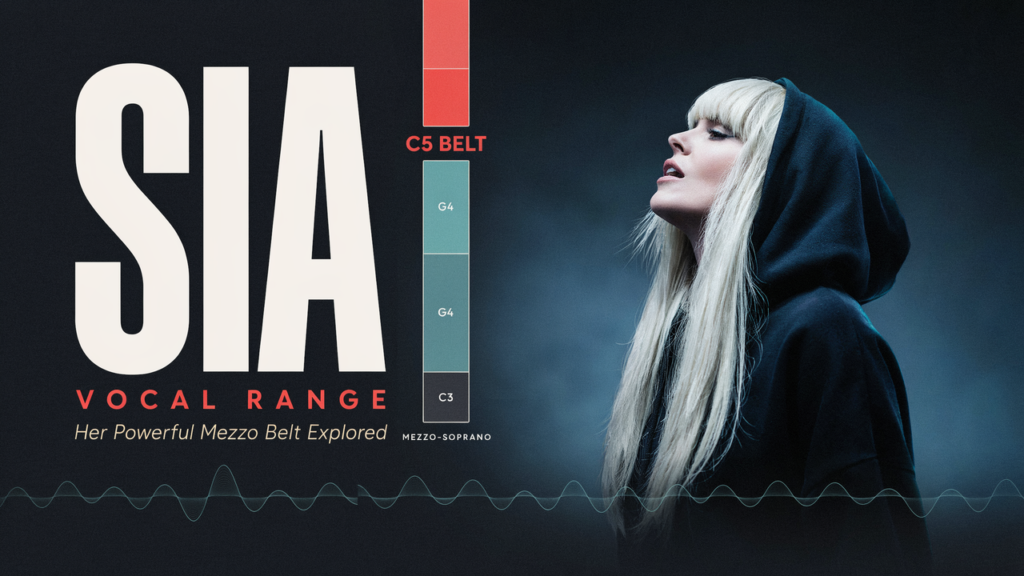
What Is Sia’s Vocal Range?
When we measure vocal range, we’re identifying the lowest and highest usable notes a singer can produce with control.
Sia demonstrates:
- A grounded lower register typical of a mezzo-soprano
- A strong, speech-based midrange
- High, sustained belts that extend into upper soprano notes
If you’re unfamiliar with range terminology, review what vocal range means before comparing yourself to a powerful belter like Sia.
Her total span is impressive. But more important than the size of the range is how she uses it — especially her upper mix.
Use the root-note scale tool to practice consistent pitch relationships.
What Voice Type Is Sia?
Sia is most commonly described as a mezzo-soprano.
Why Mezzo-Soprano?
Her comfortable singing zone (tessitura) sits in the midrange rather than consistently high soprano territory. Her tone has warmth and weight beneath the brightness.
If you compare her placement to the standard mezzo-soprano vocal range, the alignment is clear.
Mezzo vs Soprano
Sopranos typically live higher and lighter. Mezzo-sopranos sit slightly lower with a fuller middle.
Sia’s strength is not airy soprano head voice. It’s muscular upper mix.
For contrast, reviewing the soprano vocal range helps clarify the distinction.
Register Breakdown
Understanding her registers explains why her high notes sound so powerful.
Chest Voice
Her lower notes carry firmness and emotional depth. They are not extremely low, but they are solid.
Mixed Voice
This is where Sia dominates.
Her high belts are not pure chest voice being shoved upward. They are coordinated mix — chest resonance blended with head resonance.
Head Voice
She uses head voice for color occasionally, but her signature sound comes from belt-dominant mix rather than floaty head tone.
If you want to visualize where your own registers sit, a vocal range chart can make transitions easier to understand.
How Her Range Compares to the Average Female Singer
Most untrained female singers have around two octaves of comfortable range.
Sia’s usable span exceeds that, especially because of her sustained high belts.
Here’s a simplified comparison:
| Category | Typical Span | Strength Area |
|---|---|---|
| Average Female Singer | ~2 octaves | Midrange |
| Trained Mezzo | 2–3 octaves | Mix |
| Sia | ~3 octaves | Powerful upper mix |
If you want to compare yourself accurately, use a vocal range calculator after warming up.
How Sia Belts High Notes
Belting is not screaming.
Belting is controlled intensity built on support and resonance.
Sia’s belts work because:
- Airflow is steady, not explosive
- The larynx remains relatively stable
- Vowels are slightly narrowed
- Resonance is forward
Think of belting like pushing a car uphill. You don’t jerk it forward. You apply consistent pressure.
If you’re training upper extension, safe technique guidance from how to sing high notes prevents throat tension.
Step-by-Step: Building a Safer Upper Mix
Do not jump straight into high-volume belting.
Build coordination first.
- Start with gentle lip trills in your midrange.
- Slide upward slowly on “gee” or “nay.”
- Keep the sound bright but not shouted.
- Allow resonance to shift forward naturally.
- Increase volume only after pitch feels stable.
High notes should feel energized, not squeezed.
If you struggle to stay on pitch during upper notes, developing control through a pitch accuracy test helps more than pushing louder.
Common Mistakes Singers Make When Trying to Belt
- Dragging heavy chest voice too high
- Locking the jaw
- Raising the shoulders while inhaling
- Belting without warm-up
- Ignoring vocal fatigue
Belting should feel supported from the body, not forced in the throat.
If your neck tightens or you feel burning in your throat, stop. That’s your voice asking for a reset.
If you’re unsure whether your natural range sits lower, exploring alto vs mezzo-soprano differences can help clarify your classification.
Self-Check: Do You Share a Similar Profile?
Ask yourself:
- Is your strongest singing area in the midrange?
- Do higher notes feel possible with brightness rather than heaviness?
- Does your voice naturally carry intensity?
- Can you sing loudly without immediate strain?
If yes, you may have mezzo tendencies with belt potential.
If your voice feels lighter and higher overall, revisit the typical average female vocal range for context.
Realistic Expectations for Belting
Sia’s high belts are the result of years of use and professional conditioning.
You cannot safely build that level of endurance in a few weeks.
Healthy belt development happens gradually. Often progress shows up as:
- Less strain
- Clearer tone
- Better stamina
- Smoother transitions
Pain is not part of training. Fatigue may happen. Sharp discomfort is not acceptable.
Consistency beats intensity.
The Bigger Lesson
Sia’s vocal power isn’t just about hitting high notes.
It’s about control at high intensity.
She maintains pitch center while increasing emotional output. That’s coordination.
The goal isn’t to scream higher.
The goal is to sing higher without losing stability.
When you build mix correctly, range expands naturally.
FAQs
1. How many octaves can Sia sing?
She demonstrates roughly three octaves in recorded material, with strong upper mix extension.
2. Is Sia a soprano?
She is generally classified as a mezzo-soprano because her comfortable tessitura sits in the midrange rather than consistently high soprano territory.
3. What is Sia’s highest note?
Her highest notes are typically achieved through powerful mixed belt rather than pure head voice.
4. Does Sia scream or belt?
She belts. While the sound is intense, it is coordinated mix rather than uncontrolled screaming.
5. Is her vocal range considered wide?
Yes, especially considering her sustained high belts. However, control and endurance are more impressive than raw octave count.
6. Can beginners belt like Sia?
Not immediately. Safe belting requires gradual coordination development and strong breath support.
7. How can I safely build belt strength?
Warm up thoroughly, strengthen mix voice, avoid pushing chest upward, and stop immediately if you feel throat tension or pain.

John Mayer is a vocal analysis and music education writer specializing in vocal range testing, voice type analysis, pitch recognition, and singing improvement tools for singers, musicians, performers, and beginners. He creates practical content focused on vocal training, singing techniques, and voice analysis tools to help users better understand and improve their vocal abilities.