
Justin Timberlake’s vocal range refers to the span between his lowest and highest usable notes in singing. Most analyses place his voice from the lower second octave up into the fifth octave, with strong access to high notes through mix and falsetto. He is generally classified as a contemporary tenor.
That summary gives you numbers. But as a coach, I care more about how those notes are produced and where his voice is most comfortable.
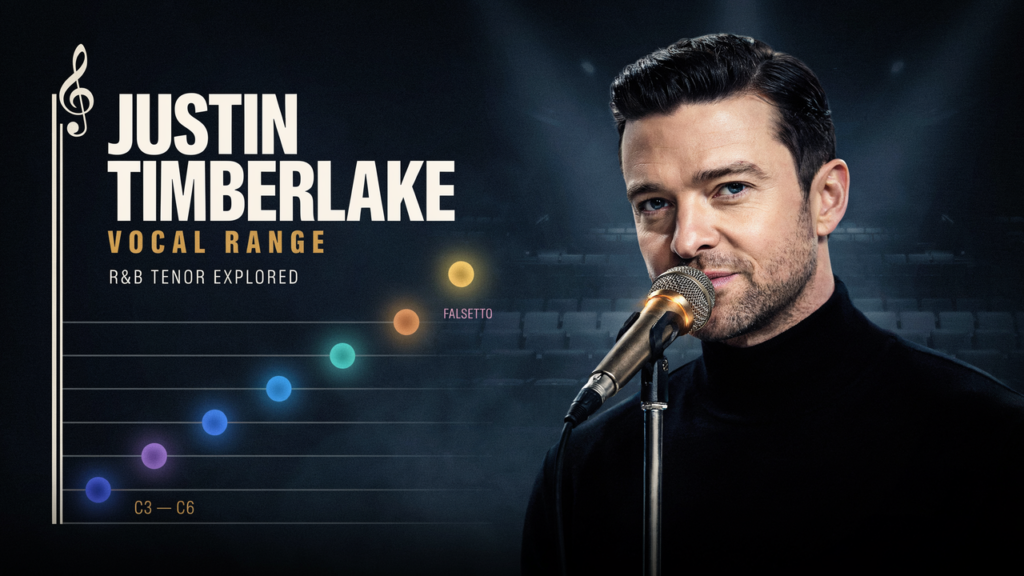
What Is Justin Timberlake’s Vocal Range?
His lower notes sit in the lower male register, but they are not the focus of his sound. His strength is clearly in the upper mid-range and high register.
He consistently sings above A4 with clarity, which supports the tenor classification. If you’re unsure how that fits into the bigger picture, this overview of the full human vocal range helps you visualize where those notes sit.
Lowest Notes
His lowest recorded notes fall in the second octave. They are usable, but they are lighter and not as resonant as his upper tones.
Highest Notes
His upper notes extend into the fifth octave, especially in mix and falsetto. These are bright, agile, and stylistically clean rather than heavy belted sounds.
To understand how this compares structurally, look at a breakdown of the tenor vocal range explained.
Total Span
Counting falsetto, his full span approaches three octaves. However, usable modal range is slightly narrower. This distinction is critical when evaluating real singing ability.
The warm-up scale builder is useful for daily vocal routines.
Is Justin Timberlake a Tenor?
In contemporary pop classification, yes.
A tenor typically has:
- Easy access to higher fourth octave notes
- Strong upper mix
- Brighter natural tone
- Higher passaggio compared to baritone
Timberlake’s tessitura — where he sings most comfortably — sits in that tenor zone.
If you’re still unsure where you fall, reviewing the differences in this guide to male voice types can clarify things.
How He Produces His High Notes
The real story isn’t just range — it’s coordination.
Chest Voice
His chest voice carries clarity without being overly heavy. That lighter chest setup allows easier transitions upward.
Mixed Voice
Much of his power above A4 comes from mix. Mix blends chest and head resonance, allowing high notes without shouting.
Think of mix like dimmer lighting instead of a harsh on/off switch. It smooths the transition between registers.
Falsetto
He frequently uses falsetto for stylistic effect. Falsetto extends the top of the range but has less vocal fold closure than modal voice.
If you want to test how high you can sing objectively, use a vocal range calculator to see your actual top note rather than guessing.
How Rare Is His Range?
Most adult men sit in baritone territory. Tenors with strong upper mix are less common but not rare in pop music.
Here’s a simplified comparison:
| Category | Typical Strength Area | Upper Comfort |
|---|---|---|
| Average Male | Mid-range | Limited above A4 |
| Baritone | Lower-mid range | Moderate highs |
| Tenor (like Timberlake) | Upper-mid range | Strong above A4 |
For perspective, compare this to the average vocal range for men.
The difference isn’t just how high he goes — it’s how controlled and consistent those notes sound.
Can You Sing Like Justin Timberlake?
This is the hidden question behind most searches.
The honest answer: you can train coordination and flexibility, but your biology sets certain limits.
Before attempting high notes, measure your starting point. You can check pitch accuracy using a pitch detector tool to ensure you’re not sliding or straining.
Step-by-Step: Testing Your Upper Range Safely
- Warm up with gentle humming or lip trills for 5–10 minutes.
- Start in a comfortable mid-range pitch.
- Glide upward on “oo” or “ee” slowly.
- Stop at the first sign of tightness.
- Repeat softly at lower volume.
High notes should feel lifted and buoyant, not squeezed or forced.
If your neck muscles tense or your throat feels dry afterward, you’ve pushed too far.
Quick Self-Check: Do You Lean Toward Tenor?
Ask yourself:
- Are high notes easier than low ones?
- Does your speaking voice sit higher than most men?
- Can you sing above A4 without shouting?
- Do low notes feel weak or unstable?
If you answered yes to most of these, you may lean tenor. If not, forcing your voice upward can cause strain.
To test accurately, follow structured steps in this guide on how to find your vocal range.
Common Mistakes When Trying to Copy His Range
Counting Falsetto as Full Voice
Falsetto extends range but does not carry the same weight as modal voice. Inflating octave counts leads to unrealistic expectations.
Shouting High Notes
Many singers try to muscle through upper notes with chest voice. That creates tension and fatigue.
Ignoring Tessitura
Just because you can hit a note once doesn’t mean it belongs in your working range.
Skipping Proper Training
Range development requires coordination exercises. If your goal is expansion, focus on structured approaches such as those outlined in how to increase your vocal range safely.
Realistic Expectations About High Notes
Most singers can improve upper access by one to three semitones with proper training. Massive jumps are rare.
High notes depend on balance, not force. Imagine balancing a spinning plate. The more you grip it, the faster it falls. Precision creates stability.
If your voice becomes hoarse, fatigued, or scratchy, rest immediately. Healthy singing always comes first.
What Makes His Voice Stand Out
Range alone doesn’t create impact. His strengths include:
- Smooth register transitions
- Consistent breath support
- Clean, controlled falsetto
- Agile phrasing
His coordination allows him to use high notes musically instead of just showing them off.
If you want to improve upper consistency, structured drills found in vocal exercises to increase range can help — but always stay within comfort.
Coaching Takeaway
Justin Timberlake’s vocal range reflects a well-developed tenor instrument with strong upper mix and stylistic falsetto control.
Your goal shouldn’t be to match his highest note. It should be to understand your own instrument, strengthen transitions, and build consistency within your healthiest range.
Control, not comparison, is what builds a reliable voice.
FAQs
1. What is Justin Timberlake’s highest note?
His highest notes reach into the fifth octave, usually produced in mix or falsetto. These notes are light and agile rather than heavy belted tones.
2. What is his lowest recorded note?
His lowest notes fall in the second octave. They are usable but not the core strength of his voice.
3. How many octaves can Justin Timberlake sing?
Including falsetto, his total span approaches three octaves. His comfortable modal range is slightly smaller.
4. Is Justin Timberlake a tenor?
Yes. Based on tessitura and upper comfort, he fits the contemporary tenor category.
5. Does he rely on falsetto for high notes?
He uses falsetto frequently for stylistic effect, but many high notes are produced in mix rather than pure falsetto.
6. Can most men sing as high as he does?
Not comfortably. Many adult men sit lower in baritone territory, making sustained high notes more challenging.
7. Can I train to sing like Justin Timberlake?
You can improve upper coordination and range with proper technique. However, your natural voice type determines your long-term limits.

John Mayer is a vocal analysis and music education writer specializing in vocal range testing, voice type analysis, pitch recognition, and singing improvement tools for singers, musicians, performers, and beginners. He creates practical content focused on vocal training, singing techniques, and voice analysis tools to help users better understand and improve their vocal abilities.