
SZA’s vocal range spans roughly two and a half to three octaves in recorded material, extending from a warm lower register into a flexible upper register that includes mixed voice and head voice. She is most commonly classified as a mezzo-soprano, with a tessitura centered in the midrange rather than the highest soprano territory.
That’s the technical summary. Now let’s break down what that really means — and what you can apply to your own singing.
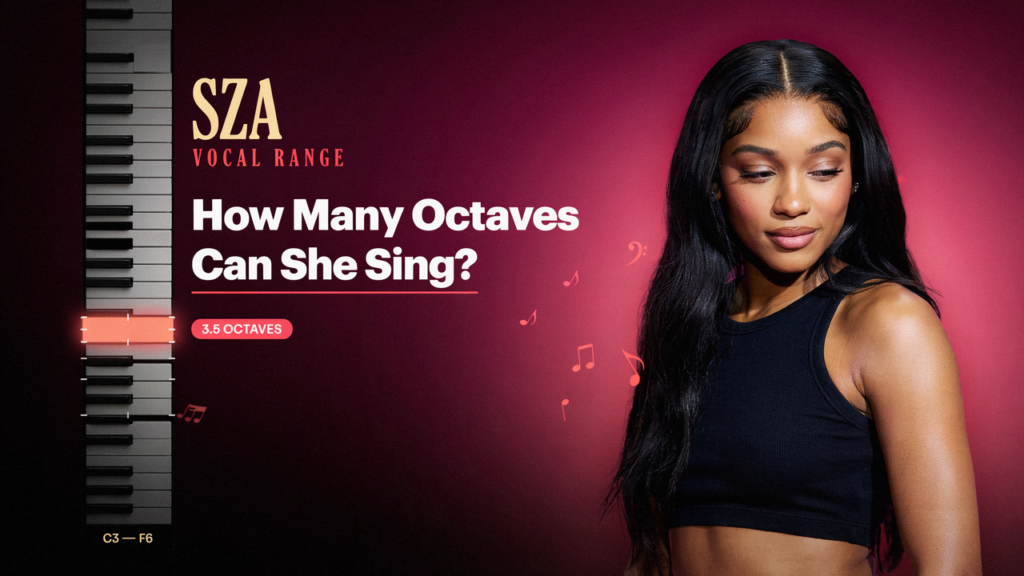
What Is SZA’s Vocal Range?
Vocal range measures the lowest and highest notes you can sing with control and usable tone.
SZA demonstrates:
- A grounded lower register
- A dominant midrange
- Controlled upper notes in mix and head voice
If you’re unsure how range is defined, reviewing what vocal range means will help you interpret classifications correctly.
Her range isn’t extreme in the way of dramatic belters. Her strength is tonal control and stylistic flexibility.
You can quickly confirm a pitch by humming into the note finder tool.
Is SZA a Mezzo-Soprano or Soprano?
She is most often described as a mezzo-soprano.
Why Mezzo?
Her tessitura — the range where she sounds most comfortable and expressive — sits in the middle of the female range.
When you compare her placement to the typical mezzo-soprano vocal range, the alignment becomes clear.
Why Not Soprano?
Sopranos typically live higher and sustain brighter upper notes consistently. If you explore the standard soprano vocal range, you’ll notice that SZA’s strongest notes sit slightly lower.
Voice type is about comfort and tonal center — not just the highest note you can reach.
Register Breakdown
Understanding her registers explains her signature sound.
Chest Voice
Her lower register has warmth and softness. It’s not heavy or overly dark.
Mixed Voice
Most of her stronger upper notes come from mix — a blend of chest and head coordination. This allows her to sing high without sounding forced.
Head Voice
She uses head voice and lighter production for stylistic effect, especially in emotional or airy passages.
If you want to visualize where these registers sit, a vocal range chart can help you compare your own placement.
Modal Voice vs Head Voice
One common confusion is assuming breathy singing equals soprano.
Breathy tone is a stylistic choice. It does not automatically define voice type.
Here’s a simplified comparison:
| Element | Modal Voice | Head Voice |
|---|---|---|
| Cord Closure | Fuller | Lighter |
| Tone | Richer | Airier |
| Power | Stronger | Softer |
| Typical Use | Core melodies | Emotional lift |
SZA uses both — often switching smoothly between them.
If you want to measure your usable modal range accurately, try a vocal range calculator before including lighter head voice notes.
How Her Range Compares to the Average Female Singer
Most untrained female singers have about two octaves of comfortable range.
SZA’s span exceeds that slightly, especially when including head voice extension.
For context, check the benchmarks in average female vocal range.
But remember: musical control matters more than sheer octave count.
How She Sings High Without Belting Hard
SZA often reaches higher notes without aggressive belting.
She does this by:
- Allowing chest weight to reduce
- Keeping airflow steady
- Letting resonance shift upward
- Avoiding excessive volume
Think of it like lifting something lightly overhead instead of throwing it upward.
If you want to train upper notes safely, reviewing how to sing high notes will help you avoid strain.
Step-by-Step: Building a Smooth Upper Register
Do not force your voice upward.
Build coordination gradually.
- Warm up gently with humming in midrange.
- Slide upward on a light “woo” or “gee.”
- Keep your jaw relaxed.
- Let the tone brighten naturally.
- Increase volume only after pitch feels stable.
If pitch control feels inconsistent, practicing with a pitch accuracy test can improve stability before adding intensity.
High notes should feel lifted, not pushed.
Common Mistakes Singers Make
- Forcing chest voice too high
- Confusing breathiness with weakness
- Locking the jaw or lifting the chin
- Over-singing soft passages
- Ignoring vocal fatigue
High notes don’t need to be loud to be effective.
If you feel throat tightness or sharp discomfort, stop immediately. That’s a coordination issue, not a strength issue.
Self-Check: Do You Share a Similar Vocal Profile?
Ask yourself:
- Does your strongest singing sit in the midrange?
- Do higher notes feel easier when sung lightly?
- Is your speaking voice moderately placed rather than very high?
- Do you naturally lean toward soft or breathy phrasing?
If yes, you may have mezzo tendencies.
If your comfort zone consistently feels higher and brighter, you might lean soprano.
Voice type is about consistency — not isolated notes.
Realistic Expectations for Range Development
SZA’s control comes from coordination, not extreme range.
You cannot safely expand your range by forcing volume.
Healthy progress looks like:
- Smoother transitions
- Reduced tension
- Stable pitch
- Improved endurance
Mild fatigue can happen during training. Pain should not.
Consistency builds range. Pushing shortens it.
The Bigger Lesson
SZA’s vocal identity isn’t built on high belting.
It’s built on control, tone, and emotional nuance.
Her strength lies in midrange dominance and smooth transitions between modal and head voice.
The goal isn’t to imitate her tone.
The goal is to understand where your own voice naturally thrives — and develop that area fully.
When your tessitura is strong, your range becomes more usable and expressive.
FAQs
1. How many octaves can SZA sing?
She demonstrates roughly two and a half to three octaves in recorded material, including modal and head voice extension.
2. Is SZA a mezzo-soprano?
Yes, she is generally classified as a mezzo-soprano due to her midrange-centered tessitura.
3. What is SZA’s highest note?
Her highest notes are typically accessed through mix or head voice rather than heavy chest belting.
4. Does breathy singing mean soprano?
No. Breathy tone is stylistic and does not determine voice classification.
5. Is her vocal range considered wide?
Her range is solid and versatile, though her artistry relies more on control and tone than extreme extension.
6. Can beginners sing in her range safely?
Yes, especially if your voice naturally sits in the midrange. Avoid forcing higher notes.
7. How can I safely improve my upper register?
Warm up consistently, lighten chest voice as you ascend, strengthen mix coordination, and stop immediately if you feel pain or persistent strain.

John Mayer is a vocal analysis and music education writer specializing in vocal range testing, voice type analysis, pitch recognition, and singing improvement tools for singers, musicians, performers, and beginners. He creates practical content focused on vocal training, singing techniques, and voice analysis tools to help users better understand and improve their vocal abilities.