
Kurt Cobain’s vocal range refers to the span between his lowest and highest usable singing notes. Most analyses place his voice from the second octave up into the fifth octave, with a working range centered in the upper baritone to tenor territory. He is commonly classified as a tenor with a gritty, distorted tone.
That gritty tone often confuses people. His voice sounded raw and aggressive, but the pitch range itself was not extreme. What made him unique was how he used it.
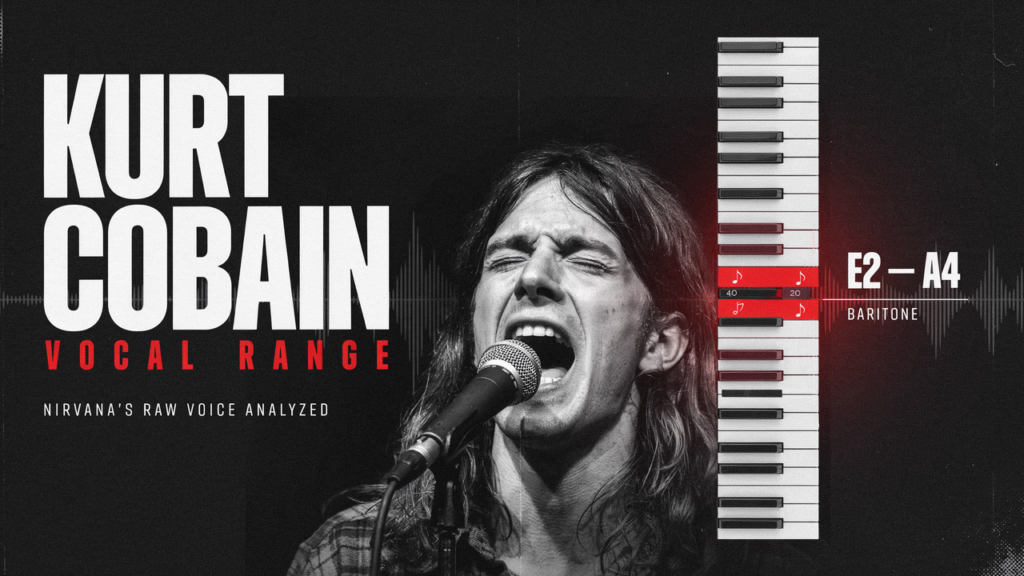
What Was Kurt Cobain’s Vocal Range?
His lowest notes sat in the lower second octave. They were present but not heavily emphasized in his music.
His strongest singing lived in the third and fourth octaves, where he delivered powerful belts and emotionally charged phrases.
If you want perspective on how those notes compare to other men, reviewing the full human vocal range helps clarify where they sit.
Lowest Notes
His low notes were usable but lighter and less resonant than a true baritone or bass.
Highest Notes
His highest notes extended into the fifth octave, often delivered with distortion or intense chest-dominant mix.
To understand how that compares structurally, look at a breakdown of the tenor vocal range explained.
Total Span
Including clean singing and controlled distortion, his total span approached three octaves. However, his tessitura — where he sang most comfortably — was in the mid-to-upper male range.
Range shows potential. Tessitura shows comfort.
If you’re working on intonation, use the note finder to verify each target pitch.
Was Kurt Cobain a Tenor or Baritone?
This debate appears often.
While his tone had a darker color at times, classification is based on tessitura and passaggio, not tonal mood.
Most vocal coaches consider him a tenor because:
- He comfortably sang above A4
- His upper register was strong and consistent
- His mid-range sat higher than typical baritones
If you’re unsure how voice types differ, the overview of male voice types can clarify.
Tone color can sound dark, but that doesn’t automatically make someone a baritone.
Distortion vs Pitch: Important Difference
Many singers mistake distortion for range.
Distortion is texture. Pitch is measurable frequency.
Cobain’s scream-like moments often sat within a typical tenor range. The grit made them feel more intense.
Think of distortion like turning up the overdrive on a guitar. The note doesn’t change — the texture does.
Understanding this prevents overestimating octave span.
Clean Voice vs Grit
He didn’t only scream. He could sing softly and cleanly when needed.
Clean Singing
His clean tone showed a clear tenor placement with forward resonance.
Distorted Belts
His high-intensity moments combined chest-dominant mix with rasp.
If you want to test your own clean upper limit, use a vocal range calculator to identify actual pitches before adding grit.
How Rare Was His Range?
His measurable range was solid but not biologically extreme.
Here’s a simple comparison:
| Category | Comfortable Focus | Upper Strength |
|---|---|---|
| Average Male | Mid-range dominant | Limited above A4 |
| Tenor | Upper-mid strong | Strong to B4–C5 |
| Kurt Cobain | Upper-mid dominant | Consistent above A4 |
For context, compare this with the average male vocal range.
The difference was intensity and emotional delivery, not just pitch height.
Can You Sing Like Kurt Cobain?
This is the real question most rock singers have.
The answer: you can train grit and upper mix, but you must do it safely.
Before attempting distortion, check pitch accuracy with a pitch detector tool.
Step-by-Step: Testing Your Upper Rock Range Safely
- Warm up gently with humming or lip trills.
- Sing a clean note around your mid-range.
- Glide upward slowly without adding distortion.
- Identify your highest clean, tension-free note.
- Only after that, experiment lightly with rasp.
Never add distortion to a note you cannot sing cleanly first.
If your throat feels scratched or painful, stop immediately.
Quick Self-Check: Do You Lean Tenor?
Ask yourself:
- Is your speaking voice mid-to-high rather than low?
- Can you sing A4 comfortably without shouting?
- Do high notes feel reachable even if gritty?
- Do low notes feel weaker than mid-range notes?
If most answers are yes, you likely lean tenor.
To verify accurately, follow the structured approach in this guide on how to find your vocal range.
Common Mistakes When Trying to Copy His Sound
Screaming from the Throat
True rock grit comes from controlled airflow and false cord engagement, not squeezing the throat.
Confusing Volume with Power
Yelling is not belting. Power comes from resonance and support.
Skipping Clean Foundation
You must develop clean pitch control before adding distortion.
Ignoring Recovery
High-intensity singing requires rest. Hoarseness is a warning sign, not proof of effort.
If you want to strengthen your upper notes safely, follow principles outlined in how to sing high notes safely.
Realistic Expectations About Expanding Range
Most singers can extend upward by one to three semitones with consistent training.
Extreme octave increases are rare.
Think of vocal range like vertical leap. You can improve technique and strength, but you cannot suddenly double your height.
Healthy singing should never leave you in pain.
Tessitura and Song Selection
Kurt Cobain wrote songs that sat well in his natural tessitura.
This is critical.
If your voice sits lower, you may need to transpose songs to avoid strain.
Understanding your natural center prevents long-term damage.
Coaching Takeaway
Kurt Cobain’s vocal range was strong and tenor-based, but not unusually massive.
What made his voice iconic was emotional intensity, texture, and fearless delivery.
Your goal should not be to copy his scream. It should be to build a stable clean foundation, develop safe grit technique, and expand gradually within your natural range.
That’s how you build a sustainable rock voice.
FAQs
1. What was Kurt Cobain’s highest note?
His highest notes extended into the fifth octave, often delivered with distortion or strong chest-dominant mix.
2. What was his lowest recorded note?
His lowest notes sat in the lower second octave, though his music rarely emphasized deep lows.
3. How many octaves could Kurt Cobain sing?
Including clean and distorted singing, his span approached three octaves. His working range was centered in the upper male register.
4. Was Kurt Cobain a tenor or baritone?
Most vocal coaches classify him as a tenor based on tessitura and upper comfort.
5. Did Kurt Cobain damage his voice?
Sustained high-intensity singing can cause fatigue. Safe technique and recovery are essential for longevity.
6. Is distortion the same as range?
No. Distortion changes texture, not pitch height. You must separate tone from measurable range.
7. Can I train to sing like Kurt Cobain?
You can develop upper mix and controlled grit with proper technique. However, your natural voice type determines your sustainable limits.

John Mayer is a vocal analysis and music education writer specializing in vocal range testing, voice type analysis, pitch recognition, and singing improvement tools for singers, musicians, performers, and beginners. He creates practical content focused on vocal training, singing techniques, and voice analysis tools to help users better understand and improve their vocal abilities.