
A 4 octave vocal range refers to the ability to sing notes spanning four full octaves (48 semitones) from the lowest to the highest consistently usable pitches. While often described online as extraordinary, a four-octave range should be evaluated carefully and scientifically, not as a shortcut to judging vocal ability.
This article explains what a 4-octave vocal range truly means, how rare it actually is, how it should be measured, and why vocal health, control, and consistency matter more than extreme range claims.
What Is a 4 Octave Vocal Range?
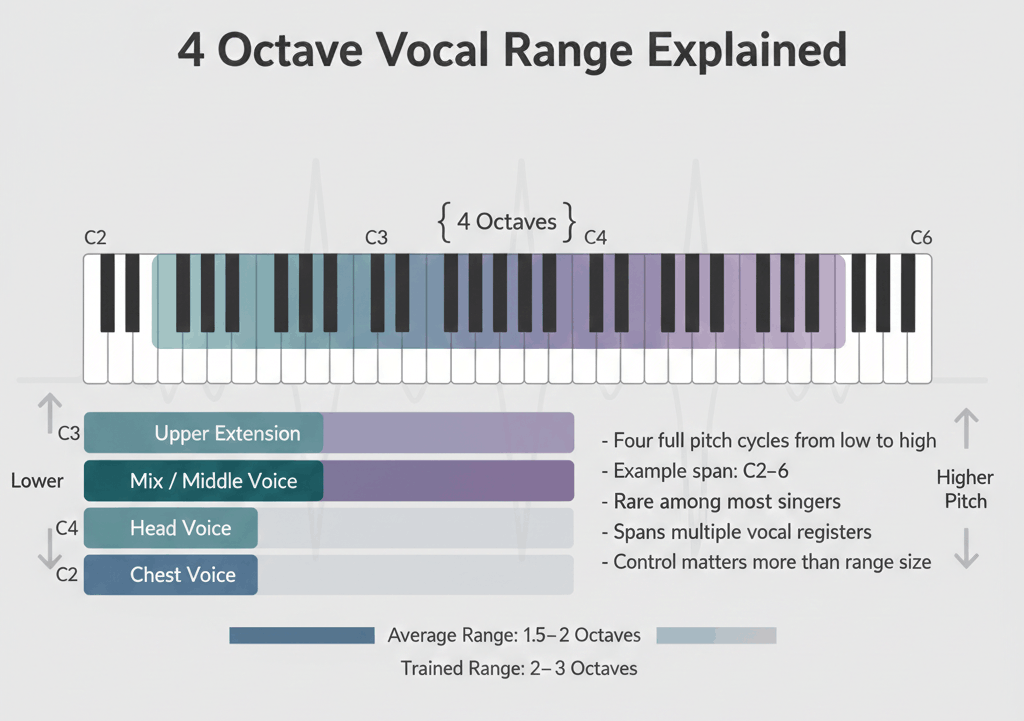
A 4 octave vocal range means a singer can perform notes across four full octaves, which is considered rare and highly impressive. It allows strong control over low, mid, and high notes, offering exceptional versatility, power, and expressive range across music styles.
In musical terms, an octave is the interval between two notes where the higher note vibrates at twice the frequency of the lower one. For example, C3 to C4 represents one octave.
A 4 octave vocal range therefore spans four such intervals, such as:
- C2 → C6
- A2 → A6
A 4 octave vocal range is the ability to sing across four full octaves (48 semitones) with stability, repeatability, and without vocal strain.
Crucially, vocal range must be defined by usable notes, not by isolated extremes. Notes that are unstable, painful, or inconsistent do not represent functional vocal ability. If you want to test your range, click here
How Rare Is a 4 Octave Vocal Range?
A true, functional 4-octave vocal range is rare, even among experienced singers.
Realistic benchmarks
- Untrained voices: ~1.5–2 octaves
- Trained singers: ~2.5–3 octaves
- Exceptional cases: 4 octaves or more
Many online claims exaggerate vocal range by counting:
- Uncontrolled falsetto
- Vocal fry
- Whistle-like sounds without pitch stability
These inflate octave counts without reflecting musical usefulness. A realistic comparison by voice category can be found in the vocal range chart.
Why a 4 Octave Vocal Range Is Not Required for Great Singing
A common misconception is that wider range equals better singing. In reality, most vocal repertoire across genres—pop, classical, musical theatre, jazz, and contemporary styles—requires far less than four octaves.
What consistently matters more than octave count:
- Pitch accuracy
- Breath management
- Register coordination
- Endurance and vocal stamina
- Musical expression
Many successful professional singers perform at a very high level with two to three octaves. To put range expectations into context, see how many octaves singers typically have.
Comfortable Range vs Extreme Notes
One of the biggest sources of misinformation online is confusing:
- Absolute extremes with
- Comfortable, repeatable range
A functional 4-octave range means the singer can:
- Maintain pitch accuracy
- Sustain consistent tone
- Sing repeatedly without fatigue or discomfort
Vocal pedagogy focuses on tessitura—the range where the voice functions best—rather than maximum highs and lows. If pitch becomes unreliable at the edges of the range, improving coordination is more important than pushing higher (see how to improve pitch accuracy).
Can Training Give You a 4 Octave Vocal Range?
For most singers, no—and that is not a failure.
Training can:
- Improve register coordination
- Increase efficiency and consistency
- Expand usable extremes modestly
Training cannot:
- Change vocal fold length or thickness
- Override anatomical limits
- Guarantee a specific octave count
Most singers safely gain a few semitones to roughly one octave with proper technique. Responsible development focuses on sustainability, as explained in how to increase vocal range safely.
How to Measure a 4 Octave Vocal Range Correctly
Accurate measurement requires discipline, not guesswork:
- Warm up gently
- Begin at your lowest comfortable note
- Ascend gradually without pushing
- Stop at the highest repeatable pitch
Whispering, shouting, or forcing extremes can distort results and increase injury risk. For objective measurement, use a pitch-based tool such as the vocal range calculator rather than relying on perception alone.
Voice Type and a 4 Octave Range
A four-octave range can theoretically occur in any voice type, but range does not determine classification. Voice type depends on:
- Tessitura
- Timbre
- Resonance balance
If classification is unclear, the voice type classifier can help guide understanding without relying solely on octave count.
Common Myths About 4 Octave Vocal Ranges
- More octaves automatically mean better singing
- Anyone can reach four octaves with enough practice
- Celebrity vocal ranges are precise and verified
In practice, many celebrity ranges are estimates, and extreme range claims are often exaggerated. Vocal health and longevity are more meaningful indicators of vocal success.
Key Takeaways
- A 4 octave vocal range spans 48 semitones
- It is rare, even among trained singers
- Functional range matters more than extremes
- Vocal skill is multi-dimensional, not numerical
- Accurate measurement prevents misinformation
Vocal testing tools are found at https://vocalrangetester.com/.