
The Weeknd (Abel Tesfaye) has a vocal range that spans roughly three octaves in recorded performances, extending from a comfortable lower register up into strong mixed voice and a distinctive, flexible falsetto. He is generally classified as a tenor, with a tessitura centered in the higher male range.
That’s the technical summary. Now let’s break it down in a way that actually helps you understand your own voice.
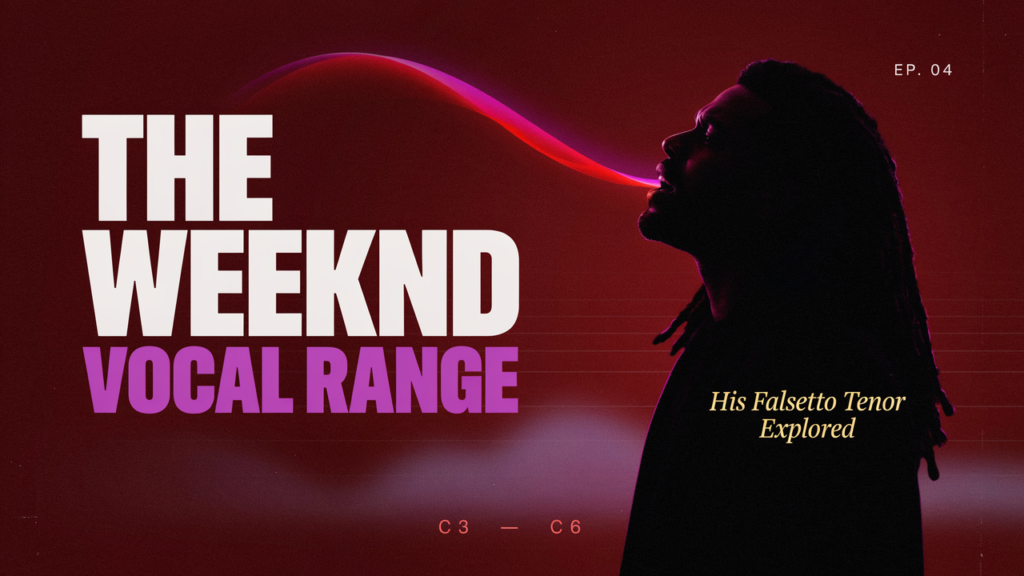
What Is The Weeknd’s Vocal Range?
Vocal range is the span between the lowest and highest notes you can sing with usable tone.
The Weeknd demonstrates:
- A relatively light lower register
- A dominant upper midrange
- A highly developed falsetto
If you’re new to the concept, review what vocal range means before comparing yourself.
Range is not just about hitting one impressive high note. It’s about consistency and control.
Use the singing note finder to see exactly what note you’re hitting in real time.
Is The Weeknd a Tenor?
Yes, he is widely classified as a tenor.
Why Tenor?
His tessitura — the notes where he sounds most natural and powerful — sits higher than a baritone’s. His speaking voice may not be extremely high, but his singing center of gravity clearly leans upward.
When compared to the typical tenor vocal range, his comfort zone aligns well.
Why Not Baritone?
Baritones usually carry more weight and darkness in the lower-mid area. If you compare him to the typical baritone vocal range, you’ll notice his upper emphasis and lighter coordination suggest tenor placement.
Voice type is about where you live comfortably — not how low you can go once.
Modal Range vs Falsetto
This is where most confusion happens.
Many online claims exaggerate octave numbers by blending modal voice and falsetto without explanation.
Here’s the difference:
| Register | What It Means | How He Uses It |
|---|---|---|
| Chest/Modal | Full speaking-like coordination | Used in lower and midrange phrases |
| Mixed Voice | Blend of chest and head | Used for stronger high notes |
| Falsetto | Lighter, thinner coordination | Used for signature high passages |
Falsetto counts as part of total range, but it does not define voice type.
If you want to measure your own notes accurately, use a vocal range calculator instead of guessing.
How His High Notes Work
The Weeknd rarely forces high notes in heavy chest voice.
Instead, he:
- Reduces vocal weight as he ascends
- Keeps airflow steady
- Allows resonance to shift forward
- Maintains relaxed jaw and neck
- Uses falsetto strategically
High notes are coordinated — not pushed.
If you’re working on upper range safely, study techniques in how to sing high notes.
Think of it like shifting gears in a car. You don’t stay in first gear at highway speed.
How His Range Compares to the Average Male Singer
Most untrained male singers have around two octaves of comfortable range.
The Weeknd’s range extends beyond that, particularly due to a strong upper register and falsetto control.
For perspective, compare against the standard average male vocal range.
But remember — range size alone does not create artistry.
Control and tone matter more.
Step-by-Step: Developing a Stronger Upper Register
If you want to build tenor-like upper flexibility, follow this process.
- Start with gentle lip trills in midrange.
- Slide upward on a light “gee” or “woo.”
- Keep breath flow steady and consistent.
- Reduce chest weight as pitch rises.
- Allow brightness to increase naturally instead of pushing volume.
If pitch feels unstable, train accuracy first using a pitch accuracy test.
Progress should feel gradual and sustainable.
Common Mistakes Singers Make
- Forcing chest voice too high
- Confusing falsetto with weakness
- Lifting the chin to “reach” notes
- Holding tension in the tongue or jaw
- Trying to imitate tone instead of coordination
Trying to copy someone’s exact sound usually leads to strain.
Your anatomy is unique.
If you feel sharp pain, persistent throat tightness, or vocal fatigue that lasts more than a day, stop and rest.
Healthy singing should never hurt.
Self-Check: Do You Share Similar Traits?
Ask yourself:
- Does your voice feel strongest in upper midrange?
- Are high notes easier when sung lighter instead of louder?
- Does your tone naturally brighten as you ascend?
- Is your lower range lighter compared to your upper range?
If yes, you may lean tenor.
If your comfort zone consistently sits lower and heavier, you might explore baritone classification.
If unsure, review broader voice types explained to clarify patterns.
Voice type is about repeated comfort, not one impressive note.
Falsetto: Why It Matters
The Weeknd’s falsetto is one of his defining features.
Falsetto allows access to higher notes with less vocal fold thickness.
However, falsetto alone doesn’t make someone a tenor.
Tenor classification depends on tessitura and modal range.
If you want to explore your own extension safely, test your limits carefully using a structured vocal range chart.
Never push for notes that feel squeezed.
Realistic Expectations for Range Development
Range expands slowly.
Healthy improvement looks like:
- Smoother transitions
- Less strain in upper notes
- Stable pitch
- Increased endurance
You cannot safely gain a full octave overnight.
Training builds coordination first — extension follows.
Consistency beats intensity.
The Bigger Lesson
The Weeknd’s vocal identity is built on contrast.
He blends controlled modal singing with expressive falsetto.
His range supports the music — it doesn’t overpower it.
The real takeaway for singers:
Develop balance.
Strengthen your comfortable range first. Then expand gradually.
Range is a byproduct of coordination, not force.
When your technique improves, your upper notes become easier and more reliable.
FAQs
1. How many octaves can The Weeknd sing?
He demonstrates roughly three octaves in recorded performances, including his strong falsetto extension.
2. Is The Weeknd a tenor?
Yes, he is generally classified as a tenor because his tessitura and upper modal emphasis sit in the higher male range.
3. What is his highest note?
His highest notes are typically accessed through mix or falsetto rather than heavy chest voice belting.
4. Does falsetto count as part of vocal range?
Yes, falsetto counts toward total range, but it does not determine voice type by itself.
5. Is his vocal range considered wide?
His range is strong and flexible, especially in the upper register, though control and tone define his sound more than sheer size.
6. Can beginners sing songs in his range safely?
Yes, but high passages should be approached with lighter coordination and proper warm-ups to avoid strain.
7. How can I safely develop falsetto?
Start gently, keep airflow steady, avoid squeezing the throat, and stop immediately if you feel pain or persistent tension.

John Mayer is a vocal analysis and music education writer specializing in vocal range testing, voice type analysis, pitch recognition, and singing improvement tools for singers, musicians, performers, and beginners. He creates practical content focused on vocal training, singing techniques, and voice analysis tools to help users better understand and improve their vocal abilities.