
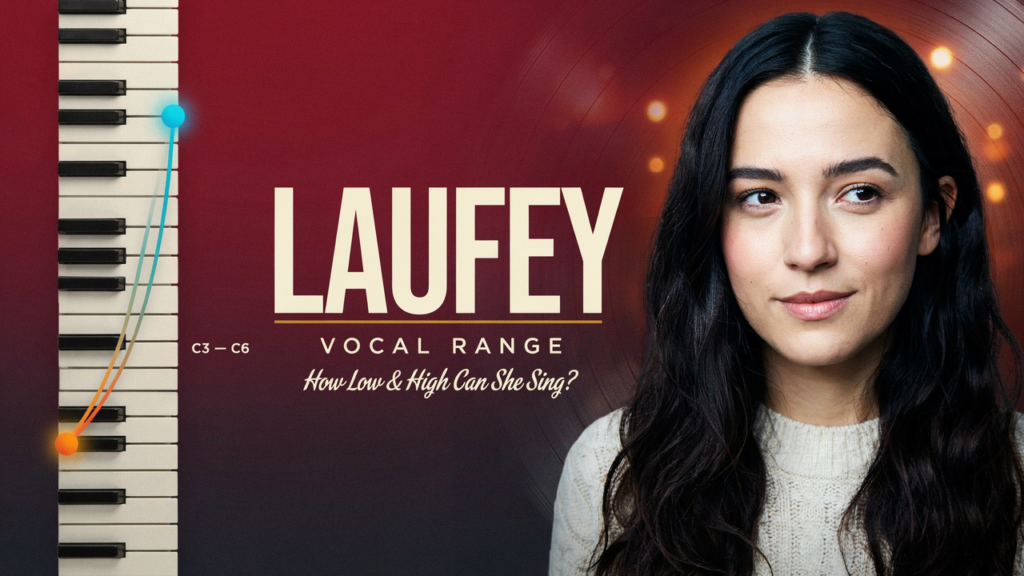
Laufey’s vocal range spans approximately from the lower mid-register into the upper soprano range, covering around 2.5 to 3 octaves in recorded performances. Her voice is commonly described as a lyric mezzo-soprano with a warm lower register and smooth head voice, shaped by jazz phrasing and classical influence.
That number alone doesn’t explain why she sounds so distinctive. Range tells you the notes someone can sing. Tessitura and tone tell you where they live comfortably.
Let’s break it down clearly.
What Is Laufey’s Vocal Range?
Based on documented live and studio recordings, Laufey’s lowest notes sit in the lower third octave area, while her highest notes reach into the fifth octave. That places her above the average female singing range, but not in extreme territory.
If you’re unsure how range is measured, this guide on what vocal range means will clarify how note spans are calculated.
What matters more than the outer limits is how consistently and comfortably she sings across her middle range. That’s where her tone feels effortless and controlled.
You can use this pitch memory exercise as a warm-up before singing.
Her Lowest and Highest Notes Explained
Lowest Notes
Her lower notes have a soft, rounded quality rather than a heavy, chest-dominant sound. She doesn’t push depth; she maintains resonance.
Think of it like speaking gently into a warm microphone rather than projecting into a theater.
Lower register traits:
- Warm but light
- Controlled airflow
- Minimal strain
- Smooth transition upward
Highest Notes
Her upper notes are clear and floaty, often sung in head voice. She doesn’t belt aggressively into the upper register.
Instead of “power,” she uses placement and airflow. If you compare that to the average vocal range for women, her top notes are strong but not extreme.
What Voice Type Is Laufey?
Laufey is often described as a lyric mezzo-soprano.
That means:
- Comfortable mid-range
- Warm tone
- Flexible phrasing
- Lighter top extension rather than dramatic high belting
If you want context, explore the mezzo-soprano vocal range breakdown to see how her placement aligns.
Some listeners wonder if she might be lower, but her tessitura sits above a typical contralto vocal range.
Voice type isn’t just about highest and lowest notes. It’s about where the voice resonates best over long performances.
Range vs Tessitura: Why It Matters
Range = total possible notes.
Tessitura = where you sound strongest and most comfortable.
Imagine a piano. You can hit every key, but you probably play most songs in the middle section.
Laufey’s tessitura lives in the mid-to-upper middle register. That’s why her phrasing feels relaxed and natural.
If you’re testing your own limits, use a tool like a vocal range calculator so you can measure accurately without guessing.
How to Compare Your Range to Laufey’s
Don’t compare tone — compare notes and comfort.
Step-by-Step: Find Your Practical Range
- Warm up gently with light humming for 3–5 minutes.
- Use a piano or pitch tool to descend slowly until the tone becomes breathy.
- Ascend gradually without forcing.
- Stop when tension appears in your throat or jaw.
- Record your lowest clean note and highest controlled note.
That’s your usable range — not your strained extremes.
If you’re new to this process, follow a detailed guide on how to test your vocal range safely.
Technical Breakdown of Her Registers
Chest Voice
Light, intimate, not overly weighty.
She avoids pressing down for artificial depth.
Mix
Subtle and smooth.
Transitions are nearly invisible.
Head Voice
Clear, floating, controlled.
No aggressive pushing or wide vibrato.
If you want to understand how registers function physically, review how the vocal cords work during singing.
Comparison: Laufey vs Typical Female Range
| Category | Laufey | Average Female Singer |
|---|---|---|
| Total Range | ~2.5–3 octaves | ~2 octaves |
| Strongest Area | Mid–upper middle | Middle |
| Lower Depth | Light warmth | Varies |
| Upper Extension | Head voice dominant | Often mixed |
She stands out more for tone and phrasing than sheer width.
What Makes Her Voice Sound “Vintage”?
It’s not just range.
Three elements shape her sound:
- Jazz phrasing (laid-back timing)
- Controlled vibrato
- Soft dynamic control
If you want to study vibrato control, this guide on developing healthy vibrato explains how subtle oscillation shapes tone.
Her approach is closer to classic jazz stylists than modern pop belters.
Self-Check: Is Your Range Similar?
Ask yourself:
- Can you comfortably sing across 2.5 octaves?
- Does your mid-range feel easy and resonant?
- Can you transition to head voice without cracking?
- Do you maintain tone without pushing?
If you answered “no” to most of these, that’s normal. Range develops gradually with training.
If you’re unsure how your voice type compares, take a structured voice type test to see where you fit.
Common Mistakes When Comparing Yourself to Her
1. Chasing High Notes Too Early
Forcing upper notes leads to strain. Develop breath control first.
2. Ignoring Tessitura
You might hit the same top note but struggle to sing a full song there.
3. Confusing Soft Tone with Weakness
A lighter voice isn’t less skilled. Control often requires more precision.
4. Overtraining the Lower Register
Trying to “sound deeper” can cause tension and artificial weight.
Healthy development always beats imitation.
Realistic Expectations
A 2.5–3 octave range is achievable for many trained singers, but it usually takes time.
Most beginners start closer to 1.5–2 octaves. With consistent warm-ups and gradual expansion, many can safely increase flexibility.
If your throat feels tight, hoarse, or fatigued, stop. Progress should feel steady — not forced.
For context, explore the broader human vocal range limits to understand what’s biologically realistic.
Final Perspective
Laufey’s vocal range is impressive but not extreme. What sets her apart is control, tone, phrasing, and comfort in her natural tessitura.
That’s a powerful lesson: musicality often matters more than raw range.
Train smart. Build gradually. Protect your voice.
FAQs
1. How many octaves can Laufey sing?
She spans roughly 2.5 to 3 octaves in recorded performances. Her strongest area sits in the mid-to-upper middle register rather than at extreme ends.
2. Is Laufey a soprano or mezzo-soprano?
She is most commonly described as a lyric mezzo-soprano. Her tessitura and tonal warmth align more closely with that classification.
3. What is her highest note?
Her highest notes reach into the fifth octave in head voice. They are sung with control rather than aggressive belting.
4. What is her lowest note?
Her lowest notes sit in the lower third octave. They are warm but not dramatically deep.
5. Is her range considered impressive?
Yes, but it’s not extreme. What makes it impressive is consistency, tone quality, and stylistic control.
6. Can beginners develop a similar range?
Many singers can gradually expand toward a 2.5-octave range with structured training. It takes time, breath work, and safe technique.
She relies heavily on controlled head voice and smooth mix transitions. Her chest voice is present but not heavily weighted.
7. Does she use chest voice or head voice more?

John Mayer is a vocal analysis and music education writer specializing in vocal range testing, voice type analysis, pitch recognition, and singing improvement tools for singers, musicians, performers, and beginners. He creates practical content focused on vocal training, singing techniques, and voice analysis tools to help users better understand and improve their vocal abilities.