
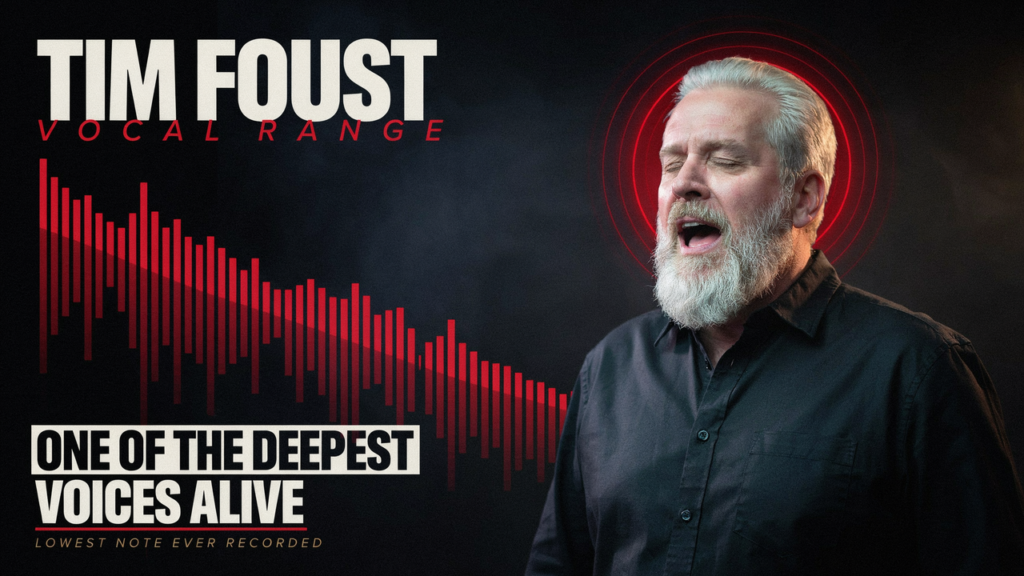
Tim Foust’s vocal range spans from extremely low bass notes in the subharmonic register up to higher bass tones in modal voice, covering roughly four to five octaves depending on how the extremes are counted. He is widely recognized as a bass, often associated with basso profundo qualities due to his unusually deep low register.
If you’ve ever heard him sing, the first reaction is usually: “How is that even possible?” Let’s break down what’s actually happening — and what singers can realistically learn from it.
What Is Tim Foust’s Lowest and Highest Note?
While exact notes vary by performance, he is known for producing pitches down in the E1 range and sometimes below using subharmonics. His upper range extends into the higher bass and lower baritone territory in modal voice, with occasional falsetto use.
The key detail most people miss: not every low pitch he produces is a standard chest-voice note.
This listening test is useful if you’re trying to build stronger pitch memory.
Modal Voice vs Subharmonics
Understanding this difference is critical.
What Is Modal Voice?
Modal voice is your normal singing voice — the voice you use for most songs. It’s stable, resonant, and sustainable.
For bass singers, modal range often sits comfortably between E2 and E4, though this varies. If you’re unsure where you fall, reviewing the bass vocal range gives helpful context.
What Are Subharmonics?
Subharmonics are produced when the vocal folds vibrate in a special coordination pattern that allows pitches lower than typical modal vibration.
Think of it like a motorcycle engine idling lower than normal RPM. It sounds deeper, thicker, and sometimes rumbling.
Subharmonics are not the same as vocal fry. Fry is loose and crackly; subharmonics are controlled and pitch-centered.
Why This Matters
When calculating total vocal range, you must separate:
- Modal lowest note
- Subharmonic lowest note
- Highest modal note
- Highest falsetto note
Otherwise, octave claims become inflated.
If you want a broader reference point, compare this to the full human vocal range to understand how rare extreme lows really are.
How Many Octaves Does He Cover?
Depending on how the extremes are counted, the span is often estimated between four and five octaves.
But here’s what matters more than total octaves:
Tessitura — the range where a singer is most comfortable and consistent.
Many singers chase wide ranges when they should be building strength in usable range. If you want to see how ranges are measured accurately, review this guide on how to measure vocal range.
How Rare Is This Kind of Low Range?
Very rare.
True low bass voices are uncommon. Controlled subharmonic production is even less common in contemporary singers.
In classical terminology, he is often associated with basso profundo characteristics — the deepest classification in the male system. If you’re unfamiliar with how voice categories work, the vocal fach system explained article provides deeper insight.
However, classification depends on more than just the lowest note. It includes:
- Tone quality
- Tessitura
- Passaggio location
- Projection
What Singers Can Learn From His Technique
You probably can’t train yourself into being a subharmonic bass if you’re naturally a tenor. But you can learn smart low-register development.
Here’s how to safely explore your lower range.
Step 1: Establish Your True Modal Low Note
Use a piano or pitch tool and gently descend in half steps. Stop when:
- The tone loses clarity
- Air leaks excessively
- Pitch becomes unstable
Never force the sound darker or heavier.
If you’re unsure of your voice category, try this voice type test to anchor your expectations.
Step 2: Build Strength Before Depth
Low notes require breath stability, not brute force.
Practice:
- Gentle descending five-note scales.
- Sustain lower notes at medium volume.
- Focus on steady airflow.
- Keep your throat relaxed.
- Avoid pushing your larynx down.
Think of low notes like slow-motion weightlifting — controlled, steady, and supported.
Step 3: Explore Controlled Fry (Carefully)
Some bass singers use light vocal fry transitions to explore depth.
But here’s the rule:
If it feels tight or scratchy, stop.
Fry should feel loose and easy. It is not a contest to see how low you can growl.
If you’re looking to expand range safely, start with fundamentals from this guide on how to increase vocal range.
Comparison: Extreme Bass vs Average Bass
| Feature | Average Bass | Extreme Low Bass (e.g., Tim Foust) |
|---|---|---|
| Modal Low Note | Around E2 | Around E1 or lower |
| Subharmonics | Rare | Often used |
| Tessitura | Low but stable | Very low-centered |
| Rarity | Uncommon | Very rare |
The important takeaway: extreme low notes are not necessary to be a strong bass singer.
Common Mistakes When Assessing His Range
1. Counting Every Sound as Modal
Subharmonics are not the same as standard chest voice.
2. Ignoring Tessitura
A singer’s lowest note doesn’t define their everyday singing range.
3. Trying to Imitate Without Foundation
Forcing low notes can lead to fatigue or strain.
4. Confusing Vocal Fry With True Pitch
Fry is unstable and not considered a usable sung note in most contexts.
If you want to compare your usable span more accurately, review the full vocal range chart.
Quick Self-Check: Can You Sing That Low?
Ask yourself:
- Can you sustain the note clearly for 3–5 seconds?
- Does it sound pitch-centered, not crackly?
- Can you repeat it consistently?
- Does it feel relaxed afterward?
If the answer is no, that note may not yet be part of your functional range.
Extreme lows should feel grounded, not forced.
Realistic Expectations for Bass Singers
Your vocal range is influenced by anatomy — vocal fold length, thickness, and resonance space.
You can expand flexibility.
You cannot redesign your vocal structure.
Healthy training improves coordination, control, and resonance efficiency. It does not transform a tenor into a subharmonic bass.
If you’re unsure where your current limits are, use a vocal range calculator to establish a clear baseline before training further.
What Makes His Voice So Distinct?
It’s not just the lowest note.
It’s the combination of:
- Depth
- Stability
- Projection
- Control in harmony settings
In ensemble singing, extreme bass voices anchor harmony the way a foundation anchors a building.
Low doesn’t win because it’s low.
It wins because it’s controlled.
Final Takeaway
Tim Foust’s vocal range is impressive not simply because of how low it goes, but because of how controlled and musical those low notes are. His technique highlights the rare potential of extreme bass voices — while also reminding singers that range alone is not the goal. Control, clarity, and healthy production matter more than chasing extremes.
FAQs
1. What is Tim Foust’s lowest recorded note?
He is widely recognized for producing notes around E1 and occasionally lower using subharmonics. Exact pitches vary by performance. The key distinction is whether the note is modal or subharmonic.
2. How many octaves does Tim Foust sing?
Estimates range between four and five octaves when including subharmonics and upper extensions. However, usable tessitura is more important than total span.
3. Is Tim Foust a true basso profundo?
He is often associated with basso profundo qualities due to his extreme low register. True classical classification depends on projection, tessitura, and tone quality, not just lowest pitch.
4. Can you train yourself to sing as low as Tim Foust?
Most singers cannot dramatically change their natural voice type. You can strengthen your lower range safely, but anatomy limits ultimate depth.
5. Does he use vocal fry?
He uses controlled low-register techniques that may resemble fry to untrained ears. However, subharmonics are more structured and pitch-defined than casual fry.
6. What is the difference between subharmonics and modal voice?
Modal voice is your standard singing voice. Subharmonics involve a specialized vibration pattern that produces pitches lower than normal vocal fold vibration.
7. Are extreme low notes dangerous to practice?
They can be if forced. Low notes should feel relaxed and supported. If you experience tightness or fatigue, stop and reset with gentle mid-range exercises.

John Mayer is a vocal analysis and music education writer specializing in vocal range testing, voice type analysis, pitch recognition, and singing improvement tools for singers, musicians, performers, and beginners. He creates practical content focused on vocal training, singing techniques, and voice analysis tools to help users better understand and improve their vocal abilities.