
The average vocal range describes how many notes or octaves most people can sing comfortably, without strain or vocal fatigue. Many singers worry their range is “too small,” but in reality, the average human singing range is much narrower than what is often claimed online.
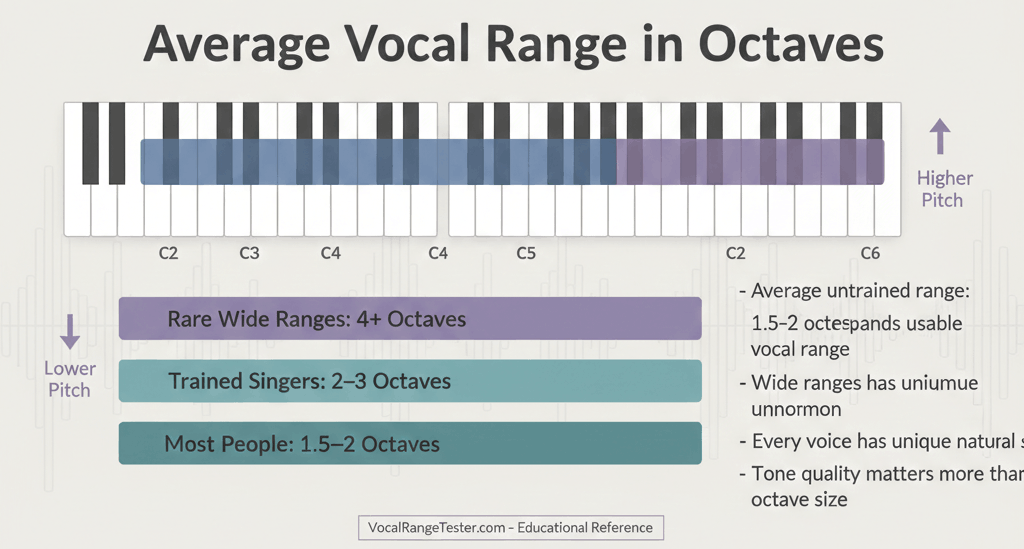
The average vocal range is about 1.5–2 octaves for most people, while trained singers typically reach 2.5–3 octaves. Professional vocalists may exceed 3–4 octaves, though tone quality and control matter more than total range.
What Is the Average Vocal Range?
In singing, vocal range refers to the span between the lowest and highest notes a person can sing with consistency and control. An octave represents a doubling of pitch frequency, such as from C3 to C4.
The average vocal range is about 1.5 to 2 octaves, measured using comfortable, repeatable singing notes rather than strained extremes.
This definition focuses on functional range, not one-time high or low sounds. For a deeper explanation of how range is defined, see what vocal range means in singing.
Average Vocal Range in Octaves
Most people fall within a relatively narrow window:
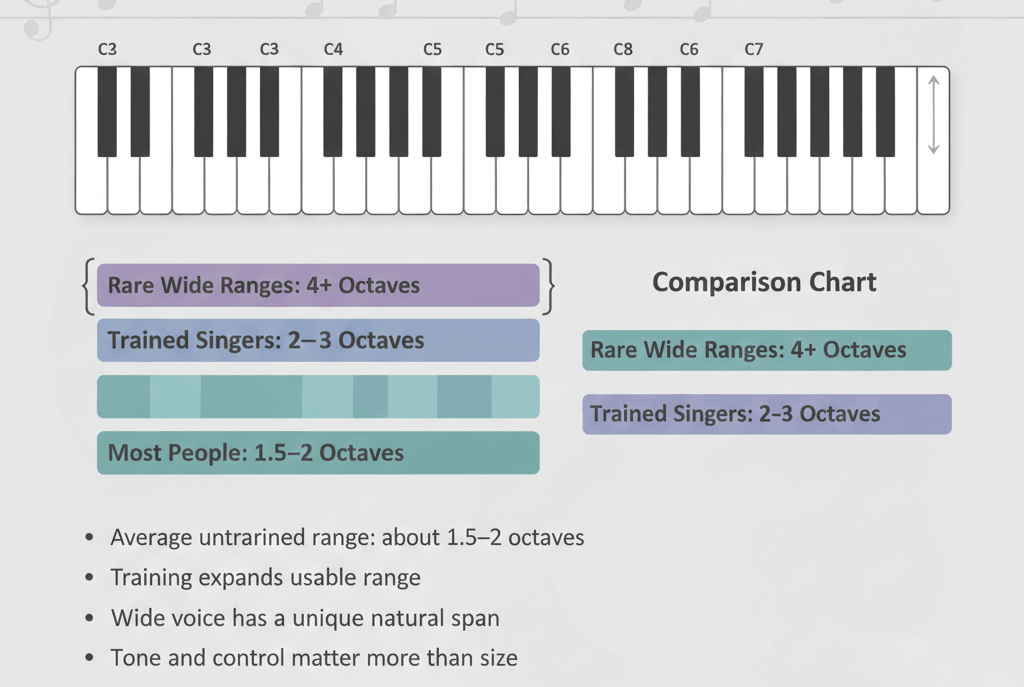
- Untrained singers: ~1.5 octaves
- Casual singers: ~2 octaves
- Well-trained singers: ~2.5–3 octaves
Ranges larger than this are possible, but they are not average and should not be treated as a standard.
If you want to see how different ranges compare visually, the vocal range chart provides a helpful reference.
Average Vocal Range for Men and Women
While there is overlap, average ranges differ slightly due to vocal anatomy.
Typical averages:
- Women: ~A3 to A5 (about 2 octaves)
- Men: ~E2 to E4 (about 2 octaves)
These are not limits—just common comfort zones. Voice type, tessitura, and training influence where each singer’s range sits. A broader discussion of how many octaves singers usually have is covered in how many octaves the human voice can sing.
Untrained vs Trained Voices: Why Averages Change
Training does not change vocal anatomy, but it improves coordination. This allows singers to:
- Use more of their existing range
- Transition smoothly between registers
- Maintain pitch accuracy at the edges
As a result, trained singers often appear to have “larger” ranges, even though their anatomy is the same. Improving control is usually more effective than chasing higher notes, which is why how to improve pitch accuracy is often more impactful than range-extension exercises alone.
Comfortable Range vs Extreme Notes (Why Most Comparisons Fail)
A common mistake is counting:
- Strained high notes
- Vocal fry lows
- One-time extremes
These inflate perceived range but do not reflect usable singing ability. The average vocal range is based on notes that can be:
- Sung repeatedly
- Sustained with stable pitch
- Produced without discomfort
This distinction explains why many people believe they are “below average” when they are not.
Is a 2-Octave Vocal Range Normal?
Yes. A 2-octave range is completely normal and sits squarely within the average for most people. Many successful singers work comfortably within this span.
Having a smaller range does not indicate poor vocal ability. Musicality, tone, timing, and expression matter far more than raw note count.
Can the Average Vocal Range Be Increased?
To a degree, yes—but with limits.
Most people can safely expand their usable range by:
- Improving breath coordination
- Strengthening register transitions
- Reducing tension
However, training typically adds semitones, not multiple octaves. A realistic, health-focused approach is explained in how to increase vocal range safely.
How to Measure Your Vocal Range Accurately
Accurate measurement avoids guesswork:
- Warm up gently
- Start at your lowest comfortable note
- Move upward without forcing
- Stop at the highest repeatable pitch
Pitch-tracking tools help remove bias. Using a vocal range calculator provides more reliable results than estimating by feel alone.
If you’re also trying to understand how your range relates to voice classification, the voice type classifier can offer structured guidance.
Why Average Vocal Range Is Not a Measure of Talent
The average vocal range is a statistical reference, not a scorecard.
What matters more than being “above average”:
- Pitch accuracy
- Tone consistency
- Stamina
- Musical expression
Many professional singers work within average ranges and excel because they use their voices efficiently and sustainably.