
When singers struggle with vocal range, they usually blame genetics or “not being born with it.” I used to think the same. In my case, range wasn’t the real problem — breathing inefficiency was.
I could technically hit certain notes, but they were unreliable, tense, and inconsistent. Once I corrected how I breathed while singing, my usable vocal range expanded naturally, without pushing or forcing. That change came from breath coordination, not range exercises.
Breathing techniques for vocal range focus on diaphragmatic breathing, steady airflow, and controlled breath support to improve pitch control, reduce strain, and expand high and low notes. Proper breathing increases vocal power, endurance, and range flexibility.
How Breathing Really Affects Vocal Range
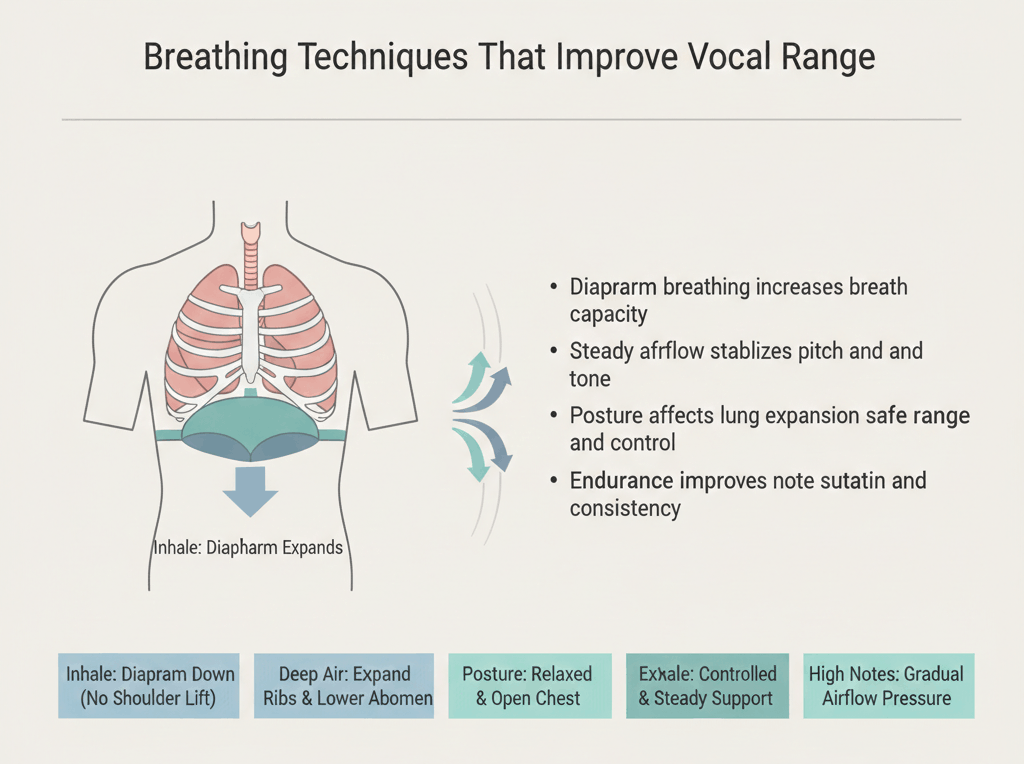
Breathing does not create new notes. It allows the vocal folds to work efficiently enough to access the notes you already have.
Before fixing my breathing:
- High notes felt tight and unreliable
- My throat tried to “push” the sound
- I ran out of breath mid-phrase
After improving breath coordination:
- High notes felt lighter
- Pitch stabilized across my range
- Notes I avoided became repeatable
Breathing improves vocal range by reducing tension and stabilizing airflow, allowing singers to access their existing range with more consistency.
Try the vocal range testing tool before training.
Why “Take a Big Breath” Often Makes Range Worse
One of the most damaging habits I had was over-inhaling before high notes.
What didn’t work:
- Lifting the shoulders
- Filling the chest with air
- Holding the breath before singing
What worked instead:
- Silent, relaxed inhalation
- Expansion around the ribs
- Continuous airflow during the phrase
More air does not equal better range. Too much air increases pressure below the vocal folds, which causes tightening — especially on high notes. When I reduced air pressure, my pitch accuracy improved noticeably (a connection explained further in how to improve pitch accuracy).
Diaphragmatic Breathing (What It Actually Feels Like)
“Sing from your diaphragm” never helped me until I understood the physical sensation, not the phrase.
What finally worked:
- Inhaling quietly through the mouth or nose
- Feeling expansion around the lower ribs
- Keeping the chest and shoulders relaxed
If your shoulders rise, the breath is too shallow. Once I corrected this, sustained notes across my range required less effort, not more.
This type of breathing supports range development safely, which is why it’s commonly paired with how to increase vocal range responsibly.
Rib Expansion: The Technique That Changed My Endurance
One of the biggest breakthroughs for me was maintaining gentle rib expansion while singing.
When my ribs collapsed early:
- Long phrases fell apart
- High notes felt squeezed
When I kept the ribs expanded:
- Breath lasted longer
- Tone stayed consistent
- Range felt easier to manage
This became especially noticeable during warm-ups and scale work like those found in vocal warm-up exercises.
Why High Notes Feel Easier With Better Breathing
High notes do not need more air — they need steadier airflow.
Once my breathing stabilized:
- My throat stopped “reaching”
- High notes felt lighter
- Transitions between registers improved
Poor breathing forces the throat to compensate. Efficient breathing lets the vocal folds do their job without interference.
Breathing Also Improves Low Notes
I initially thought breathing only mattered for high notes. That was wrong.
Low notes require:
- Slower airflow
- Stable breath support
- Relaxed vocal folds
When my breathing was inconsistent, low notes sounded weak or breathy. After improving breath control, my lower range became clearer and more resonant — an important part of overall vocal health and longevity (see vocal health tips).
How Long It Took to Notice Real Improvement
From personal experience:
- Awareness improved within days
- Consistency improved within weeks
- Range reliability improved over months
Breathing changes are subtle but cumulative. The biggest improvement wasn’t hitting higher notes — it was trusting my voice not to fail.
To measure progress objectively, I periodically used a vocal range calculator instead of relying on perception alone.
Common Breathing Mistakes That Limit Vocal Range
These mistakes held me back the longest:
- Raising shoulders while inhaling
- Overfilling the lungs
- Pushing air on high notes
- Holding the breath before phonation
Fixing these did more for my range than any “sing higher” exercise.
Applying Breathing Techniques to Real Songs
Breathing techniques only work when applied to music, not just drills.
What helped most:
- Practicing songs in comfortable keys
- Short phrases before long ones
- Focusing on airflow, not volume
Once breathing improved, I stopped worrying about labels and focused on how my voice functioned, which made singing feel sustainable.
- Breathing doesn’t add notes — it unlocks them
- Less air often works better than more
- Rib stability matters more than lung capacity
- Poor breathing limits range faster than anatomy
- Consistent breath = consistent range
FAQs
1. Can breathing techniques really increase vocal range?
Breathing techniques do not change vocal anatomy, but they can significantly increase your usable vocal range by improving airflow control and reducing tension. Many singers discover notes they already had but couldn’t access consistently due to poor breath coordination.
2. What is the best breathing technique for improving vocal range?
The most effective approach is diaphragmatic breathing combined with controlled rib expansion. This allows steady airflow and balanced pressure, which helps both high and low notes feel easier and more reliable.
3. Is diaphragmatic breathing necessary for singing?
While singers don’t consciously control the diaphragm, efficient singing relies on the breathing pattern associated with diaphragmatic movement. Shallow chest breathing often limits range and endurance, especially on higher notes.
4. Why do high notes feel harder when my breathing is poor?
Poor breathing creates unstable airflow, forcing the throat to compensate. This leads to tightening and strain. Proper breath support stabilizes airflow so the vocal folds can vibrate freely, making high notes feel lighter.
5. Does breathing help with low notes too, or only high notes?
Breathing affects both ends of the range. Low notes need slower, well-supported airflow. Without stable breath control, low notes often sound weak, breathy, or inconsistent.
6. How long does it take to see results from breathing practice?
Most singers notice awareness changes within days, consistency improvements within weeks, and clearer range reliability over several months. Breathing improvements are gradual but cumulative.
7. Is taking a bigger breath better for singing higher?
No. Over-inhaling often increases pressure and causes tension. High notes usually require less air with better control, not more air. Efficient breathing is about regulation, not volume.
8. Can poor breathing limit vocal range even if my voice is healthy?
Yes. Many healthy voices appear “limited” simply because inefficient breathing prevents stable coordination. Fixing breathing often unlocks range without any additional vocal exercises.
9. Does lung capacity determine how wide my vocal range is?
Lung capacity has very little to do with vocal range. Breath management and airflow control matter far more than how much air you can hold.
10. What is the most common breathing mistake that reduces vocal range?
The most common mistake is holding the breath or pushing air when singing difficult notes. This increases tension and limits range faster than almost any other habit.
Related Articles:
- Proper breath control starts with understanding range mechanics, which is explained clearly in this vocal range overview.
- Many singers see better results when combining breathing with structured warm-up routines before pushing extremes.
- To see how airflow affects accuracy, it helps to review this pitch accuracy guide.
- Expanding usable notes safely depends on coordination, as outlined in this range expansion resource.
- Breath support becomes more critical at the top, which is why this high-note technique guide is often recommended.
- Measuring progress objectively is easier when you follow a clear measurement method alongside breathing practice.
- Long-term gains rely on consistency and care, making these vocal health tips essential for sustainable improvement.