
When I first tried to improve my pitch accuracy, I assumed something was wrong with my ear.
I could hear when notes were off — but I still couldn’t stay in tune while singing.
The mistake I didn’t realize at the time was simple:
pitch accuracy isn’t just hearing — it’s coordination.
Once I stopped blaming my ear and started fixing breath stability, note targeting, and feedback, my pitch improved faster than it ever had before.
If you want objective feedback instead of guessing, tools on VocalRangeTester.com make it easier to see whether you’re actually in tune while practicing.
This guide explains why singers go off pitch, what actually fixes it, and includes clear routines and FAQs based on real experience — not generic advice.
How Do You Improve Pitch Accuracy?
To improve pitch accuracy, practice matching notes with a piano or tuner, sing scales slowly, and record your voice to catch off-key moments. Consistent ear training and controlled breath support are what most effectively fix out-of-tune singing.
You improve pitch accuracy by training ear-to-voice coordination, stabilizing breath support, practicing slow pitch matching, and using feedback to correct mistakes consistently.
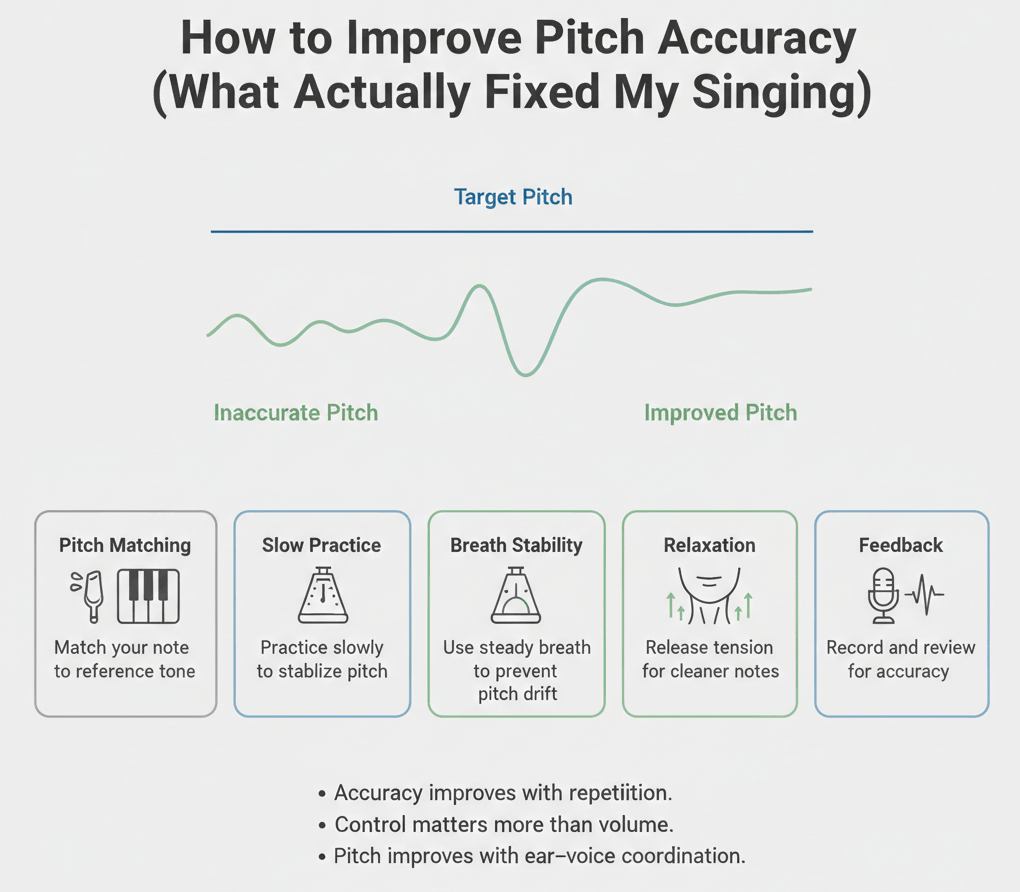
What Pitch Accuracy Really Means (And What It Doesn’t)
Pitch accuracy means consistently producing the intended note, not sliding close to it or correcting after the fact.
It does not mean:
- Singing louder
- Having a large vocal range
- Singing emotionally
I’ve seen singers with average ranges sing perfectly in tune, and others with wide ranges struggle badly. Range and pitch are separate skills (see how vocal range actually works).
Why Singers Sing Off Pitch (Real Causes)
From experience, pitch problems usually come from one or more of these:
- Unstable breath → pitch drifts
- Sliding into notes → inaccurate targeting
- Jaw or tongue tension → delayed correction
- Lack of feedback → mistakes go unnoticed
This is why pitch accuracy often improves quickly when singers fix breathing techniques for vocal range, even without changing ear training.
The Biggest Pitch Mistake I Made
I practiced songs instead of notes.
Songs hide pitch problems because:
- Notes move too quickly
- Mistakes get masked by music
- You never sit long enough on one pitch
My pitch improved most when I practiced single notes and short patterns — boring, but extremely effective.
Step-by-Step: How to Improve Pitch Accuracy
1. Practice Single-Note Matching First
Play one reference note and match it exactly.
Ask:
- Is the note steady?
- Does it drift sharp or flat?
- Can I repeat it cleanly?
Using a pitch accuracy analyzer helped me catch problems my ear missed.
2. Stabilize Breath Before Volume
When I pushed volume, my pitch went sharp.
When airflow stayed steady, pitch corrected itself.
Think:
- Calm inhale
- Even airflow
- No pushing
3. Stop Sliding Between Notes
Sliding feels safe — but it destroys accuracy.
Instead:
- Hear the note internally
- Pause
- Sing it directly
This trains precision instead of guessing.
4. Slow Practice Works Faster
Fast singing hides pitch problems.
Slow practice exposes — and fixes — them.
Uncomfortable at first. Extremely effective long-term.
Simple Daily Pitch Accuracy Routine (10–15 Minutes)
| Exercise | Time | Why It Helps |
|---|---|---|
| Single-note matching | 3 min | Trains accuracy |
| 3-note scales | 4 min | Improves transitions |
| Sustained note holds | 3 min | Stabilizes pitch |
| Interval jumps | 3–5 min | Reduces sliding |
Exercise Details
Single-Note Matching
Hold one pitch for 5–8 seconds. Repeat on different notes.
3-Note Scales
Sing slowly. Reset breath between notes.
Sustained Holds
Quiet volume. Watch for drift.
Interval Jumps
Jump cleanly — no sliding.
How Long Does Pitch Accuracy Take to Improve?
From real practice:
- Awareness improves in days
- Consistency improves in weeks
- Reliability improves in months
Pitch accuracy improves steadily when practice is targeted.
Pitch Accuracy vs Vocal Range
Improving pitch accuracy often makes your range feel easier, even if the number of notes doesn’t change.
That’s because accurate pitch reduces:
- Tension
- Over-correction
- Fatigue
This is why many singers feel their voice “opened up” after fixing pitch issues.
Tools That Help (Without Replacing Skill)
Helpful tools include:
- Pitch visualizers
- Tuners
- Recording + playback
They don’t replace technique — they speed up feedback, which accelerates learning.
- Pitch accuracy is learnable
- Breath stability matters more than talent
- Slow practice beats song repetition
- Feedback speeds improvement
- Consistency beats perfection
Test your vocal range at https://vocalrangetester.com/.
Frequently Asked Questions
Can pitch accuracy really be improved?
Yes. Pitch accuracy is a coordination skill that improves with targeted practice and feedback.
Why can I hear pitch problems but still sing off pitch?
Because hearing and producing pitch use different systems. Coordination must be trained.
How often should I practice pitch accuracy?
Short daily sessions (10–15 minutes) are more effective than long, irregular practice.
Do pitch apps actually help?
Yes — when used as feedback, not as a crutch.
Why is my pitch worse on high notes?
High notes increase tension and airflow demands, which destabilize pitch if breath isn’t controlled.
Does breath control really affect pitch?
Yes. Unstable airflow is one of the biggest causes of pitch drift.
Can beginners improve pitch accuracy?
Absolutely. Beginners often improve faster because bad habits aren’t fully ingrained yet.
How do I know if I’m improving?
Notes feel easier to land, corrections happen faster, and recordings sound steadier.
Is being “tone-deaf” real?
True tone deafness is rare. Most pitch issues are coordination problems.
Should I practice songs or exercises?
Exercises first. Songs later. Accuracy comes before performance.
Related Articles:
- Improving pitch starts with awareness, and using a pitch accuracy analyzer helps reveal where inconsistencies actually occur.
- Many singers struggle because they misunderstand range limits, which is clarified in this guide to average vocal ability.
- Pitch issues often show up at range edges, making this vocal range calculator useful for identifying problem zones.
- Comparing yourself objectively can uncover habits, which is why a singer comparison tool adds useful perspective.
- Accuracy improves faster when the voice is prepared properly, so this warm-up generator can support daily practice.
- Some pitch problems stem from strain or misuse, which is addressed in this vocal health resource.
- For deeper insight into coordination issues, AI-based voice analysis can highlight patterns the ear often misses.