
The tenor vocal range is often described as “the high male voice,” but that oversimplification causes more confusion—and vocal strain—than clarity.
When I first started identifying my voice, I focused almost entirely on how high I could sing. On a good day, I could squeeze out notes that matched tenor charts. But those same notes felt unreliable in songs, tiring in rehearsals, and inconsistent from day to day.
That’s when I learned the difference between having a note and owning a range.
The tenor vocal range is a high male voice type, typically spanning C3 to C5. It has a bright, strong, and flexible tone, well-suited for high melodies, lead roles, and expressive singing in classical, pop, and contemporary music.
What Is the Tenor Vocal Range?
The tenor vocal range refers to the pitch range most commonly associated with tenor voices, typically spanning from C3 to A4, based on notes a singer can produce comfortably and consistently.
Tenor classification depends more on tessitura and vocal comfort than on the single highest note a singer can reach.
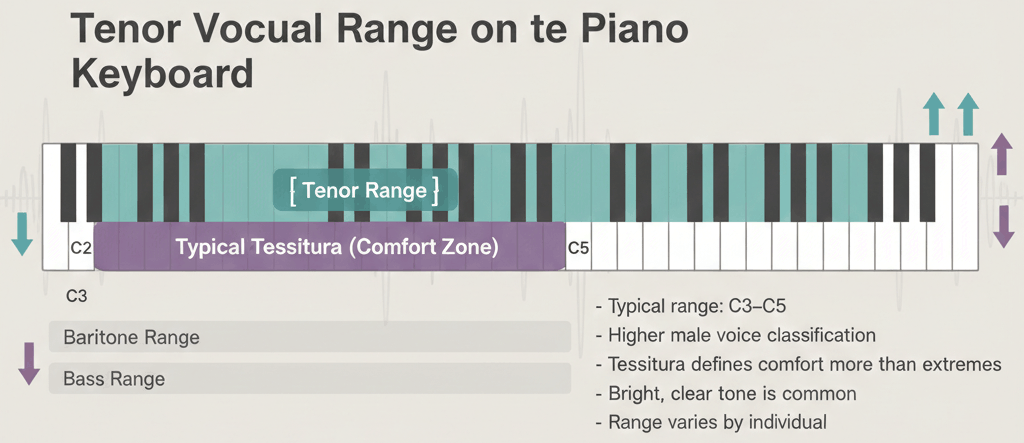
Tenor Vocal Range Notes (What Actually Counts)
Typical Tenor Range
- Lower boundary: around C3
- Upper comfortable boundary: around A4
- Extended notes: B4 or higher may appear with training, but are not required
Early on, I made the mistake of counting notes I could only hit once at the end of practice. Those notes inflated my range on paper but didn’t help me sing music comfortably.
Tenor range notes should be:
- repeatable
- sustainable
- usable in real songs
For clarity on note labeling, see vocal range notes.
Tenor Tessitura (The Most Important Factor)
Tessitura is where your voice feels best most of the time—not just where it can reach.
For many tenors, tessitura often sits around:
- E3 to G4
This is where:
- tone stabilizes
- endurance improves
- singing feels less effortful
Many singers misclassify themselves because they ignore tessitura and focus only on extremes. Charts rarely explain this well.
How High Can a Tenor Sing?
This question causes more vocal strain than almost any other.
A healthy tenor:
- does not need to sing C5
- should not force high notes to “prove” voice type
- often sounds best below their maximum pitch
High notes should feel lighter, not louder. If they require pushing or neck tension, something is off. Technique matters far more than classification, which is why how to sing high notes without straining is essential reading before chasing range.
Tenor vs Baritone (Why Overlap Is Normal)
This is where many singers get stuck—and I did too.
| Factor | Tenor | Baritone |
|---|---|---|
| Comfortable upper range | Higher | Lower |
| Tessitura | Mid–high | Mid–low |
| High-note effort | Easier | Heavier |
| Low notes | Possible | More natural |
Overlap is expected. This is why range alone doesn’t determine voice type. For broader context, see voice types and compare with baritone vocal range.
How to Tell If You’re a Tenor (Without Guessing)
Instead of relying on charts alone, use this process:
- Measure your comfortable vocal range
- Notice where your voice feels best most often
- Identify where fatigue appears
- Compare tessitura, not extreme notes
A clear, step-by-step method is explained in how to test your vocal range. You can also get a quick reference using a simple online tool on the homepage.
Common Myths About the Tenor Vocal Range
| Myth | Reality |
|---|---|
| “Tenors must sing very high” | Comfort matters more than height |
| “If I hit C5, I’m a tenor” | One note proves nothing |
| “Tenors can’t sing low” | Many can |
| “Range equals voice type” | Tessitura is more important |
These myths push singers toward unsafe habits more than lack of talent ever does.
Using the Tenor Range in Real Singing
Once I stopped chasing extreme high notes and started working inside my comfortable tenor tessitura, everything improved:
- song choice became easier
- stamina increased
- consistency improved
Use the tenor range to:
- choose keys that fit your voice
- avoid constant strain
- build endurance before extension
For long-term sustainability, pair range work with vocal health tips.
The tenor vocal range:
- typically spans C3–A4
- is defined by comfort, not extremes
- overlaps naturally with baritone
- depends heavily on tessitura
Frequently Asked Questions
1. What is the standard tenor vocal range?
Most tenors sing comfortably between C3 and A4, though individual voices vary.
2. Do tenors need to sing very high?
No. Tenor singing prioritizes comfort and consistency, not extreme notes.
3. Is C5 required to be a tenor?
No. Many healthy tenors rarely sing C5.
4. Can tenors sing low notes?
Yes. Many tenors sing low notes comfortably.
5. How do I know if I’m a tenor or baritone?
Focus on tessitura and vocal comfort, not just range.
6. Can training increase my tenor range?
Training can improve control and extension, but forcing range is unsafe.
7. Does the tenor range change with age?
Yes. Range and tessitura can shift over time.