
When I first learned about vocal range notes, I treated them like a scorecard.
I wrote down my lowest and highest notes, compared them to charts online, and immediately tried to sing songs that technically fit those notes. On paper, everything looked right. In practice, my voice felt tight, inconsistent, and unreliable.
That’s when I realized something important:
Vocal range notes are the lowest and highest pitches a person can sing comfortably, such as C3–C5 or F3–F5. They define your total singing range, help determine your voice type, and guide you in choosing songs that fit your voice.
What Are Vocal Range Notes?
Vocal range notes are the specific musical notes that define the lowest and highest pitches you can sing comfortably, consistently, and without strain.
A note does not count if:
- You can only hit it once
- Your throat tightens
- You need to push volume
- Your voice feels worse afterward
You can measure pitch using this voice frequency testing tool.
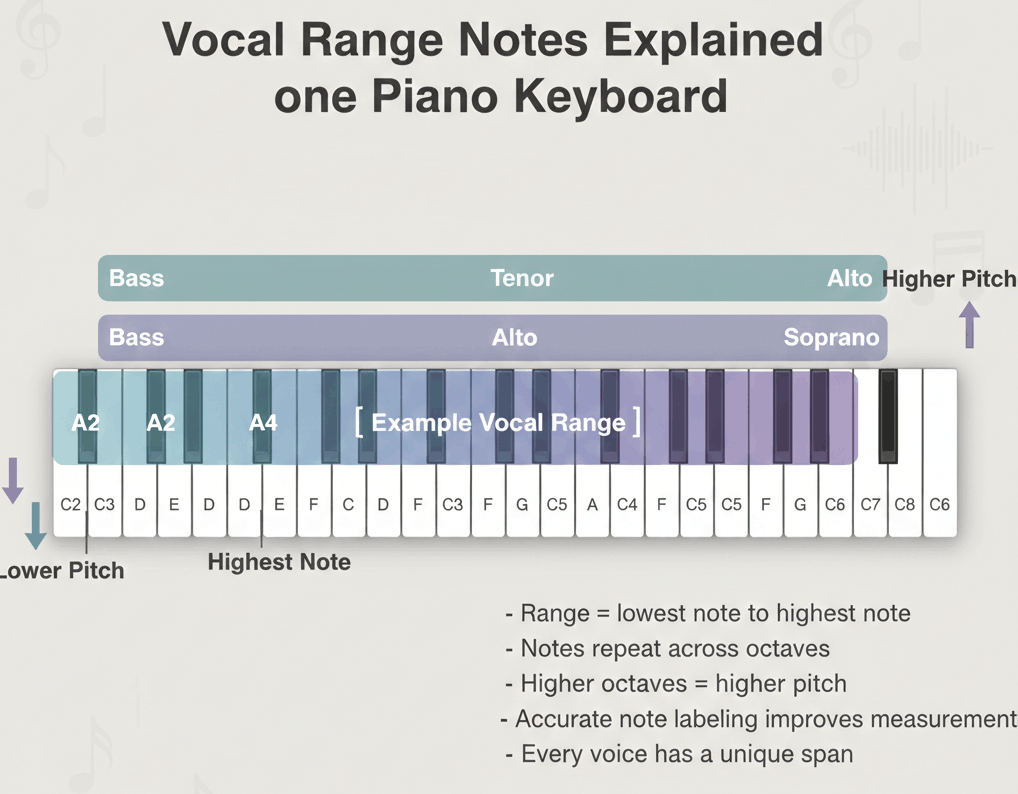
How Vocal Range Notes Work (Notes, Octaves, Reality)
Vocal range notes are written using:
- Letter names (C, D, E, F, G, A, B)
- Octave numbers (C3, G4, etc.)
Example:
A2–E4 means your lowest comfortable note is A in the 2nd octave, and your highest comfortable note is E in the 4th octave.
Early on, I counted notes I could barely reach at the very end of a session. They inflated my range—but they weren’t usable. Vocal range notes should reflect what your voice can rely on, not what it can survive.
Lowest vs Highest Notes (What Actually Counts)
Your Lowest Vocal Range Note
A valid low note:
- Sounds clear (not airy)
- Feels easy to repeat
- Doesn’t require pushing volume
If you need to “lean” on the note to keep it alive, it doesn’t belong in your range.
Your Highest Vocal Range Note
A valid high note:
- Feels lighter, not louder
- Doesn’t engage neck or jaw tension
- Works across multiple attempts and days
Understanding why high notes feel different makes more sense once you understand how vocal cords work.
How to Find Your Vocal Range Notes Safely (What Finally Fixed My Results)
Step 1: Warm Up First
Skipping this step gave me wildly different answers every time.
Gentle warm-ups (humming, lip trills) stabilize results. A short routine from vocal warm-up exercises is enough.
Step 2: Find Your Lowest Comfortable Note
- Start mid-range
- Move down one note at a time
- Stop when the tone weakens or feels unstable
Write down the last easy note, not the lowest possible sound.
Step 3: Find Your Highest Comfortable Note
- Move upward gradually
- Stop before tension appears
- Avoid increasing volume to “help” the note
This was my biggest correction: if I needed volume, the note didn’t count.
Step 4: Confirm Consistency
This step corrected my range more than anything else.
- Repeat the notes
- Rest briefly
- Test again another day
If a note only works once, exclude it.
For a full walkthrough, see how to test your vocal range or use a simple online tool from the homepage.
Vocal Range Notes vs Voice Type (Where Most People Get Misled)
I assumed my range notes automatically defined my voice type. They don’t.
Voice type depends on:
- Where your voice feels best most of the time (tessitura)
- Tone quality
- Register balance
- Long-term behavior, not extremes
Learn proper classification at voice types.
Vocal Range Notes by Voice Type (Approximate Examples)
These are averages, not rules:
- Soprano: ~C4–A5
- Alto: ~F3–D5
- Tenor: ~C3–A4
- Baritone: ~A2–F4
- Bass: ~E2–C4
For context, see average vocal range and human vocal range.
Common Mistakes With Vocal Range Notes (I Made These)
| Mistake | Result |
|---|---|
| Counting strained notes | Inflated, unusable range |
| Testing while tired | Missing high notes |
| Skipping warm-ups | Inconsistent results |
| Comparing to others | Unsafe pushing |
| Treating range as status | Poor song choices |
Charts help—but only if you use them properly. See vocal range chart as a reference, not a goal.
How to Use Vocal Range Notes in Real Singing
Once I stopped chasing extreme notes and started using my comfortable range, everything improved.
Use your range notes to:
- Choose songs in suitable keys
- Transpose songs intelligently
- Train control before expansion
- Track progress objectively
If you want to expand safely, follow how to increase vocal range safely and protect your voice with vocal health tips.
Vocal range notes are:
- Your lowest and highest comfortable singing notes
- Based on consistency, not effort
- A tool for smarter song choice and training
Frequently Asked Questions
1. What are vocal range notes?
They are the specific musical notes that define your comfortable singing range.
2. How should I write my vocal range?
List your lowest and highest comfortable notes (e.g., G2–E4).
3. Do extreme notes count?
Only if they are repeatable and strain-free.
4. Can vocal range notes change?
Yes—training, health, and rest all affect them.
5. Is vocal range the same as tessitura?
No. Tessitura is where your voice feels best most of the time.
6. What is a normal vocal range?
Most untrained singers have about 1.5–2 comfortable octaves.
7. Should finding my range ever hurt?
Never. Pain means stop immediately.