
Most articles list voice types and stop there. That’s exactly why so many singers feel confused, misclassified, or vocally tired.
I’ve been there—trying to force my voice into a category because a chart told me I should. What finally helped wasn’t another label, but understanding how voice types actually work.
The main singing voice types are Soprano, Alto, Tenor, Baritone, and Bass. These categories classify voices by pitch range and tone, helping singers choose suitable songs, vocal parts, and training methods based on their natural range.
This guide explains voice types clearly, safely, and practically, using tables and real-world logic—not rigid rules.
What Are Voice Types?
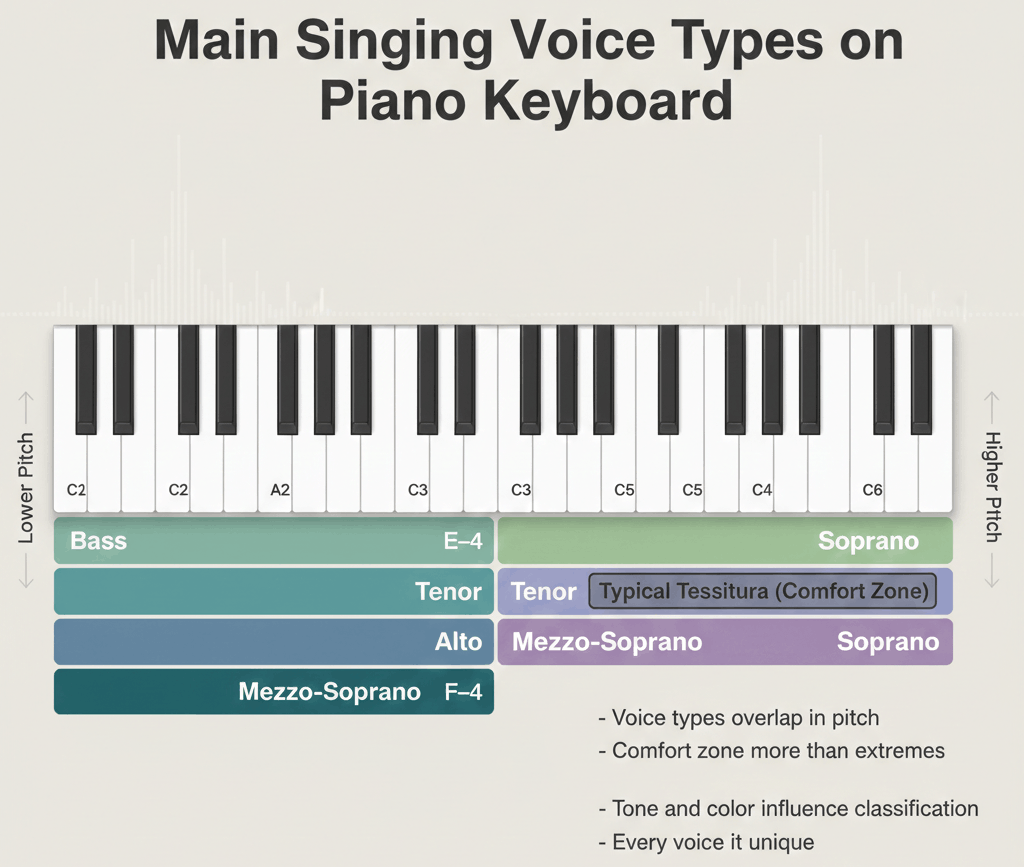
Voice types are descriptive categories used to group voices based on tessitura (comfortable range), tone quality, vocal weight, and register behavior—not simply how high or low someone can sing.
Important:
Voice types describe how a voice naturally functions, not how far it can be pushed.
Why Voice Types Exist (Real Purpose vs Common Misuse)
Intended purpose
Voice types help singers:
- choose comfortable song keys
- avoid long-term vocal strain
- understand natural vocal tendencies
Common misuse
Voice types are often treated as:
- goals to reach
- rankings of ability
- fixed identities
That misuse causes more vocal problems than lack of talent ever does.
Main Singing Voice Types
Female Voice Types
| Voice Type | General Tessitura | Common Traits |
|---|---|---|
| Soprano | Higher | Light, bright upper range |
| Mezzo-soprano | Mid | Warm, flexible tone |
| Alto / Contralto | Lower | Darker, heavier color |
Male Voice Types
| Voice Type | General Tessitura | Common Traits |
|---|---|---|
| Tenor | Higher | Brighter upper range |
| Baritone | Mid | Balanced, full tone |
| Bass | Lower | Deep, weighty sound |
⚠️ These are ranges of comfort, not limits—and overlap is normal.
Vocal Range vs Tessitura vs Voice Type (Table)
This distinction solves most confusion.
| Concept | What It Describes | Why It Matters |
|---|---|---|
| Vocal range | All notes you can produce | Broad measurement |
| Tessitura | Notes you sing comfortably | Most important factor |
| Voice type | Pattern of comfort + tone | Practical classification |
Many singers misclassify themselves by using range alone.
Voice Type Overlap (Why Labels Aren’t Clean)
Voice types overlap because:
- human anatomy exists on a spectrum
- training affects coordination
- voices change with age
Overlap Example
| Scenario | What It Means |
|---|---|
| Two singers share the same high note | They may still have different voice types |
| One singer sings higher but tires faster | Likely outside tessitura |
| Voice feels “in between” types | Very common |
Overlap is expected, not a problem.
How Voice Types Are Identified (Evidence-Based)
Voice type is identified over time, not in one session.
Factors used:
- where the voice feels most stable
- tone consistency across pitches
- register connection smoothness
- fatigue patterns
Helpful tools for gathering objective data:
- vocal range calculator – maps usable notes
- AI voice analysis – observes tone & stability
- voice type classifier – starting reference (not a final label)
Voice Weight & Tone
Pitch alone doesn’t define a voice. Weight matters.
| Vocal Weight | Typical Feel | Often Associated With |
|---|---|---|
| Light | Easy, agile | Sopranos, tenors |
| Medium | Balanced | Mezzos, baritones |
| Heavy | Dense, grounded | Altos, basses |
If you suspect lower-voice tendencies, the deep voice test can add context without forcing conclusions.
Beginner Mistakes vs Better Approach (Comparison Table)
| Common Mistake | Better Approach |
|---|---|
| Labeling voice too early | Observe patterns first |
| Forcing range | Build comfort |
| Comparing to celebrities | Compare function |
| Ignoring fatigue | Use fatigue as data |
I improved faster once I stopped chasing labels and started tracking comfort.
Tools That Actually Help (When Used Correctly)
Instead of guessing, use tools for data, not identity:
- vocal warm-up generator – builds safe coordination
- pitch accuracy analyzer – tracks control
- singer comparison tool – shows overlap realistically
Risks of Misusing Voice Types
| Risk | Long-Term Effect |
|---|---|
| Singing outside tessitura | Chronic fatigue |
| Forcing extremes | Loss of control |
| Label obsession | Slower progress |
| Ignoring comfort | Vocal strain |
Voice types should reduce risk, not increase it.
Voice types describe how a voice naturally functions based on comfort, tone, and tessitura—not just pitch.
They overlap, change over time, and are tools for healthy singing—not rigid labels.
You can check your singing pitch instantly online.
Frequently Asked Questions
1. What are voice types in singing?
They describe how a voice naturally works, not how far it can stretch.
2. Is voice type based on vocal range?
No. Tessitura and tone matter more.
3. Can my voice type change?
Yes, especially with age and training.
4. Why don’t I fit one voice type clearly?
Because voices exist on a spectrum.
5. Should beginners classify their voice?
No—focus on comfort and coordination first.
6. Does voice type affect song choice?
Yes, but comfort matters more than labels.
7. Are voice types the same across all genres?
No. Classical systems are stricter than modern styles.