
When people ask “What is vocal range?” they’re usually asking something deeper than a definition. What they really want to know is whether their voice is normal, limited, or good enough.
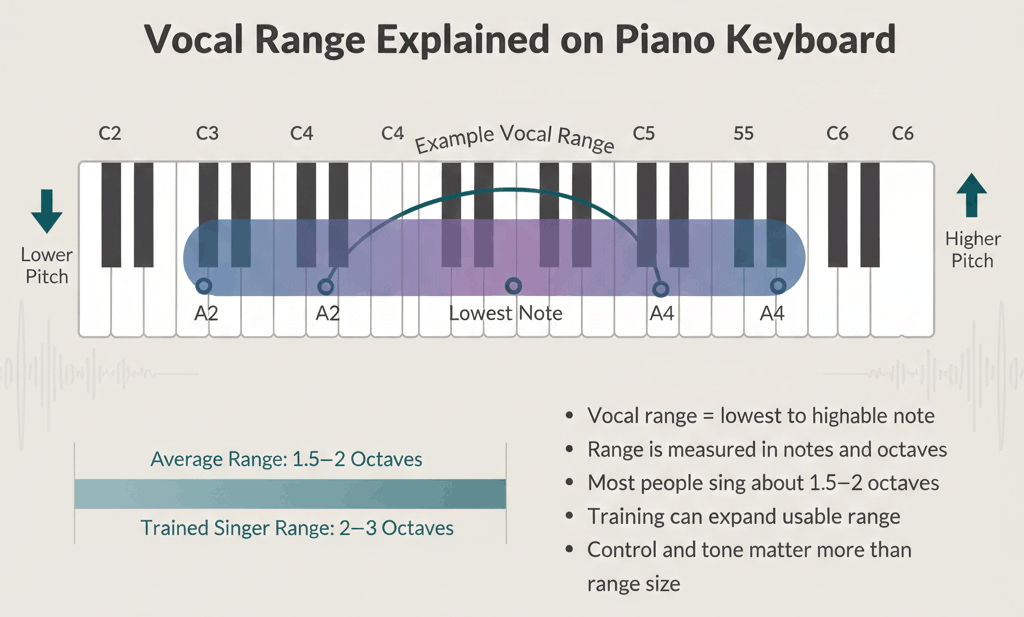
Vocal range is the span between the lowest and highest notes a person can sing comfortably. Most people have a range of 1.5–2 octaves, while trained singers often reach 3+ octaves. It helps determine voice type and choose songs that fit your voice.
I remember measuring my vocal range for the first time and feeling underwhelmed by the number. I assumed a bigger range meant better singing—and that misunderstanding led me to push notes that looked impressive but felt unreliable.
What changed everything was learning what vocal range actually represents—and what it doesn’t.
What Is Vocal Range?
Vocal range is the full span of musical notes a person can sing, from their lowest comfortable note to their highest clear note without strain. It’s usually measured in notes or octaves and helps determine a singer’s voice type, song suitability, and training focus.
Vocal range describes what notes are possible, not which notes are comfortable, sustainable, or best-sounding.
Vocal range is the full span of notes a person can sing, from their lowest comfortable pitch to their highest clear note. Most people sing 1.5–2 octaves, trained singers reach 2.5–4 octaves, and rare voices exceed 5 octaves. Range depends on technique, voice type, and training.
You can start by checking your voice using our Vocal range tester tool .
How Vocal Range Is Measured
Vocal range is measured by identifying:
- The lowest note you can produce clearly (without distortion)
- The highest note you can produce clearly (without strain)
These notes are labeled using musical notation (for example, F2–C5).
If note names and octaves feel confusing, vocal range notes explains them in a beginner-friendly way.
Average Vocal Range;
- Most people: ~1.5–2 octaves
- Trained singers: ~2.5–3.5 octaves
- Exceptional singers: 4–5+ octaves (rare)
Vocal Range vs Singing Ability (Why They’re Not the Same)
One of the biggest misconceptions is that vocal range equals singing skill.
It doesn’t.
| Concept | What It Describes |
|---|---|
| Vocal range | Notes you can produce |
| Singing ability | Control, tone, timing, consistency |
| Musicality | Expression and phrasing |
I learned this when I realized I could technically hit notes that sounded unstable in songs. Range alone didn’t make them usable.
Vocal Range vs Tessitura (The Difference That Matters Most)
Tessitura is the part of your vocal range where your voice feels best most of the time.
| Term | Meaning |
|---|---|
| Vocal range | Total span of possible notes |
| Tessitura | Where your voice is most comfortable |
| Extreme notes | Occasional, high-effort pitches |
Most good singing happens in the middle of the range, not at the edges. Visual references like a vocal range chart help show why overlap between voices is normal.
What Is a Normal Vocal Range?
There is no single “correct” vocal range, but most people fall into predictable averages:
- Most people: ~2–3 octaves
- Well-trained singers: ~3–4 octaves
- Extreme outliers: wider ranges exist, but are rare
For context, compare average vocal range with the broader limits of the human vocal range.
A smaller range is not a flaw—it’s common.
Common Voice Types & Ranges
Female Voices
- Soprano: C4–C6
- Alto: F3–F5
Male Voices
- Tenor: C3–C5
- Baritone: A2–A4
- Bass: E2–E4
Why Vocal Range Varies Between People
Vocal range varies because of:
- vocal fold size and thickness
- anatomy of the vocal tract
- coordination and training
- age, health, and vocal use
This is why two people with the same range may sound completely different.
Does Vocal Range Determine Voice Type?
No. Vocal range alone does not determine voice type.
Voice type depends on:
- tessitura
- tone quality
- where the voice transitions between registers
This is why many singers don’t fit neatly into one category. Range is a data point—not a label.
How to Find Your Vocal Range (Safely)
The best way to use vocal range information is to measure it without forcing.
A step-by-step method is explained in how to test your vocal range.
Once measured, use your range to:
- choose sensible song keys
- avoid constant strain
- understand your voice better
What Vocal Range Is Not
Vocal range does not tell you:
- how talented you are
- how high you should sing
- which songs you must sing
- whether your voice is “good”
Most vocal frustration comes from asking range to answer questions it was never meant to answer.
Common Myths About Vocal Range
| Myth | Reality |
|---|---|
| “Bigger range = better singer” | Control matters more |
| “Everyone should expand range” | Comfort comes first |
| “High notes define skill” | Consistency defines skill |
| “Range equals voice type” | Tessitura matters more |
What Affects Vocal Range?
- Genetics (vocal cord size & structure)
- Age & hormonal changes
- Vocal training & technique
- Breath control & posture
- Vocal health & hydration
- Muscle coordination & flexibility
Chest, Head & Mixed Voice
Vocal range spans different vocal registers:
- Chest voice — lower, fuller tone
- Head voice — higher, lighter tone
- Mixed voice — blend for smooth transitions
- Falsetto/Whistle — extreme high notes (not always counted as full range)
Can Vocal Range Improve?
Yes. With proper training, most singers can:
- Expand usable range by several notes to an octave
- Sing higher/lower without strain
- Improve tone, control, and endurance
Frequently Asked Questions
1. What does vocal range mean in singing?
It means the lowest and highest notes your voice can produce.
2. Is vocal range the same as voice type?
No. Voice type depends on comfort, tone, and tessitura.
3. What is a normal vocal range?
Most people sing comfortably within 2–3 octaves.
4. Can vocal range change over time?
Yes. Training, health, and age can affect range.
5. Should beginners focus on increasing vocal range?
Beginners should focus on control and comfort first.
6. Does vocal range affect song choice?
Yes, but tessitura matters more than extreme notes.
7. Is a small vocal range a problem?
No. Many great singers work within modest ranges.