
A 5 octave vocal range means a singer can perform notes across five full octaves — an extremely rare ability requiring exceptional vocal control. Only a few artists, like Mariah Carey and Dimash, are known to reach this range, often using whistle and chest registers.
What Is a 5 Octave Vocal Range?
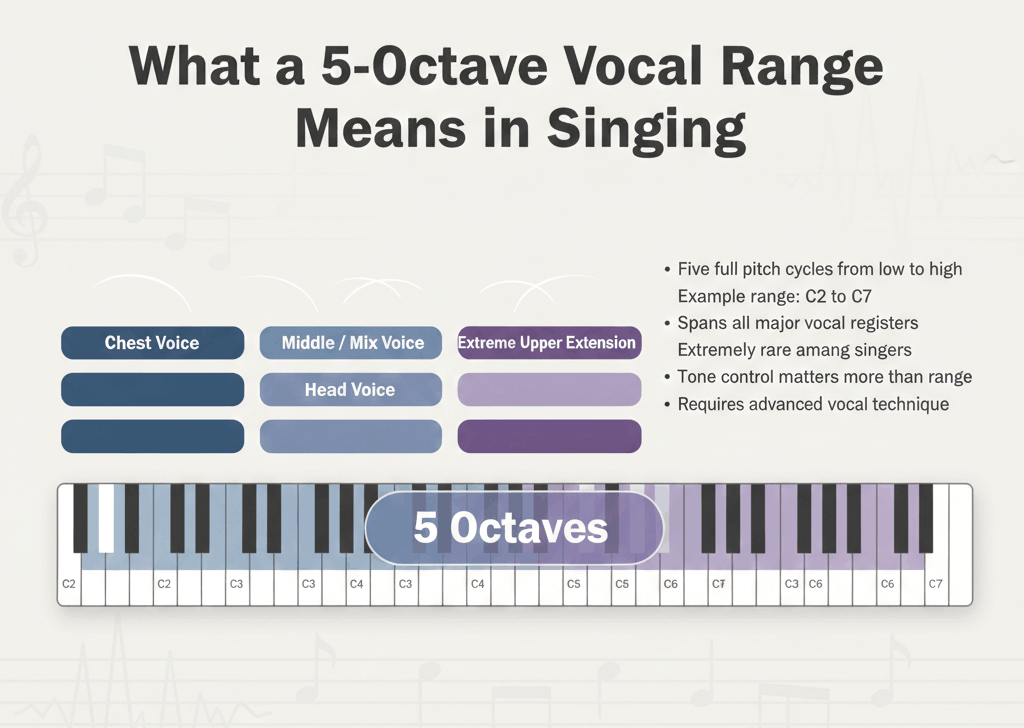
A 5 octave vocal range means a singer can span five full octaves, an extremely rare and elite ability. It allows access to very low, mid, and ultra-high notes, exceeding most professional singers and enabling exceptional vocal versatility.
In music, an octave is the interval between two notes where the higher note vibrates at twice the frequency of the lower one. For example, C3 to C4 is one octave.
A 5 octave vocal range spans five such intervals, such as:
- C2 → C7
- A1 → A6
A 5 octave vocal range is the ability to produce notes across five full octaves (60 semitones), typically including extreme upper or lower registers, though not all notes may be musically usable.
You can test your vocal range online for free using this tool.
Is a 5 Octave Vocal Range Actually Possible?
Yes — but only in rare cases, and usually with important caveats.
Most claims of five octaves rely on:
- Whistle register notes
- Very low vocal fry
- Non-sustained or unstable sounds
While these can be measured acoustically, they are often not usable in real music. A realistic overview of how wide the human voice can be is explained in how many octaves the human voice can sing.
How Rare Is a 5 Octave Vocal Range?
A functional five-octave vocal range is exceptionally rare, even among elite singers.
Realistic benchmarks:
- Untrained voices: ~1.5–2 octaves
- Well-trained singers: ~2.5–3 octaves
- Exceptional outliers: 4 octaves
- Extreme edge cases: 5 octaves (often theoretical)
A comparison by voice category and expected limits can be seen in the human vocal range chart.
Functional Range vs Theoretical Range (Critical Distinction)
One of the biggest sources of misinformation online is counting:
- Strained highs
- One-time extremes
- Unstable whistle or fry
A functional range means notes can be:
- Sung repeatedly
- Controlled in pitch
- Sustained without strain
Vocal pedagogy prioritizes tessitura—the range where the voice performs best—rather than extreme limits. When pitch becomes unreliable, improving coordination is more valuable than pushing higher (see how to improve pitch accuracy in singing).
Does a 5 Octave Vocal Range Make You a Better Singer?
No.
Vocal skill depends far more on:
- Pitch accuracy
- Breath management
- Tone consistency
- Endurance
- Musical expression
Most professional repertoire requires far less than five octaves. Many outstanding singers perform at a high level with two to three octaves. Extreme range alone does not predict vocal quality.
Can Training Give You a 5 Octave Vocal Range?
For most singers, no.
Training can:
- Improve efficiency
- Smooth register transitions
- Slightly extend usable extremes
Training cannot:
- Change vocal fold anatomy
- Override genetic limits
- Guarantee extreme octave counts
A responsible, health-first approach to development is outlined in how to safely increase vocal range.
How to Measure a 5 Octave Vocal Range Correctly
Accurate measurement requires discipline and objectivity:
- Warm up gently
- Start from your lowest comfortable note
- Ascend gradually without forcing
- Stop at the highest repeatable pitch
Avoid whispering or pushing extremes, which can distort results and strain the voice. For objective measurement, use a pitch-tracking method like the online vocal range calculator rather than relying on perception alone.
Voice Type and Extreme Vocal Ranges
A five-octave span can theoretically occur in any voice type, but range does not define classification. Voice type depends on:
- Tessitura
- Timbre
- Resonance balance
If classification is unclear, the voice type identification tool can help clarify where the voice functions best.
Common Myths About 5 Octave Vocal Ranges
- More octaves automatically mean better singing
- Anyone can reach five octaves with enough practice
- Celebrity vocal range claims are precise and verified
In reality, many celebrity ranges are estimates, and extreme claims often ignore vocal health and sustainability.
Frequently Asked Questions (FAQ)
1. Is a 5 octave vocal range real?
Yes, but it is extremely rare and often includes non-musical registers like whistle or fry.
2. How many singers truly have a 5 octave range?
Very few. Most verified cases are exceptional outliers rather than the norm.
3. Does whistle voice count toward vocal range?
It can be measured acoustically, but it is often not musically usable.
4. Is a 5 octave range useful for singing?
For most music, no. Control and consistency matter far more than extremes.
5. Can training unlock a 5 octave vocal range?
Training improves efficiency, not anatomy. Extreme ranges cannot be guaranteed.
6. Is a 5 octave vocal range safe to use regularly?
Regularly forcing extreme notes increases the risk of vocal strain and injury.
7. Are celebrity vocal range claims accurate?
Many are estimates or inflated by counting unstable extremes.
8. What is the maximum usable human vocal range?
For most singers, around 2.5–3 octaves is musically functional.
9. What matters more than octave count?
Pitch accuracy, tone, stamina, and musical expression.
10. How can I test my vocal range accurately?
Use controlled testing with pitch-tracking tools rather than guessing.
Related Articles:
- Many discussions around extreme range start by defining the limits of the human vocal range in realistic terms.
- To understand how exceptional five octaves are, it helps to compare them with a more common three-octave range.
- Before claiming rare ranges, singers often rely on a proper way to measure their lowest and highest usable notes.
- Some vocal types naturally skew wider, which is why this soprano reference is often mentioned in high-range discussions.
- Advanced tools can remove guesswork, and this vocal range calculator helps quantify claims objectively.
- Range alone isn’t everything, as this explanation of pitch accuracy shows what really counts musically.
- For singers exploring extremes, this deep voice test helps confirm how low usable notes truly go.