
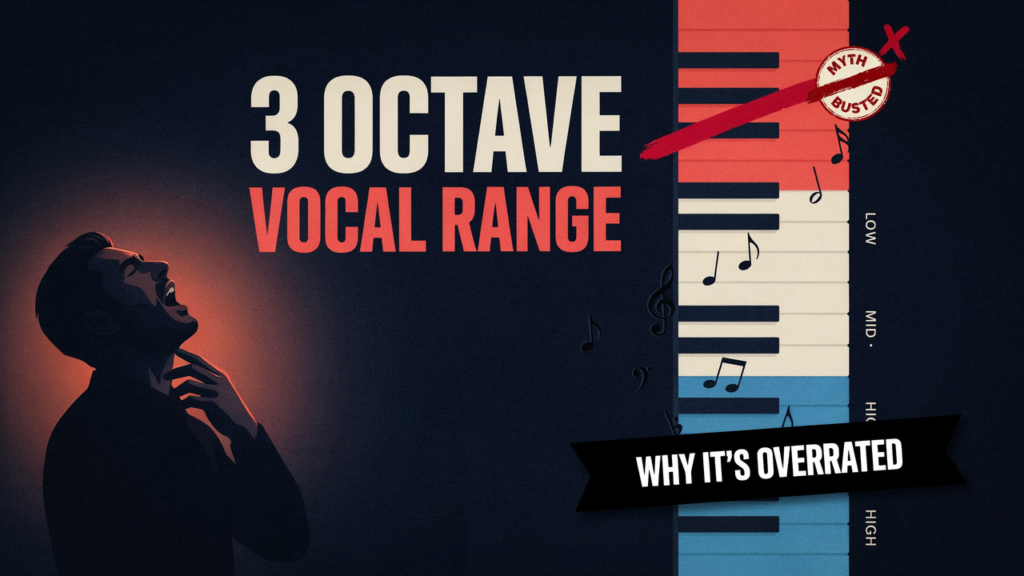
A 3 octave vocal range means a singer can produce notes spanning three full octaves (for example, C3–C6). That sounds impressive—but by itself, it does not determine voice type, singing skill, or vocal health. In real-world singing, usable range and tessitura matter far more than octave count.
Why “3 octave vocal range” gets so much attention
Range is easy to measure and easy to brag about. Social media, talent shows, and celebrity marketing often reduce singing ability to a single number: How many octaves can you sing?
That creates three common assumptions:
- More octaves = better singer
- A 3 octave range is rare or elite
- Everyone should train to get one
All three assumptions are incomplete—or flat-out wrong without context.
What a 3 octave vocal range actually means
An octave is the distance between one pitch and the next pitch with the same name (e.g., C to C). A 3 octave range simply measures the distance between your lowest and highest producible notes.
Examples:
- C3 to C6 = 3 octaves
- A2 to A5 = 3 octaves
That’s it. The term says nothing about:
- Tone quality
- Comfort
- Consistency
- Endurance
- Musical usefulness
It only measures distance, not function.
Is a 3 octave vocal range rare?
No—not particularly.
With basic training:
- Many adult singers can touch three octaves at the extremes
- Especially if falsetto, fry, or breathy head voice is counted
- Even untrained singers often approach 2–2.5 octaves naturally
What is rarer is a 3 octave usable range—where most of those notes can be sung with good tone, control, and stamina.
Range vs tessitura: the distinction that changes everything
This is where most misunderstandings come from.
- Range = every note you can produce, including strained edges
- Tessitura = the range where your voice works best most of the time
Two singers may both claim a 3 octave range:
- Singer A sounds strong and relaxed through most of it
- Singer B strains on the top and whispers on the bottom
Only one of those ranges is musically useful.
Key insight:
A singer with a comfortable 1.5–2 octave tessitura will outperform a singer with a strained 3 octave range every time.
Does a 3 octave range make you a better singer?
No—on its own, it doesn’t.
Great singing depends on:
- Tone consistency
- Pitch accuracy
- Breath coordination
- Musical expression
- Endurance
Range helps only if it’s usable.
In many styles (choir, opera, musical theatre, pop), singers spend the vast majority of their time within one to two octaves. Notes outside that area are used sparingly for effect—not constantly.
Why extreme range is often overrated
A large range is visually impressive but musically misleading.
Common issues with “range chasing”:
- Pushing chest voice too high
- Forcing lows beyond natural resonance
- Using unhealthy vocal fry or breathiness to extend extremes
- Confusing noise with usable pitch
This can lead to:
- Chronic fatigue
- Loss of tone
- Inconsistent pitch
- Increased injury risk over time
Professional singers prioritize efficiency, not extremes.
What professionals mean by “usable range”
A usable range is the span of notes you can:
- Sing repeatedly
- Maintain consistent tone
- Control dynamics
- Perform without fatigue
For many excellent singers:
- Usable range = ~1.5–2.5 octaves
- Extreme notes exist, but aren’t relied on
This is why opera casting, choir placement, and the vocal fach system focus on tessitura, not octave counts.
Can you train to get a 3 octave range?
Sometimes—but it shouldn’t be the goal.
Training can:
- Smooth register transitions
- Improve coordination
- Extend usable range slightly upward or downward
But training cannot:
- Change vocal anatomy
- Override natural tessitura
- Turn extremes into effortless daily notes
If a 3 octave range develops naturally as technique improves, that’s fine. Chasing it deliberately is rarely productive.
Famous singers and octave claims
You’ll often see headlines like:
- “Singer X has a 4-octave range”
- “Singer Y can sing 5 octaves”
These claims usually:
- Include falsetto, fry, or non-sustained sounds
- Count notes never used musically
- Ignore comfort and consistency
They’re marketing statements, not pedagogical benchmarks.
Voice type and octave range: no direct link
A common misconception is that a large range determines voice type.
Reality:
- Sopranos, mezzos, tenors, baritones, and basses can all have wide ranges
- Voice type is defined by tessitura, timbre, and passaggio, not octave span
- A bass with a high falsetto is still a bass
- A soprano with strong low notes is still a soprano
Range overlaps across all voice types.
You can measure your voice accurately with VocalRangeTester.com.
A healthier way to evaluate your voice
Instead of asking, “How many octaves can I sing?” ask:
- Where does my voice feel strongest?
- Which notes can I sing for long periods without fatigue?
- Where does my tone stay consistent?
- Which keys suit me best musically?
Those answers tell you far more about your voice than an octave number ever will.
Common myths (and the truth)
Myth: “A 3 octave range means elite talent.”
→ Truth: Talent depends on control, not count.
Myth: “Everyone should aim for 3 octaves.”
→ Truth: Most music doesn’t require it.
Myth: “If I don’t have 3 octaves, I’m limited.”
→ Truth: Many world-class singers work comfortably within two.
Final verdict
- A 3 octave vocal range measures distance, not quality
- It is not rare, but it is often exaggerated
- Usable range and tessitura matter far more
- Healthy singing prioritizes comfort, tone, and stamina
If your goal is better singing—not just bigger numbers—focus on how your voice functions, not how far it stretches.
- Putting range claims in context is easier after seeing Aaliyah’s vocal span.
- Another useful comparison comes from Adam Lambert’s range.
- You can also check how pop vocals stack up with Adam Levine’s range.
- For a soul-driven example, look at Amy Winehouse’s vocal range.
- Understanding lower voices helps when you review tenor versus bass.
- Female voice categories become clearer with alto and contralto differences.
- If you’re deciding on training, this take on whether vocal coaching works adds perspective.

John Mayer is a vocal analysis and music education writer specializing in vocal range testing, voice type analysis, pitch recognition, and singing improvement tools for singers, musicians, performers, and beginners. He creates practical content focused on vocal training, singing techniques, and voice analysis tools to help users better understand and improve their vocal abilities.