
Adele’s documented vocal range spans A2 to E5 — approximately 2.5 octaves — which is modest by pop standards but deployed with technical command and emotional weight that has made her one of the best-selling vocalists of the 21st century. Her voice type is a dramatic mezzo-soprano, and her strength lies not in range extension but in the quality, power, and expressiveness of every note within her natural tessitura.
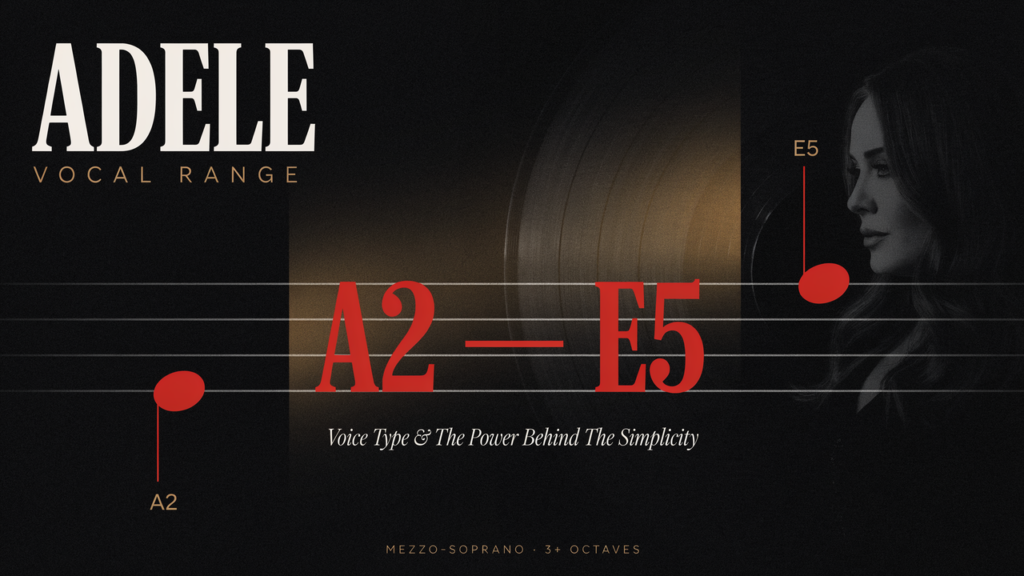
Adele Vocal Range at a Glance
| Detail | Value |
|---|---|
| Full Documented Range | A2–E5 |
| Span | ~2.5 octaves |
| Voice Type | Dramatic mezzo-soprano |
| Lowest Note | A2 (110 Hz) |
| Highest Note | E5 (659 Hz) |
| Tessitura | C4–Bb4 |
| Known For | Emotional delivery, belting power, chest voice weight |
What Voice Type Is Adele?
Adele is a dramatic mezzo-soprano — the heaviest of the mezzo-soprano subcategories. Her voice carries significant weight and volume potential in the mid-range, a warm but powerful quality in the chest register, and a naturally lower tessitura than lighter mezzo voices.
The “dramatic” designation reflects the full, rich sound of her voice at higher dynamics. Unlike a lyric mezzo — which is lighter and more agile — a dramatic mezzo is built for sustained, powerful phrases with emotional gravitas. This is evident throughout her recordings: her voice does not thin out or brighten at high dynamics the way a lyric or coloratura voice would; it gets fuller and more intense.
It is worth noting that 2.5 octaves is considered a good but not exceptional range for a professional singer. Adele herself has acknowledged that her range is not her calling card. What places her among the elite is the consistent quality of her tone, her breath support, and the emotional conviction she brings to every phrase.
See the full mezzo-soprano vocal range guide for more context on her voice type.
What Makes Adele’s Voice Distinctive
Chest voice weight. Her chest voice — the lower, heavier register — carries an unusual amount of resonance and warmth below E4. This is the characteristic mezzo quality, but in Adele’s case it is amplified by the dramatic weight of her voice. When she sings quietly at C4, it sounds like a much bigger voice being restrained.
Controlled belt. Her belting technique is clean and well-supported. Unlike singers who strain into a shout at high dynamics, Adele’s belt maintains a round, open quality up to about E5. This suggests strong breath support and proper laryngeal positioning. Test your own breath support with the breath control test.
Vibrato. Her natural vibrato is wide and slow compared to many contemporary pop singers, closer to a classical singer’s vibrato than the tighter, faster vibrato favoured in contemporary commercial music. This contributes to the timeless, almost vintage quality of her recordings. Analyse your own vibrato with the vibrato analyzer.
Diction and phrasing. Her British vowels — slightly more open and resonant than American equivalents — contribute to the perception of vocal richness. Her phrasing has a conversational directness: she finishes words cleanly and places emphasis where a speaker would, not where a trained singer might conventionally choose.
Songs That Showcase Her Range
“Hello” (2015) — Moves through her full comfortable range (A2–Db5), with the key modulation in the final chorus pushing her to E5. A clean demonstration of her complete usable range in one performance.
“Rolling in the Deep” (2010) — Sustained belting in the Bb4–D5 range shows the power of her chest voice. The chorus is one of the most technically demanding regularly-sung pop lines of its era.
“Someone Like You” (2011) — Primarily uses her A2–A4 zone, showcasing the intimate, understated quality of her voice at lower dynamics.
“Skyfall” (2012) — The orchestral accompaniment demands significant volume and tonal projection. This performance confirms her ability to sustain over large arrangements without losing tone quality.
“When We Were Young” (2015) — The final chorus builds to a restrained but powerful climax, showing her upper belting range at full emotional intensity.
How Her Range Compares
2.5 octaves is above the average untrained singer (~1.5–2 octaves) but below the upper tier of professional vocalists. This underscores that range is not the primary determinant of vocal quality or commercial success.
Among dramatic mezzos, her range is typical. Amy Winehouse — another dramatic mezzo — follows the same pattern: the dramatic mezzo voice type prioritises power and expression within a defined range rather than extending to the extremes.
Use the singer comparison tool to map her range against other artists, or find your own range to see where you sit.
Test Your Own Voice
If you share Adele’s voice type — dramatic mezzo-soprano with a natural lower tessitura — the voice type test will confirm it. The free vocal range test identifies your exact span. If you sing mostly in the C4–Bb4 zone with chest voice weight, you may already be working in Adele’s natural territory.
Frequently Asked Questions
What is Adele’s vocal range? Adele’s documented range is A2 to E5, spanning approximately 2.5 octaves. Her most comfortable and characteristic zone is C4 to Bb4.
What voice type is Adele? She is a dramatic mezzo-soprano — a heavier, more powerful mezzo voice type characterised by warmth, weight, and sustained belting capability rather than extreme upper range.
Is Adele’s vocal range good? Yes. 2.5 octaves is a solid professional range. What makes a vocal range “good” is not just span but quality and consistency across that span. Adele’s 2.5 octaves are used with exceptional technical control and emotional expressiveness.
Has Adele had vocal problems? In 2011, Adele underwent surgery for a vocal cord hemorrhage — a bleed on the vocal cords caused by overuse or strain. The procedure was performed by Dr. Steven Zeitels at Massachusetts General Hospital. She made a full recovery. This experience is one reason she is careful about her performance schedule.
Who has a similar voice to Adele? Amy Winehouse and Jennifer Hudson are frequently cited as comparable voices — all dramatic mezzos with rich lower registers and powerful belting ranges.

John Mayer is a vocal analysis and music education writer specializing in vocal range testing, voice type analysis, pitch recognition, and singing improvement tools for singers, musicians, performers, and beginners. He creates practical content focused on vocal training, singing techniques, and voice analysis tools to help users better understand and improve their vocal abilities.