
Lizzo’s documented vocal range spans B2 to F5 — approximately 2.5 octaves — with a voice type classified as mezzo-soprano. What many listeners don’t know is that Lizzo has a formal classical music background: she studied classical flute at the University of Houston and has classical vocal training that is evident in her breath support, diction, and the projection she achieves in live performances. Her voice is significantly more technically developed than her pop persona typically suggests.
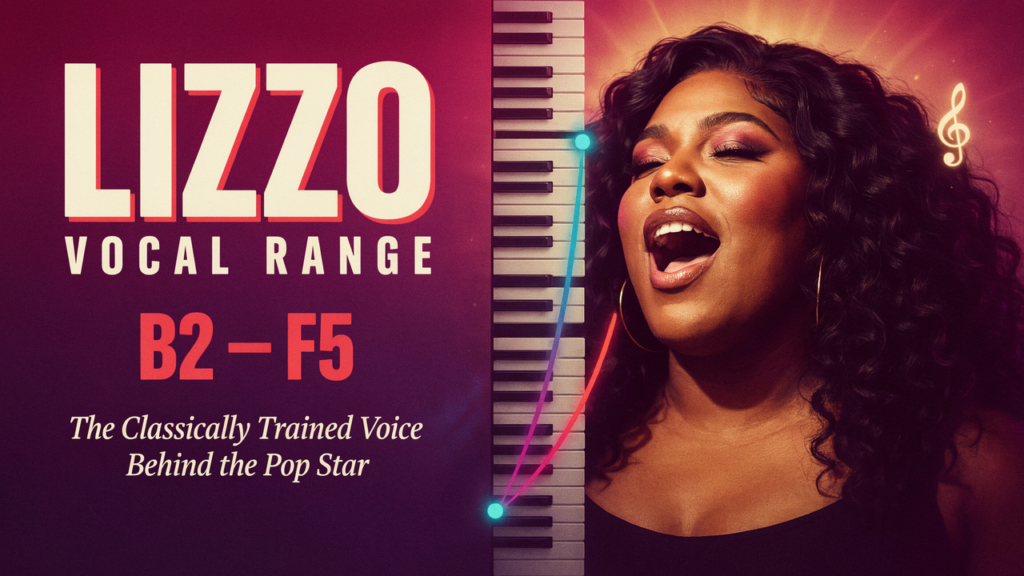
Lizzo Vocal Range at a Glance
| Detail | Value |
|---|---|
| Full Documented Range | B2–F5 |
| Span | ~2.5 octaves |
| Voice Type | Mezzo-soprano |
| Lowest Note | B2 (123.5 Hz) |
| Highest Note | F5 (698.5 Hz) |
| Tessitura | D4–C5 |
| Known For | Gospel-pop power, classical training background, flute performance |
What Voice Type Is Lizzo?
Lizzo is a mezzo-soprano — the middle female voice type, sitting between soprano and contralto. Her natural tessitura (D4–C5) is characteristic of a standard mezzo, and her chest voice carries the warmth and weight associated with that classification rather than the lighter brightness of a lyric soprano.
Her classical music training is the most underappreciated aspect of her voice. Breath control — the foundation of all vocal technique — is taught as a discipline in classical training, and her ability to sustain phrases at high dynamics while performing choreography reflects that foundation. Most pop singers who belt at her volume show signs of throat tension; her well-supported sound suggests correct technique.
See the full mezzo-soprano vocal range guide for context on her voice type within the broader classification system.
What Makes Lizzo’s Voice Distinctive
Gospel chest voice power. Her mid-range (D4–Bb4) carries significant volume and weight — a gospel belt technique rather than the more contained pop belt. This is partly natural, partly trained.
Flute doubling. Her ability to play professional-level flute while singing (or switch between the two in performance) reflects exceptional breath and embouchure control, since both activities make significant demands on the respiratory system. Check your own breath capacity with the breath control test.
Precision in riffs. Her R&B-influenced ornamental runs are pitch-accurate and rhythmically tight — evidence of real musical training rather than pure natural instinct.
Key Songs That Showcase Her Range
“Good as Hell” (2016) — Mid-range gospel-pop in D4–Bb4 demonstrating her natural tessitura.
“Truth Hurts” (2017) — Full chest voice showcase from D4 to E5.
“About Damn Time” (2022) — Shows her pop tessitura and rhythmic vocal delivery at its most commercial.
“Juice” (2019) — The high F5 appears in the bridge, her most technically demanding commercial recording.
Test Your Voice
If you’re a female singer wondering about your voice type, the voice type test provides a clear answer. The choir voice part test identifies your choral classification. The find my vocal range online tool maps your full span.
Frequently Asked Questions
What is Lizzo’s vocal range? B2 to F5 — approximately 2.5 octaves.
What voice type is Lizzo? Mezzo-soprano, with significant gospel and R&B technique layered onto a classical music education.
Does Lizzo have classical training? Yes. She studied classical flute at the University of Houston, and her broader musical education included vocal technique that is evident in her breath support and projection.
Who has a similar voice to Lizzo? Beyoncé and Jennifer Hudson are frequently cited as comparable mezzo-sopranos with similar gospel-influenced power and chest voice weight.

John Mayer is a vocal analysis and music education writer specializing in vocal range testing, voice type analysis, pitch recognition, and singing improvement tools for singers, musicians, performers, and beginners. He creates practical content focused on vocal training, singing techniques, and voice analysis tools to help users better understand and improve their vocal abilities.