
Billie Joe Armstrong’s documented vocal range spans D3 to B4 — approximately two octaves — with a voice type classified as tenor sitting at the bottom of the tenor range, close to the baritone border. His voice is not remarkable for its range but for its rhythmic attack, melodic clarity, and the clean, aggressive punk-pop delivery that defined Green Day’s commercial breakthrough and influenced a generation of rock vocalists.
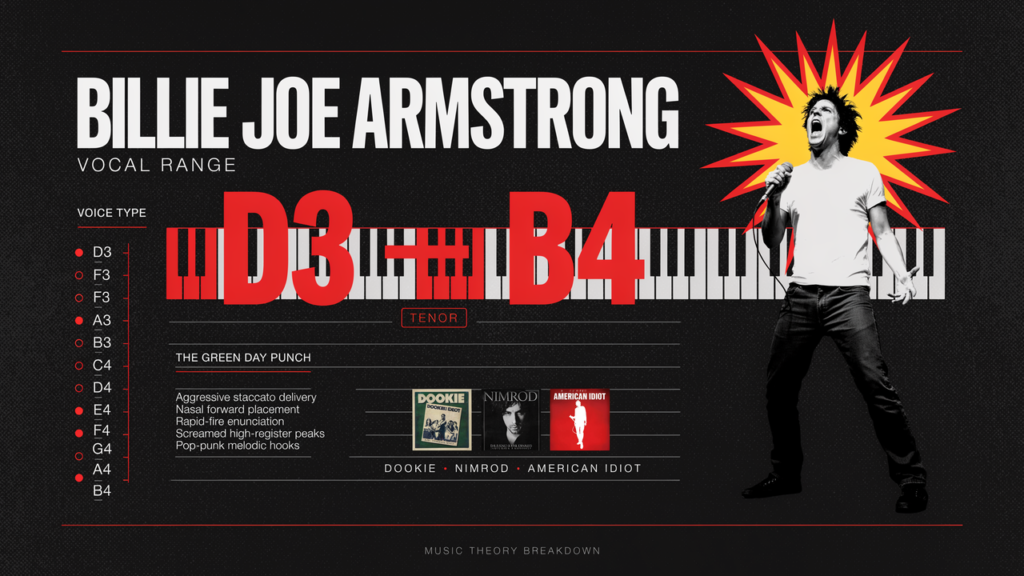
Billie Joe Armstrong Vocal Range at a Glance
| Detail | Value |
|---|---|
| Full Documented Range | D3–B4 |
| Span | ~2 octaves |
| Voice Type | Tenor (lower tenor / baritone-tenor border) |
| Lowest Note | D3 (146.8 Hz) |
| Highest Note | B4 (493.9 Hz) |
| Tessitura | G3–E4 |
| Known For | Clean punk-pop delivery, melodic clarity, rhythmic precision |
What Voice Type Is Billie Joe Armstrong?
Billie Joe Armstrong sits at the lower end of the tenor range, close to the baritone-tenor border. His natural tessitura (G3–E4) is lower than a typical lyric tenor, and his voice lacks the brightness and upper extension of a classic tenor. However, his chest voice up to B4 has the forward, nasal quality of tenor placement rather than the darker, rounder sound of a baritone — hence the tenor classification.
He has never used falsetto in commercial recordings in any significant way, which limits his upper range documentation. His voice is a working-man’s tenor: functional, direct, built for endurance over spectacle. The tenor vs baritone guide shows where his voice sits on that border.
What Makes His Voice Distinctive
Clean melodic delivery. In the context of punk and pop-punk — genres where vocal clarity is often sacrificed for energy — his melodic lines are consistently pitch-accurate and intelligible. This clarity has been essential to Green Day’s crossover appeal.
Rhythmic precision. His vocal rhythms lock tightly with the drum patterns, creating a vocal-rhythm relationship that is tighter than most rock vocals.
British-Californian punk influence. His vocal style draws equally from British punk (The Clash, the Buzzcocks) and California melodic punk, producing a hybrid that was new in 1994 and became a template for early 2000s pop-punk.
Key Songs That Showcase His Range
“American Idiot” (2004) — Mid-range rhythmic energy in G3–F#4.
“Boulevard of Broken Dreams” (2004) — Melodic introspection in D3–E4.
“Basket Case” (1994) — Fast rhythmic delivery showcasing the upper range of his chest voice (G4–B4).
“Good Riddance (Time of Your Life)” (1997) — Acoustic showcase revealing his natural voice quality without distortion or high energy.
Frequently Asked Questions
What is Billie Joe Armstrong’s vocal range? D3 to B4 — approximately two octaves.
Is Billie Joe Armstrong a tenor or baritone? He sits at the lower-tenor/baritone-tenor border. His voice quality is more tenor than baritone in character, but his tessitura is lower than a standard lyric tenor.
What makes punk-pop vocals distinctive? Punk-pop prioritises rhythmic precision, melodic clarity, and energy over tonal beauty or extreme range. Armstrong’s voice is a model of the genre: clean, direct, rhythmically exact, and immediately recognisable.

John Mayer is a vocal analysis and music education writer specializing in vocal range testing, voice type analysis, pitch recognition, and singing improvement tools for singers, musicians, performers, and beginners. He creates practical content focused on vocal training, singing techniques, and voice analysis tools to help users better understand and improve their vocal abilities.