
Marvin Gaye’s documented vocal range spans A2 to G5 — approximately three octaves, including his fully developed falsetto — with a voice type classified as a lyric tenor. His voice is among the most studied in soul music: a pure, sensuous instrument capable of extraordinary tenderness and depth, deployed in a series of recordings (What’s Going On, Let’s Get It On, I Want You) that redefined what was emotionally possible in popular music.
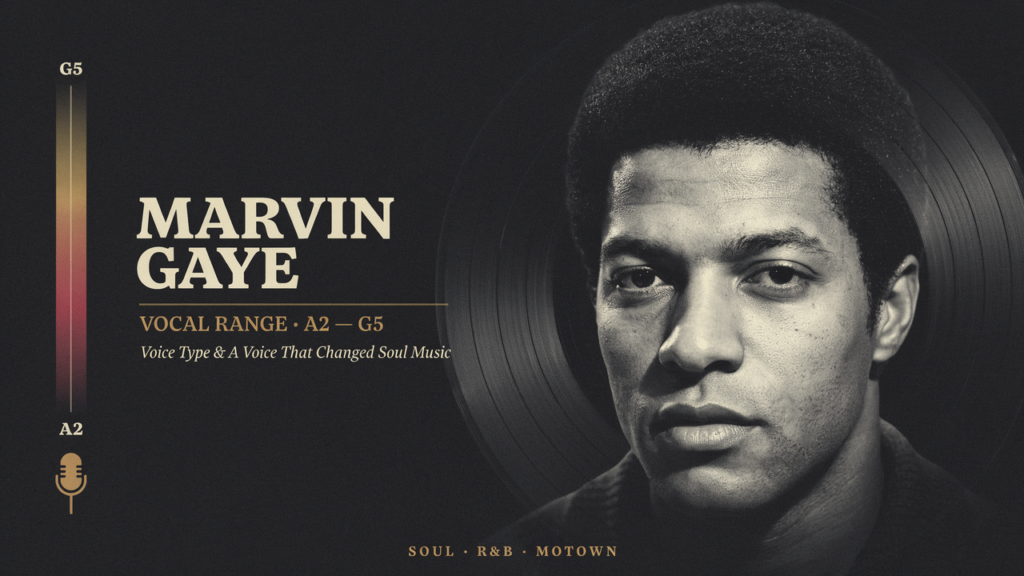
Marvin Gaye Vocal Range at a Glance
| Detail | Value |
|---|---|
| Full Documented Range | A2–G5 (including falsetto) |
| Span | ~3 octaves |
| Voice Type | Lyric tenor |
| Lowest Note | A2 (110 Hz) |
| Highest Note | G5 (784 Hz) in falsetto |
| Tessitura | G3–D5 |
| Known For | Falsetto, vocal tenderness, emotional depth, soul innovation |
What Voice Type Was Marvin Gaye?
Marvin Gaye was a lyric tenor — his natural voice had the brightness and agility of a tenor with a lighter, more agile quality than a dramatic tenor. His tessitura (G3–D5) is characteristic of a lyric tenor’s natural performing zone.
He frequently employed his falsetto — a register that extended his practical range to G5 — not as a technique for reaching extreme notes but as an expressive colour in its own right. His falsetto had a warm, breathy intimacy quite different from the purer, brighter falsetto of classical countertenors. It was a soul instrument: shaped for emotional expression rather than technical demonstration.
His singing was also informed by his gospel roots and by his admiration for Frank Sinatra — an unusual influence for a soul vocalist that explains the lyric, legato quality of his slower performances. See the tenor vocal range guide for how lyric tenor compares to other male voice types.
What Made Marvin Gaye’s Voice Distinctive
Falsetto as primary expression. Most male singers use falsetto for effect or for notes beyond their chest voice range. Gaye used it as one of his primary expressive registers — choosing falsetto for intimacy and emotional vulnerability even when chest voice would have been physically accessible. Check your own falsetto with the falsetto test.
Multi-track layering. His I Want You album pioneered a production technique where he sang against himself in multiple octaves and registers simultaneously. The Marvin Gaye “choir” created by overdubbing his own voice became a signature element of 1970s soul production.
Dynamic intimacy. His recordings often feel whispered — close-miked with minimal dynamic difference between verse and chorus — creating a conversational quality at odds with the intensity of the musical content.
Key Songs That Showcase His Range
“Mercy Mercy Me (The Ecology)” (1971) — Pure lyric tenor in his natural tessitura (Bb3–E5).
“Let’s Get It On” (1973) — The interplay between chest voice and falsetto within a single phrase defines this performance.
“What’s Going On” (1971) — Shows the warmth and conversational intimacy of his lower register (A2–D4).
“I Heard It Through the Grapevine” (1968) — Full chest voice power in C4–E5, showing his more aggressive side.
“Sexual Healing” (1982) — Late career document of his falsetto and its intimate quality.
How His Range Compares
A typical lyric tenor spans C3–C5 in chest voice, with falsetto extending higher. Gaye’s A2 low note and G5 falsetto peak position him comfortably within lyric tenor expectations. Compare his range against other soul artists with the singer comparison tool.
Test Your Voice
If you sing comfortably in the G3–D5 range with a developed falsetto, you may share Gaye’s lyric tenor characteristics. The voice type test will confirm. The falsetto test identifies your falsetto range and quality.
Frequently Asked Questions
What was Marvin Gaye’s vocal range? A2 to G5 — approximately three octaves, inclusive of his falsetto register.
What voice type was Marvin Gaye? Lyric tenor — a lighter, more agile tenor with a natural tessitura in the G3–D5 range and a well-developed falsetto extending to G5.
What made Marvin Gaye’s falsetto special? His falsetto had a warm, breathy intimacy rather than the pure brightness of classical falsetto technique. He used it as an emotional register — for vulnerability and tenderness — rather than primarily for reaching high notes.
Who has a similar voice to Marvin Gaye? Stevie Wonder is the closest Motown contemporary. Sam Smith is a modern artist who has cited Gaye as an influence and shares some of the falsetto-forward vocal approach. Frank Ocean is another contemporary with comparable falsetto integration.
How did Marvin Gaye influence modern singing? His falsetto integration became a template for R&B and soul singing from the 1970s onward. Artists from Prince to D’Angelo to Frank Ocean cite his approach to using falsetto as a primary expressive register rather than an occasional effect.

John Mayer is a vocal analysis and music education writer specializing in vocal range testing, voice type analysis, pitch recognition, and singing improvement tools for singers, musicians, performers, and beginners. He creates practical content focused on vocal training, singing techniques, and voice analysis tools to help users better understand and improve their vocal abilities.