
An octave is a doubling of pitch. Four octaves equals 48 distinct semitones from your lowest to highest producible note. On paper, that’s a big span. In practice, how people count those notes differs—and that’s where confusion starts.
Many singers include:
- Chest voice (lower, speech-like range)
- Head voice / mix (upper singing range)
- Falsetto or even whistle register (very high, flute-like tones)
Counting everything can inflate totals. Voice teachers typically separate total possible range from musically useful range.
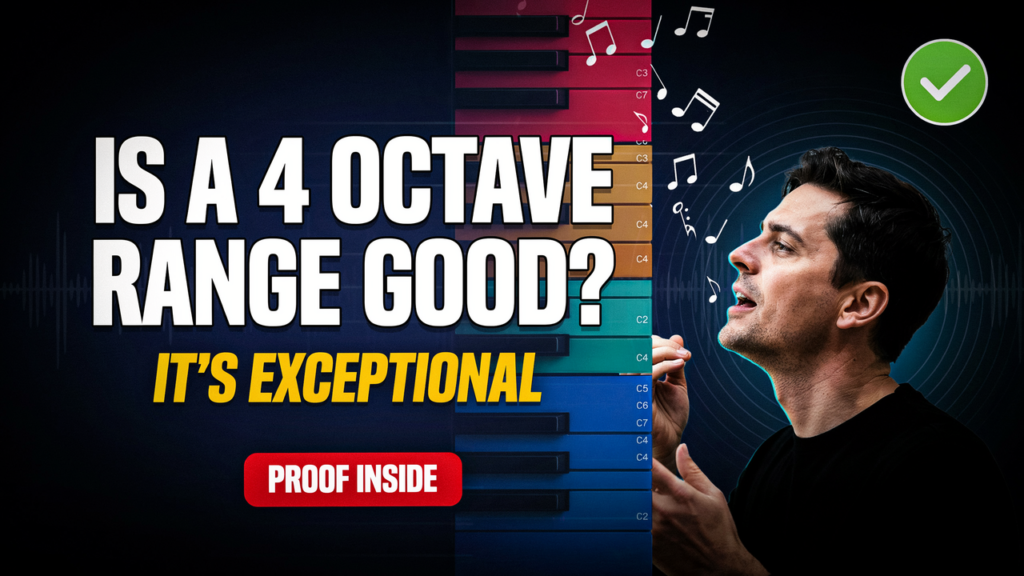
How rare is a 4-octave range?
It’s uncommon, especially when defined as clean, controllable notes. Average adult singing ranges are often around 2 to 2.5 octaves, depending on training, voice type, and how strictly notes are counted. Reaching 4 octaves usually requires:
- Years of technique development, or
- Counting registers (like falsetto/whistle) that aren’t used in most songs
So yes—rare compared to the average singer—but rarity alone doesn’t equal usefulness.
You can check your singing pitch instantly online.
The key distinction: total range vs usable range
This is the most important concept to understand.
Total range
- Every sound you can produce from lowest to highest
- May include breathy, unstable, or very quiet notes
- Often what people quote online
Usable range
- Notes you can sing in tune, with control, at performance volume
- Notes you could realistically use in songs
- Usually smaller than total range
A singer with a reliable 2.5–3 octave usable range often outperforms someone with a shaky 4-octave total range.
Tessitura: what actually matters for music
Tessitura is the range where your voice sounds best and feels most comfortable over time. This is what composers, bandleaders, and casting directors care about.
Why tessitura matters more than extremes:
- Songs live in the middle, not the edges
- Consistent tone and stamina beat occasional high notes
- Most performances avoid constant extremes to protect the voice
If your tessitura is strong—even if your total range isn’t huge—you’re in a great position musically.
Does falsetto or whistle “count”?
Technically: yes, they’re pitches you can produce.
Musically: it depends.
Falsetto and whistle:
- Often lack the power and tone of modal singing
- Are used stylistically, not constantly
- Can be fragile if not trained
That’s why many professionals specify “modal range” (your main singing voice) when discussing range. A 4-octave claim that relies heavily on falsetto or whistle isn’t the same as a 4-octave modal range.
How to tell if you really have a 4-octave range
Use this checklist to verify honestly:
- 48 distinct notes: Can you sing them clearly, not slide or approximate?
- Pitch stability: Can you hold each note for 2–3 seconds in tune?
- Dynamic control: Can you sing softly and moderately loud?
- Repeatability: Can you hit the notes consistently on different days?
- Musical context: Could you place those notes inside a melody?
If several answers are “no,” your total range may be 4 octaves, but your usable range is likely smaller—and that’s normal.
Is a 4-octave range good for beginners?
For beginners, range size is not a priority.
Early goals should be:
- Pitch accuracy
- Breath support
- Healthy coordination
- Even tone across registers
Chasing extreme highs or lows too early can build bad habits. Many great singers expanded their range after mastering control in a smaller span.
Can training increase your range?
Yes—to a point.
Training can:
- Smooth register transitions
- Strengthen weak notes
- Add several semitones (sometimes more)
Training cannot:
- Completely change your anatomy
- Guarantee extra octaves for everyone
Most improvements come from making existing notes usable, not adding brand-new extremes.
Examples of singers with very large ranges (context only)
Some well-known singers are often cited as having ranges near or above four octaves. Take these claims cautiously:
- Measurement methods vary
- Studio effects and one-off sounds are often included
- Their success comes from musicality, not just range
This reinforces the main point: range supports artistry; it doesn’t replace it.
Final verdict
A 4-octave vocal range can be impressive, but it’s not automatically “good” or useful. What actually matters is:
- How much of that range is controlled
- Where your tessitura sits
- How consistently you can sing with tone, pitch, and stamina
If your voice sounds good and feels reliable across songs, you’re doing it right—regardless of the number attached to your range.
FAQs
Is a 4-octave vocal range rare?
Yes, compared to the average singer. It’s especially rare if measured as fully controllable notes.
Is a 4-octave range better than a 3-octave range?
Not necessarily. A strong 3-octave usable range often outperforms a weak 4-octave total range.
Do falsetto and whistle notes count?
They count for total range, but many musicians exclude them when discussing practical singing range.
What’s the average vocal range?
Roughly 2–2.5 octaves for most untrained adults, with variation by voice type and training.
- Evaluating vocal ability often starts by understanding what a three-octave range represents for most trained singers.
- Broader context helps when comparing claims about a five-octave vocal range and how rare it is.
- Vocal classification plays a role, which is why many singers review how tenor and baritone voices differ when assessing range.
- Sustainable progress depends on learning how to increase vocal range safely rather than forcing notes.
- Physical mechanics matter, so it helps to revisit how the vocal cords function across registers.
- Tone and comfort improve when singers apply Alexander Technique exercises to reduce tension.
- Real-world benchmarks become clearer by checking whether a two-octave range is considered good for beginners.

John Mayer is a vocal analysis and music education writer specializing in vocal range testing, voice type analysis, pitch recognition, and singing improvement tools for singers, musicians, performers, and beginners. He creates practical content focused on vocal training, singing techniques, and voice analysis tools to help users better understand and improve their vocal abilities.