
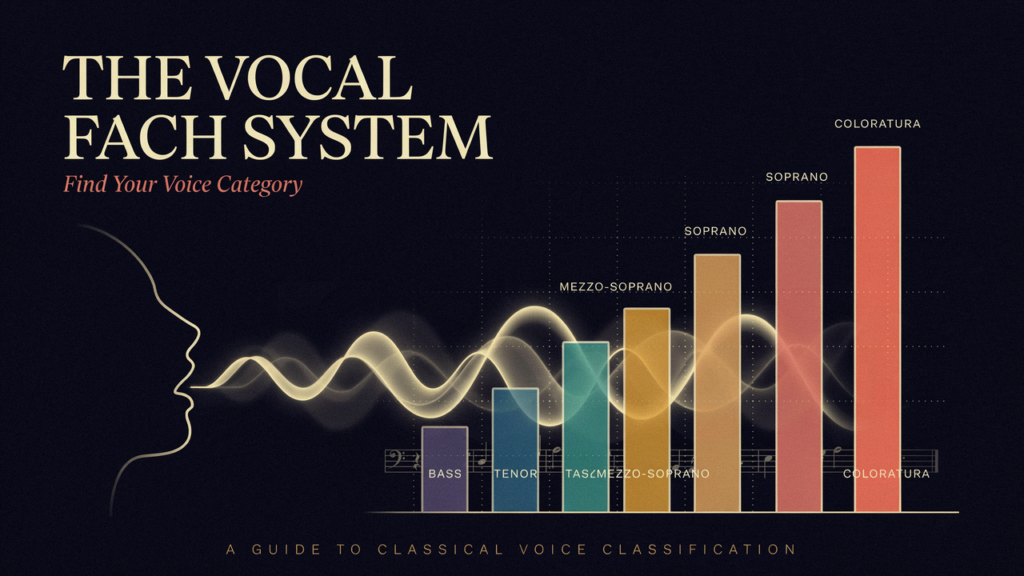
The vocal fach system is a classical (operatic) voice classification framework that groups singers by tessitura, vocal weight, timbre, range, and typical roles—not just by basic voice type (soprano, tenor, baritone, bass). It exists to guide casting, repertoire choice, and long-term vocal health. It is powerful when used correctly—and harmful when applied too early or too rigidly.
Why the vocal fach system exists
Opera demands endurance, projection over orchestras, and stylistic consistency across long roles. Early in operatic history, casting by simple voice type proved insufficient. Two tenors could sing the same pitch—but one could sustain lyrical phrases for hours while another could cut through a full orchestra with dramatic weight.
The fach system (from German Fach, meaning “category” or “compartment”) evolved to solve this by grouping voices according to how they function, not just how high or low they go.
A clear definition (what fach actually means)
The vocal fach system is an operatic classification method that considers:
- Tessitura (where the voice lives comfortably)
- Vocal weight (light vs heavy)
- Timbre (color/brightness/darkness)
- Range (secondary, not primary)
- Typical operatic roles
Key distinction:
- Voice type answers what your voice is (e.g., tenor).
- Fach answers how your voice behaves and which roles suit it.
Voice type vs fach (the most common confusion)
| Concept | What it describes | Examples |
|---|---|---|
| Voice type | General category | Soprano, Tenor, Baritone |
| Fach | Subcategory based on function | Lyric Tenor, Dramatic Baritone |
| Purpose | Identity | Casting & repertoire |
A singer does not “become” a fach in the way they have a voice type. Fach is a practical label used for specific repertoire decisions.
The core elements of fach
1. Tessitura (most important)
Fach is anchored in where the voice is comfortable most of the time, not extremes. A role with a high tessitura will exhaust a singer whose comfort zone sits lower—even if they can hit the notes.
2. Vocal weight
This describes the perceived density and carrying power of the sound.
- Light voices float and move easily
- Heavy voices carry dramatic intensity and volume
3. Timbre (tone color)
Brightness, darkness, edge, warmth—these qualities influence which roles sound believable and sustainable.
4. Passaggio behavior
Where and how the voice transitions between registers affects role suitability.
5. Endurance
Opera roles are long. Fach protects singers from repertoire that would wear them down.
Major fach families (overview)
Below is a functional overview, not an exhaustive list.
Soprano (examples)
- Lyric soprano – light, flexible, warm
- Spinto soprano – lyric core with dramatic push
- Dramatic soprano – heavy, powerful, sustained intensity
- Coloratura soprano – agility-focused, high tessitura
Mezzo-soprano
- Lyric mezzo
- Dramatic mezzo
Tenor
- Lyric tenor – bright, flexible
- Spinto tenor – lyric with weight
- Dramatic tenor / Heldentenor – heavy, heroic endurance
- Jugendlicher Heldentenor – youthful dramatic tenor
Baritone
- Lyric baritone
- Verdi baritone – strong upper middle, authority
- Dramatic baritone
Bass
- Lyric bass
- Bass-baritone
- Dramatic bass
Important:
Different opera houses and traditions may use slightly different labels
What the fach system is NOT
This matters for accuracy and vocal health.
- It is not a beginner classification tool
- It is not fixed for life
- It is not determined by a single range test
- It is not relevant for most non-classical singers
Fach emerges over time, with training, repertoire exposure, and physical maturity.
When fach should be used (and when it shouldn’t)
Appropriate use
- Conservatory-level classical study
- Opera studio auditions
- Professional or pre-professional casting
- Long-term repertoire planning
Inappropriate use
- Beginners and early teens
- Choir-only singers
- Pop, rock, or musical theatre contexts
- Online quizzes that “assign” fach
Expert consensus:
Premature fach labeling often leads to miscasting, strain, and stalled development.
Why fach can change
Voices evolve. As technique improves and the body matures:
- Tessitura may settle
- Weight may increase
- Color may deepen
- Endurance may expand
Many singers move from lighter to heavier fach categories over time. This is normal and expected.
Fach vs vocal health: the real reason it matters
The fach system exists to protect singers.
Singing repertoire outside your functional category can cause:
- Chronic fatigue
- Loss of tone
- Technical compensation
- Increased injury risk
Singing within appropriate fach:
- Improves stamina
- Preserves longevity
- Enhances casting consistency
- Builds sustainable careers
This is why reputable teachers are cautious—and why opera houses take fach seriously.
Common myths (and corrections)
Myth: “Once you know your fach, it never changes.”
→ Correction: Fach often evolves with maturity and training.
Myth: “Fach equals range.”
→ Correction: Tessitura and weight matter far more than extremes.
Myth: “Everyone needs to know their fach.”
→ Correction: Only classical/opera singers truly need it.
Practical guidance for singers
If you’re studying classical voice:
- Focus first on healthy technique
- Learn your tessitura, not your label
- Let repertoire and endurance reveal your direction
- Reassess periodically with a qualified teacher
If you’re not studying opera:
- Fach knowledge can be interesting—but it’s not essential
- Tessitura and comfort still matter, regardless of genre
This tool for measuring singing range helps singers improve accuracy.
Final verdict
- The vocal fach system is an operatic tool, not a personality test
- It classifies voices by how they function, not just how high or low they sing
- Used correctly, it protects voices and careers
- Used prematurely, it causes confusion and strain
The smartest approach is patience: let the voice reveal itself over time, guided by trained ears and healthy technique.
- Many singers refine their classification by comparing alto and mezzo roles.
- Seeing how ensembles group voices starts with choir range charts.
- Extreme categories make more sense when you review a four-octave range.
- High-end voice types often overlap with techniques like whistle voice work.
- Understanding practical paths helps when you look into becoming a background singer.
- Style-specific fachs connect well with guides on becoming a country singer.
- Comparing extreme voices is easier after checking a true four-octave benchmark.

John Mayer is a vocal analysis and music education writer specializing in vocal range testing, voice type analysis, pitch recognition, and singing improvement tools for singers, musicians, performers, and beginners. He creates practical content focused on vocal training, singing techniques, and voice analysis tools to help users better understand and improve their vocal abilities.