
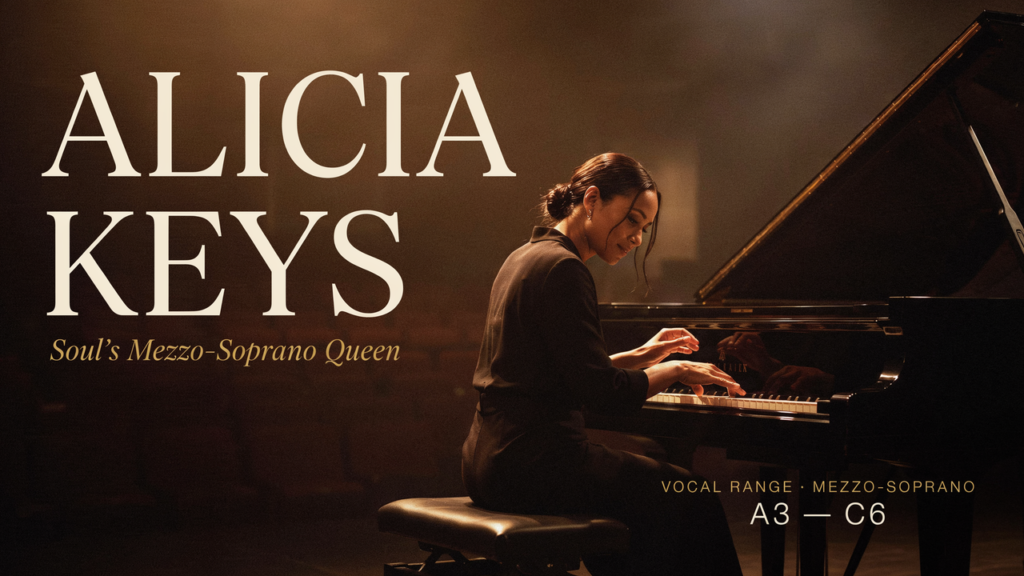
Alicia Keys’ vocal range is commonly estimated at around three octaves, with a mezzo-soprano tessitura centered in the middle register. There is no officially verified measurement of her exact highest and lowest notes. What is clear from decades of recordings and live performances is that her strength lies in mid-range power, control, musicianship, and emotional delivery, not in showcasing extreme highs.
For contemporary pop and R&B artists, vocal ranges are rarely tested or published in a formal way. In Alicia Keys’ case:
- Songs are written and transposed to suit her piano-driven compositions
- Studio recordings may include subtle layering or reinforcement
- Live performances prioritize expression and groove over extremes
- Classical voice classifications don’t cleanly apply
Because of this, any precise note claims you see online should be treated as estimates, not facts.
You can find your highest and lowest singing notes easily.
Vocal range vs tessitura (the distinction that matters)
To understand Alicia Keys’ voice accurately, it’s essential to separate two concepts:
- Vocal range: the full span of notes a singer can produce at all
- Tessitura: the range where a singer performs comfortably and consistently
For professional singers, tessitura is far more revealing than extreme notes—and Alicia Keys’ tessitura is clearly mid-range.
Alicia Keys’ tessitura and voice type
Across her catalog—from Songs in A Minor to later albums—Alicia Keys consistently sings:
- In a mid female tessitura
- With strength and resonance in the middle register
- With selective, controlled access to higher notes
This strongly supports classifying her as a mezzo-soprano, rather than a light soprano.
Important clarification
Online discussions sometimes label her a soprano simply because she can sing high. That’s misleading.
Singing high occasionally does not define voice type—where the voice lives does.
How Alicia Keys uses vocal registers
Alicia Keys’ vocal identity is defined by balance and weight, not brightness or acrobatics.
Chest voice
- Warm, grounded, and expressive
- Used extensively in verses and emotional passages
- Anchors her soulful sound
Her chest coordination gives her voice authority without harshness.
Mixed voice
- Strong and controlled
- Used for choruses and emotional climaxes
- Allows power without strain
Her mix is firm but not aggressive, contributing to longevity.
Head voice
- Used selectively for color
- Clear but not dominant
- Often brief rather than sustained
Unlike singers who live in head voice, Alicia Keys uses it sparingly.
Falsetto
- Rare in her style
- Used as a color choice, not a foundation
This restraint keeps her tone grounded and intimate.
Estimated vocal range (with clear caveats)
Commonly cited estimates suggest:
- Lower notes: approximately A2–B2
- Upper notes: approximately C6 (usually brief, not sustained)
This implies a span of around three octaves, depending on how head voice notes are counted.
Why estimates vary:
- Studio production affects perception
- High notes are used selectively
- Live arrangements often adjust keys
From a pedagogical standpoint, her usable tessitura matters more than her extremes.
Why Alicia Keys’ voice sounds powerful without sounding “high”
Many listeners describe Alicia Keys as having a powerful voice, even though she doesn’t constantly sing high. That’s because power doesn’t come from pitch alone.
Contributing factors include:
- Strong breath support
- Efficient chest-to-mix coordination
- Resonant vowel choices
- Dynamic control
- Piano-led harmonic support
Her voice fills space emotionally rather than acoustically.
Piano-driven songwriting and vocal range
Because Alicia Keys writes at the piano, her melodies tend to:
- Sit naturally within her tessitura
- Emphasize harmonic movement over melodic leaps
- Use dynamics and phrasing instead of range display
This results in songs that feel vocally rich without demanding extremes.
Common myths about Alicia Keys’ vocal range
Myth: “Alicia Keys has an enormous vocal range.”
Reality: Her range is solid, but her control and musicianship stand out more.
Myth: “She’s a soprano because she sings high notes.”
Reality: Her tessitura aligns more closely with mezzo-soprano.
Myth: “She belts all the time.”
Reality: She balances chest, mix, and restraint carefully.
Myth: “Range is why she’s successful.”
Reality: Songwriting, tone, and emotional clarity are equally important.
Alicia Keys compared to other female R&B/pop singers
Compared to artists like:
- Beyoncé: wider displayed range and heavier belting
- Adele: lower tessitura with dramatic dynamic peaks
- Brandy: lighter tone with more head-dominant singing
Alicia Keys stands out for grounded mid-range power and musicianship, not for vocal flash.
What singers can learn from Alicia Keys
From a technical and artistic perspective, Alicia Keys demonstrates that:
- You don’t need extreme range to sound powerful
- Mid-range mastery builds consistency and longevity
- Musicality can outweigh vocal athleticism
- Emotional delivery matters more than pitch height
For singers with naturally mid-range voices, her career is especially instructive:
own the center of your voice instead of chasing the top.
Why “Alicia Keys vocal range” keeps ranking
People keep searching this because:
- Her voice sounds strong without being flashy
- She defies pop stereotypes about female singers
- Singers want to understand why her sound works
The real answer isn’t a number—it’s balance, restraint, and musical intelligence.
Final verdict
- Alicia Keys’ vocal range is commonly estimated at around three octaves
- There is no officially verified measurement
- She is best described as a mezzo-soprano
- Her strength lies in mid-range power, control, and expression
- Her career proves that musicality matters more than extremes
If you’re studying vocal ranges to improve your own singing, Alicia Keys offers a clear lesson:
build depth and consistency before chasing height.
Related Articles:
- Her soulful span is outlined clearly in this featured range profile.
- Placing her voice among female types is easier with this alto versus contralto guide.
- Many of her biggest hits sit comfortably inside what this three-octave breakdown explains.
- Supporting a piano-led vocal like hers starts with this posture reference.
- Singers working toward similar control can use this octave potential check.
- Developing expressive bends and slides is detailed in this vocal movement guide.
- Comparing her smooth mezzo tone with another pop vocalist is easy using this artist range article.

John Mayer is a vocal analysis and music education writer specializing in vocal range testing, voice type analysis, pitch recognition, and singing improvement tools for singers, musicians, performers, and beginners. He creates practical content focused on vocal training, singing techniques, and voice analysis tools to help users better understand and improve their vocal abilities.